Portuguese
  Spanish


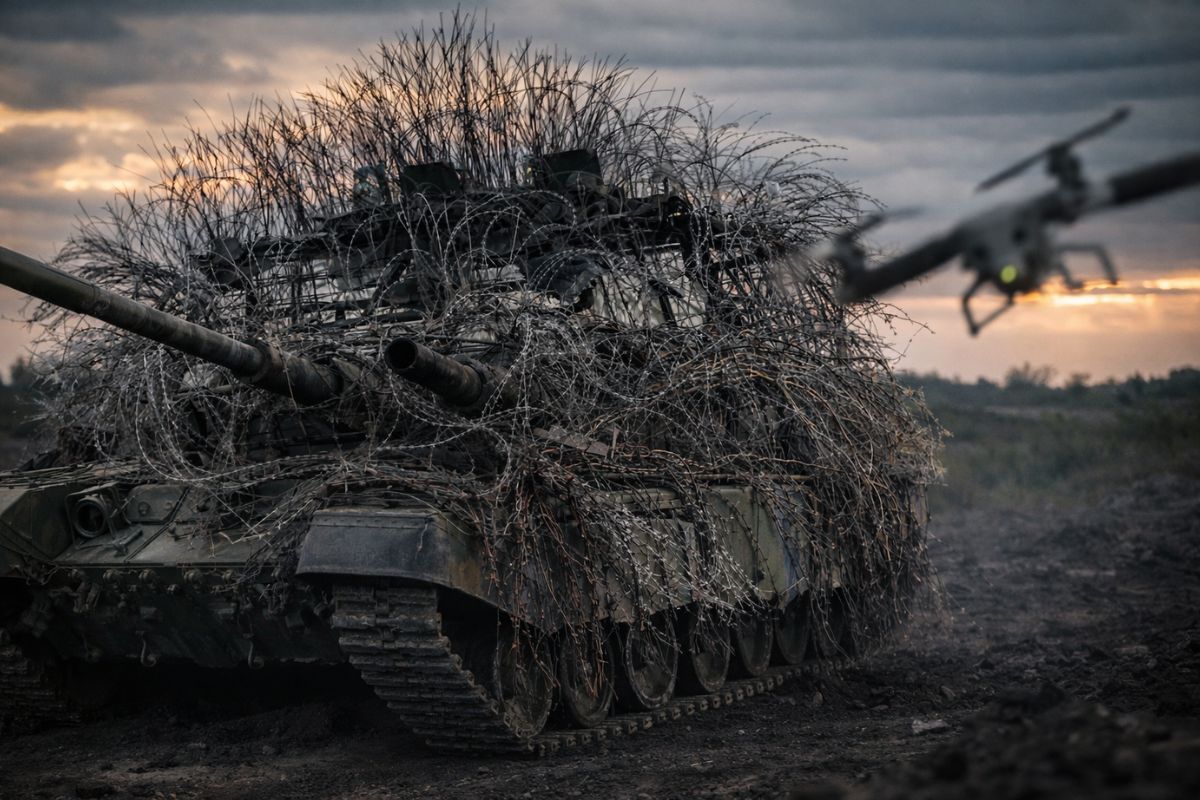

In Ukraine, Russia Covered Tanks With Cables, Spikes, and Cages to Anticipate Explosions From FPV Drones, Reducing Hull Damage and Imposing a New Learning Curve on Enemy Operators; What Seemed Like Military Scrap Turned Into a Transitory Solution, Copied by Adversaries and Observed by Allied Armies on Different Fronts.
Russia transformed part of its armored vehicles into visually strange platforms, with external layers of metal reminiscent of “turtles,” “hedgehogs,” and now the so-called “dandelion.” The goal was not aesthetics or formal modernization, but immediate survival in a scenario saturated with FPV drones.
On the Ukrainian battlefield, where cheap and frequent attacks changed the pace of ground warfare, this improvised choice shifted from a source of mockery to a concrete tactical factor. What seemed like industrial decay revealed a practical logic: if the impact occurs before the hull, the damage can decisively diminish.
From Initial Ridiculousness to Emergency Adaptation
Russia was not the first to improvise in war, but took visual adaptation to an extreme point. Metal cages, tensioned cables, spikes, chains, and additional plates started to cover vehicles almost entirely in some cases, changing the tanks’ profile and creating an unusual visual signature on the front line.
-
U.S. Establishes Permanent Embassy in Jerusalem, Reigniting International Debate Over Israel’s Capital

-
The world has nearly 12,000 nuclear warheads, with the majority held by the United States and Russia; see the figures for China, France, and the United Kingdom.

-
Venezuela Faces UN Alert for Hunger, Disease, and Service Collapse After Earthquakes Cause Nearly 2,000 Deaths and $6.7 Billion in Damages

-
Brazil Deploys Navy Field Hospital with ICU, Orthopedics, Pediatrics to Earthquake-Stricken Area in Venezuela, Offering 30 Beds and 150 Daily Consultations


Initially, this design was treated as a caricature: heavy structures, messy appearance, and rough finishing. Still, function prevailed over form. In prolonged conflicts, imperfect solutions can hold high value when they buy critical seconds between detection, drone approach, and final impact.
The diffusion of these structures also responded to the speed of the problem. With FPV drones repeatedly attacking vulnerable points, traditional armor ceased to be a sufficient guarantee in many contexts.
Russia then began adding an external “sacrifice zone,” thinking less about technical elegance and more about containing immediate losses.
The Logic of the “Dandelion” Against FPV Drones
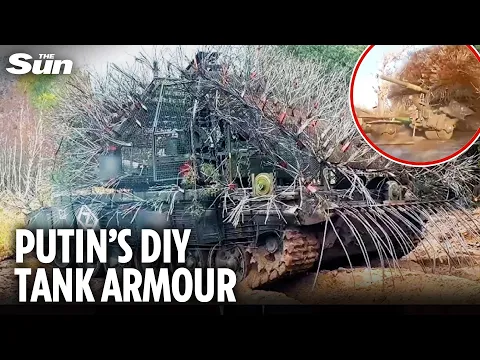

The principle is simple: create distance between the drone’s explosive charge and the main surface of the tank. When the detonation occurs before the hull, a significant portion of the energy dissipates in the intermediate space and on the external structures. Every extra centimeter can be the difference between critical damage and manageable damage.
In the shape dubbed “dandelion,” branched rods and meshes form a three-dimensional barrier that hinders a clean attack trajectory. Instead of directly hitting a sensitive area, the drone may collide with cables, spikes, or grids and explode before the ideal position.
This type of protection does not make the vehicle invulnerable but alters the odds. In a war of attrition, where the volume of attacks weighs as much as precision, increasing survival chances even on a small scale already changes tactical decisions: route, advance speed, exposure, and recovery window of the armored vehicle.
Tactical Advantage, Accumulated Costs
Russia gained time with these adaptations but paid a clear operational price. Additional structures increase weight, elevate the vehicle profile, and can compromise mobility, acceleration, fuel consumption, and maneuverability, especially in difficult terrain. Armoring more can mean moving worse.
There is also an impact on maintenance and logistics. The more improvised parts, the greater the complexity of repairing damage, replacing components, and standardizing field procedures.
In systems already pressured by an intense combat pace, this creates daily friction between desired protection and actual availability.
Another limit lies in the type of threat. These coverings help against certain attack vectors, but do not resolve everything: they do not provide absolute protection against precise artillery, nor do they automatically neutralize tactics that exploit less protected angles, such as attacks from below. The effectiveness exists, but it is localized and temporary.
When Copying Begins, The Advantage Shrinks
One of the most relevant signs of this episode was the change in the adversary’s perception. What began as an object of scorn evolved into technical observation and then into partial adoption of similar solutions by Ukrainian units on some vehicles. In practice, war validates what works, not what looks good.
The effect spilled over from the direct combat line. The idea of creating external layers to frustrate drones began to inspire testing and adaptations in broader military environments, including Western forces monitoring the evolution of this type of threat.
This reveals a central dynamic: field innovation does not rely only on laboratories or lengthy programs.
In contexts of extreme pressure, the learning curve is accelerated, and improvised solutions can become temporary references even without traditional technological pedigree.
The Improvised Race That Redefines Ground Warfare
Russia exposed, with its “dandelion” tanks, an uncomfortable truth of the current phase of the conflict: those who adapt faster, even imperfectly, reduce losses in the short term.
In this environment, the cycle between attack and defense is continuous: protection emerges, the attack changes; the attack changes, another protection arises.
This race also repositions the role of the tank. Instead of merely a shock and fire platform, it increasingly becomes a system that needs to survive swarms of cheap drones and experienced operators, combining traditional armor with experimental external barriers.
In the end, improvisation does not replace a complete doctrine but fills gaps between immediate needs and definitive solutions. The “ugliness” of these armored vehicles turned into a tactical language of a war where rapid adaptation is as valuable as sophisticated technology.
Russia’s experience with cables, spikes, and cages shows that the FPV drone warfare is not decided by a single innovation, but by successive layers of adjustment, response, and counter-response.
The “dandelion” does not solve the problem, but explains how small physical changes can shift the balance for some time.
If you were defining priority for an armored vehicle in the field today, what would weigh more: maximum immediate protection, even at the cost of mobility, or greater agility, accepting a higher risk against FPV drones?