






 Portuguese
  Spanish
  7 min of reading
  0 comments


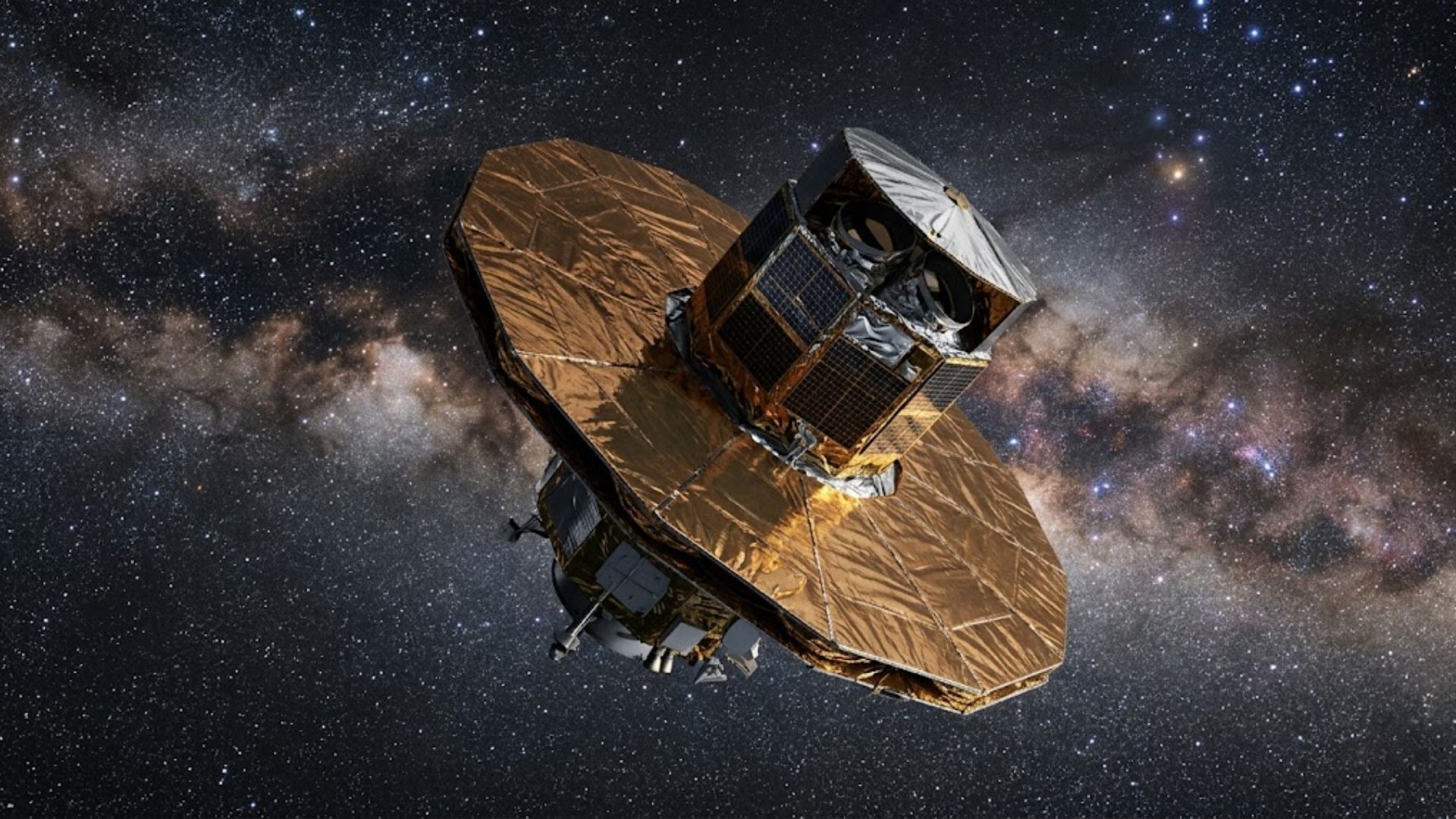
Gaia discovered the largest stellar black hole ever identified in the Milky Way, hidden near Earth and practically invisible.
In April 2024, scientists from the European Space Agency announced one of the most surprising discoveries in modern astronomy: a gigantic, practically invisible black hole located relatively close to Earth was hidden within the Milky Way without being directly detected for decades. Named Gaia BH3, the object has approximately 33 times the mass of the Sun and is located in the constellation Aquila, less than 2,000 light-years from the Solar System.
The discovery was made using data from the Gaia space telescope, a mission by the European Space Agency created to map the Milky Way with unprecedented precision. According to ESA, it is the largest stellar-origin black hole ever identified in our galaxy. Until then, objects of this size were mainly observed through gravitational waves in collisions occurring in very distant galaxies.
Most impressively, the Gaia BH3 was not emitting intense bursts of radiation, nor devouring matter violently as black holes are typically portrayed in movies and documentaries. It was “dormant,” practically invisible, hidden in deep space while a companion star orbited around it. Continue reading below to understand how the Gaia telescope managed to find an object that does not emit light and why this discovery could change the understanding of the formation of giant black holes.
-
“Bee drone”: Researchers develop an autonomous drone that does not require GPS and can return home after flights of more than 600 meters — meet the Bee-Nav

-
Aluminum alloys created in the USA make truck engines 15% lighter and over 10% more efficient in GM test.
-
China transforms 7 billion tons of coal waste into sand, gravel, and bricks for construction and attempts to reduce the pressure on rivers, quarries, and former mining areas.

-
Stars display different colors in the sky and science explains why.




The Gaia telescope found the black hole by noticing that a star was “wobbling” in an impossible way
Gaia did not detect the black hole directly. This would be extremely difficult because the object practically does not emit visible light. Instead, scientists noticed that a star in the constellation Aquila exhibited strange movement, as if being pulled by something extremely massive and invisible.


According to the European Space Agency, Gaia BH3 was discovered because the telescope identified an abnormal oscillation in the trajectory of the companion star. This gravitational “wobble” indicated that some invisible object was orbiting along with it.
The Gaia mission specializes precisely in this type of measurement. The telescope can track the position, speed, and movement of billions of stars with incredible precision. Small changes in stellar movement can reveal the presence of planets, hidden stars, and even invisible black holes.
That’s exactly what happened. As scientists analyzed the data from the upcoming Gaia DR4 release, they noticed that the star was being influenced by something much heavier than any known common star.
Gaia BH3 has a mass equivalent to 33 suns and became the largest known stellar black hole in the Milky Way
After additional analyses conducted with ground-based telescopes, researchers confirmed that the invisible object had about 32.7 to 33 solar masses. This immediately made it the largest stellar-origin black hole ever found within the Milky Way.
According to the European Southern Observatory (ESO), the value far exceeds the mass of traditional stellar black holes known in the galaxy. Many previously detected black holes have masses between 5 and 15 times the mass of the Sun.

The Gaia BH3 falls into a very rare category. Its size approaches the black holes detected by gravitational wave observatories like LIGO and Virgo, responsible for recording gigantic cosmic collisions in distant galaxies.
The ESA classified the object as a true “sleeping giant.” The name arose because it was relatively close to Earth in astronomical terms but remained practically hidden due to the absence of intense radiation emission.
The black hole is relatively close to Earth on a cosmic scale and surprised astronomers
Although 2,000 light-years may seem an absurd distance by human standards, in astronomical context, Gaia BH3 is relatively close. The Milky Way is about 100,000 light-years in diameter, making the object a comparatively close cosmic neighbor.
According to the ESA, no one expected to find such a massive black hole so close to the Solar System. Researcher Pasquale Panuzzo, leader of the study published in the journal Astronomy & Astrophysics, stated that this is the kind of discovery a scientist makes only once in a lifetime.
The surprise was even greater because the black hole was practically invisible. Many known black holes are discovered because they are “feeding” on nearby stars and emitting huge amounts of X-rays. Gaia BH3 did not do this.
It was in a state called “dormant” or “asleep,” in which there is practically no intense accretion of matter. This means it does not produce the energetic glow normally associated with these extreme objects.
Gaia BH3 probably was born from the death of a colossal star with more than 40 times the mass of the Sun
Researchers believe that the black hole formed after the collapse of a gigantic star, with a mass exceeding 40 times that of the Sun. When extremely massive stars exhaust their nuclear fuel, they can explode as supernovas and collapse gravitationally.

According to Reuters and ESA, the chemical composition of the system indicates that this ancestral star was extremely poor in heavy elements, a condition known as “low metallicity.” This is important because such stars lose less mass over their lifetime, allowing them to leave behind much larger black holes.
This characteristic helps explain why Gaia BH3 reached such extreme mass. Theoretical models had already predicted that metal-poor stars could generate giant black holes, but finding such a close example surprised astronomers.
The system also has a relatively old companion star, with about 76% of the Sun’s mass, orbiting the black hole in a highly elongated trajectory.
Gaia BH3 challenges part of the traditional models on stellar evolution and black hole formation
The discovery generated enormous interest because it puts pressure on current models of stellar evolution. Many astronomers believed that such massive black holes would be extremely rare in the modern Milky Way.
According to researchers involved in the study, Gaia BH3 demonstrates that ancient and metal-poor stars can form much larger black holes than previously imagined. This brings the Milky Way closer to the phenomena observed in black hole collisions detected by gravitational waves.
Another intriguing detail is the fact that the system seems to belong to an ancient stellar stream called ED-2, probably a remnant of a cluster destroyed by the galaxy’s gravity billions of years ago.
Researchers also observed that the system moves through the Milky Way in the opposite direction to the typical flow of the galaxy’s stars, reinforcing the idea of an unusual and very ancient origin.
The Gaia telescope is creating the largest three-dimensional map of the Milky Way ever produced by humanity
The discovery of Gaia BH3 shows the power of the Gaia mission. Launched by the European Space Agency in 2013, the space telescope was designed to map the position and movement of approximately two billion stars.
The goal is to build the most precise three-dimensional map ever made of the Milky Way. To achieve this, Gaia measures distances, velocities, brightness, chemical composition, and tiny displacements of objects scattered throughout the galaxy.

This precision allowed the detection of the small “gravitational wobble” caused by Gaia BH3 on the companion star. Without instruments of this level, the object would likely remain invisible.
The mission has also discovered stellar rivers, ancient clusters, exoplanets, hypervelocity stars, and other hidden black holes, such as Gaia BH1 and Gaia BH2.
Gaia BH3 is practically invisible because it is not “devouring” matter like other famous black holes
A large part of known black holes was discovered through the emission of extremely energetic X-rays. This happens when the object pulls matter from a nearby star and forms a superheated disk around itself.
Gaia BH3 is different. According to observations made even with the Chandra space observatory, it shows extremely low activity. This means that there is almost no matter currently falling into the black hole.
Because of this, the object remained hidden for a long time. It was only discovered thanks to the gravitational influence on the companion star.
This detail led scientists to raise another impressive possibility: the Milky Way may be full of giant “dormant” black holes that remain invisible because they are not emitting intense radiation.
The discovery suggests that the galaxy may hide many other “invisible monsters”
Researchers believe that Gaia BH3 may be just the tip of the iceberg. As the Gaia mission is still analyzing billions of stars, new hidden black holes may appear in the coming years.
One of the most important factors is that the companion star of Gaia BH3 became detectable precisely because it entered a giant phase, greatly increasing its brightness. This facilitated the observation of the movement caused by the black hole.
According to studies published after the discovery, there may be many other similar systems hidden in the Milky Way, especially involving weaker stars that have not yet been analyzed with sufficient precision. This means the galaxy may contain an entire population of “invisible giants” silently orbiting in deep space.
Gaia BH3 showed that there are still giant objects hidden relatively close to Earth
The discovery of Gaia BH3 reinforced one of the most fascinating ideas of modern astronomy: even within our own galaxy, there are still extreme objects that remain practically invisible.
A black hole with 33 times the mass of the Sun managed to remain hidden relatively close to Earth until a telescope specialized in mapping stellar movements noticed a small gravitational wobble in a distant star.

The case also showed that the Milky Way probably still harbors much stranger structures than scientists imagined, especially in ancient and little-explored regions of the galaxy.
Now, as the Gaia telescope continues analyzing billions of stars, astronomers believe that new “invisible monsters” may emerge in the coming years, once again changing the understanding of the largest objects formed by the death of stars in the Universe.







Be the first to react!