Portuguese
  Spanish


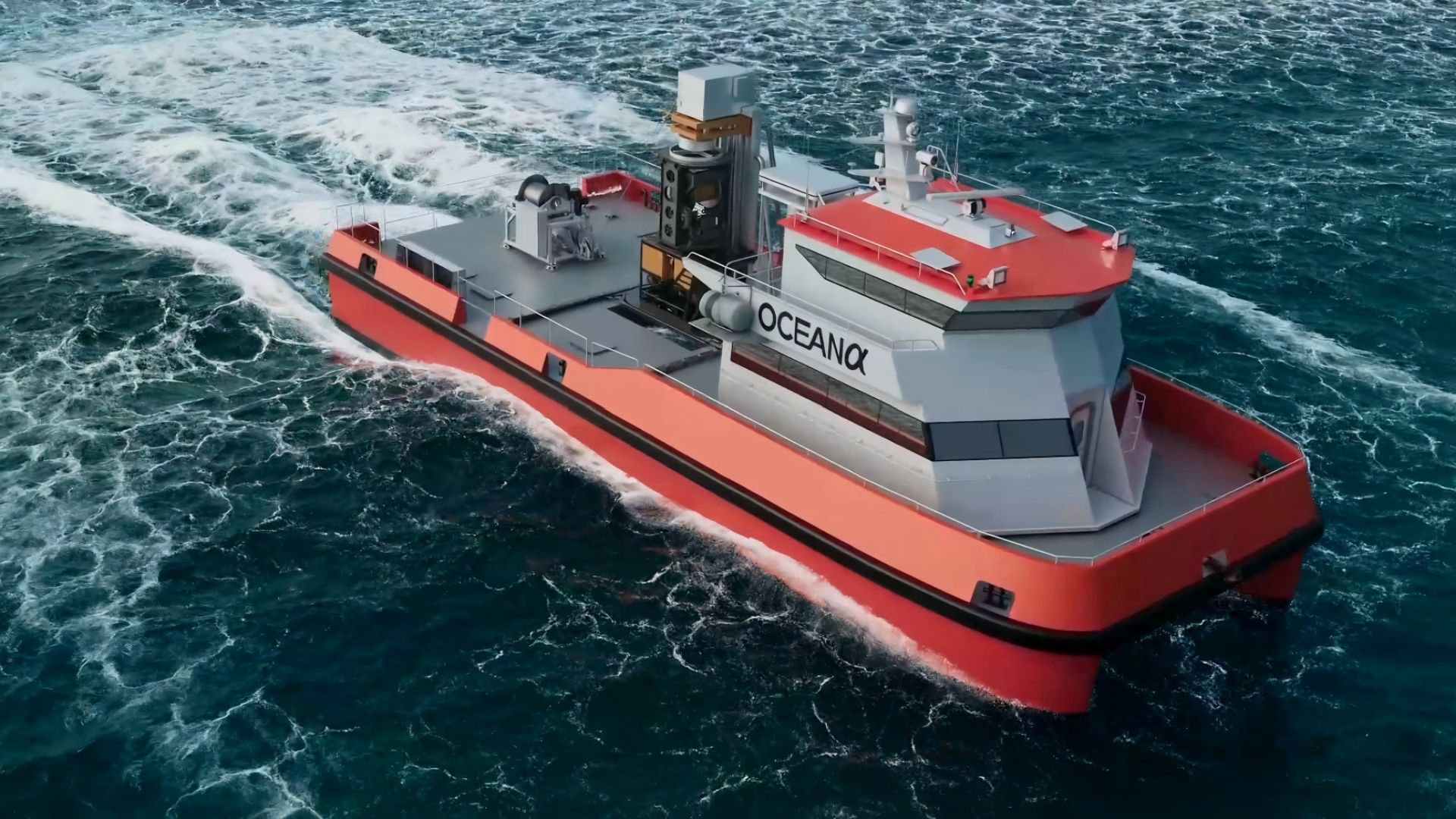

V180 by OceanAlpha combines autonomous ship, 2-ton ROV, DP2, and Starlink for underwater inspection up to 3,000 meters.
OceanAlpha introduced the V180 USV–ROV System, an autonomous naval system designed for underwater inspection, maintenance, and repair operations in deep waters. The platform combines a 24-meter unmanned surface vessel with an integrated work-class ROV. According to OceanAlpha itself, the system was unveiled on March 10, 2026, during Oceanology International 2026 in London. The set has a displacement of 180 tons at full load, a 2-ton ROV, operational capacity up to 3,000 meters deep, and autonomy of up to 30 days.
The central point is not just the size of the ship. The advancement lies in the union of offshore USV, underwater ROV, DP2 dynamic positioning, dual Starlink communication, and remote control on land, a set designed to reduce human exposure in high-risk offshore operations.
V180 USV–ROV: the Chinese autonomous ship created for deep water underwater inspection
The V180 was developed to operate in complex underwater operations, especially in the segment known as IMR, an acronym for inspection, maintenance, and repair. This type of mission is common in oil and gas structures, offshore wind farms, submarine cables, and ocean engineering projects.
-
Nigeria Dumps 120 Million Tons of Sand into Atlantic to Build Massive City with 8.4 km Sea Wall for Protection Against Ocean Waves and Erosion

-
German Engineer Developed Diesel Engine Running on Vegetable Oil Decades Before Electric Cars Became Popular; Can This Forgotten Idea Work in 2026?

-
James Webb Telescope Uncovers Unexpected Clues on Mysterious Moon, Potentially Redefining Planetary Origins

-
$1.5 Billion Sleipnir Vessel Transforms Ocean into Floating Construction Site with 12 Hybrid Engines and Capacity to Lift 20,000 Tons


Unlike many autonomous boats used only for data collection, bathymetry, or environmental monitoring, the V180 was designed to operate with a work-class ROV. This allows it to go beyond visual observation and perform technical tasks in deep underwater environments.


OceanAlpha claims that the system integrates an offshore USV platform with DP2 and an ROV dedicated to IMR missions up to 3,000 meters. This places the V180 in a category closer to traditional offshore support vessels than to small USVs used in coastal surveys.
2-ton ROV allows underwater inspection, maintenance, and repair up to 3,000 meters
The ROV embarked on the V180 weighs 2 tons and is designed for underwater work operations. In practice, this means performing tasks that require stability, strength, sensors, cameras, manipulators, and precise control on structures installed on the seabed.
In a real underwater inspection, it is not enough to just send a camera to a pipeline, cable, or offshore equipment. Many missions require controlled approach, instrument reading, thickness measurement, structural evaluation, obstacle removal, and physical interaction with industrial components.
Therefore, the presence of a work-class ROV is decisive. The combination of an autonomous ship and an underwater robot allows operators on land to control the set without keeping a crew embarked in an environment subject to waves, wind, rough seas, and operational risks.
DP2 System keeps the autonomous ship stationary during operations with underwater ROV
The DP2 dynamic positioning is one of the most important technologies of the V180. In underwater operations, the ship needs to remain stable while the ROV works connected by umbilical, transmitting power, commands, and data between the surface and the seabed.

If the ship drifts a few meters, the cable may suffer excessive tension, impair the robot’s positioning, or compromise the operation. The DP2 uses sensors, reference systems, and thrusters to keep the vessel at the work point with high precision.
The DP2 classification indicates operational redundancy, meaning the system is designed to maintain positioning even in the event of a critical component failure. For offshore IMR missions, this stability is essential because the ROV needs to work close to expensive and sensitive structures.
Starlink dual connects operators on land to the autonomous ship and the underwater robot
Another relevant technical point is the use of Starlink dual satellite communication. OceanAlpha reports that the V180 has been equipped with this system to support remote control from an onshore operation center.
This connection allows the transmission of telemetry, video, commands, and operational data between the ship, the ROV, and the operators. In practice, specialists can follow the mission without being physically on board, reducing travel, exposure to risk, and dependence on embarked teams.
The model also opens up space for remote participation of engineers, technicians, and specialists from different locations. In offshore operations, this can speed up decisions, reduce logistical costs, and decrease the need for transfers by helicopter or support vessels.
Double moonpool: the engineering detail that facilitates launching and recovering the ROV at sea
The V180 uses a double moonpool configuration, meaning openings in the hull that allow equipment to be launched and recovered directly from the bottom of the ship. This architecture is especially useful for operations with heavy ROVs in an offshore environment.
In conventional ships, launching an ROV can involve cranes, hoisting systems, technicians on deck, and complex maneuvers in open sea. With the moonpool, the equipment can be launched from a more protected area closer to the vessel’s center of motion.

OceanAlpha also highlights the open deck and flexible layout of the V180. Without the need for large areas for permanent crew accommodation, the design can prioritize fuel, mission systems, technical modules, and underwater operation equipment.
Uncrewed autonomous ship reduces human exposure in dangerous offshore operations
The main operational promise of the V180 is to remove people from dangerous maritime areas. Instead of keeping technicians on board for weeks at sea, the system allows operators to control the ship and the ROV from an onshore center.
OceanAlpha itself states that this approach eliminates the need for personnel working in dangerous sea states and high-risk offshore environments. The goal is to reduce human exposure and decrease the likelihood of accidents during complex operations.
This point is especially relevant in inspections of underwater infrastructure. Oil platforms, data cables, offshore wind farms, and ocean engineering equipment require regular maintenance, but many of these tasks occur in remote, deep, and operationally challenging locations.
Three modes of operation show that offshore autonomy still depends on maritime rules
The V180 supports three modes of operation: autonomous navigation, remote control, and manned operation. This detail shows that the transition to fully unmanned operations still depends not only on technology but also on maritime rules and safety requirements.
In certain regions, port approaches, crossing commercial routes, or operations near offshore installations may require human presence, specific supervision, or regulatory authorization. Therefore, the manned mode still appears as an operational alternative.
In practice, remote control tends to be one of the most important modes at the beginning of adoption. It allows operators on land to command the ship and the ROV with the support of cameras, sensors, telemetry, and real-time communication systems.
V180 targets offshore oil, gas, wind energy, and submarine cables
The target market for the V180 includes offshore oil and gas, offshore wind energy, submarine cables, ocean engineering, and scientific research. These are sectors that rely on frequent inspections and maintenance of assets installed under challenging conditions.
OceanAlpha cites applications such as oil and gas infrastructure inspection, offshore wind farm construction, submarine surveying, and oceanographic research. This shows that the platform was designed for multiple missions, not just a single type of operation.
There is also a strategic factor: submarine cables and offshore infrastructures have become critical assets for energy, data, and the global economy. The greater the dependence on these structures, the higher the demand for systems capable of inspecting and repairing equipment safely and at lower operational costs.
V180 can accelerate the automation of offshore submarine maintenance
The V180 represents an important advance in offshore automation because it combines three critical elements into a single platform: a larger autonomous ship, a work ROV, and remote control on land.
This combination directly addresses one of the most expensive and risky points of the maritime industry: keeping people embarked on long and dangerous missions.

The technology still needs to prove its performance on a commercial scale, under different regulations, weather conditions, and industrial client requirements. Even so, the launch shows a clear direction for the sector: increasingly remote, automated, and integrated submarine operations.
With 24 meters, 180 tons, 2-ton ROV, DP2, dual Starlink, and a range of up to 3,000 meters, the V180 places OceanAlpha in a competition that goes beyond small autonomous boats. The question now is to what extent unmanned ships can replace part of the operations currently performed by conventional offshore vessels.