Portuguese
  Spanish


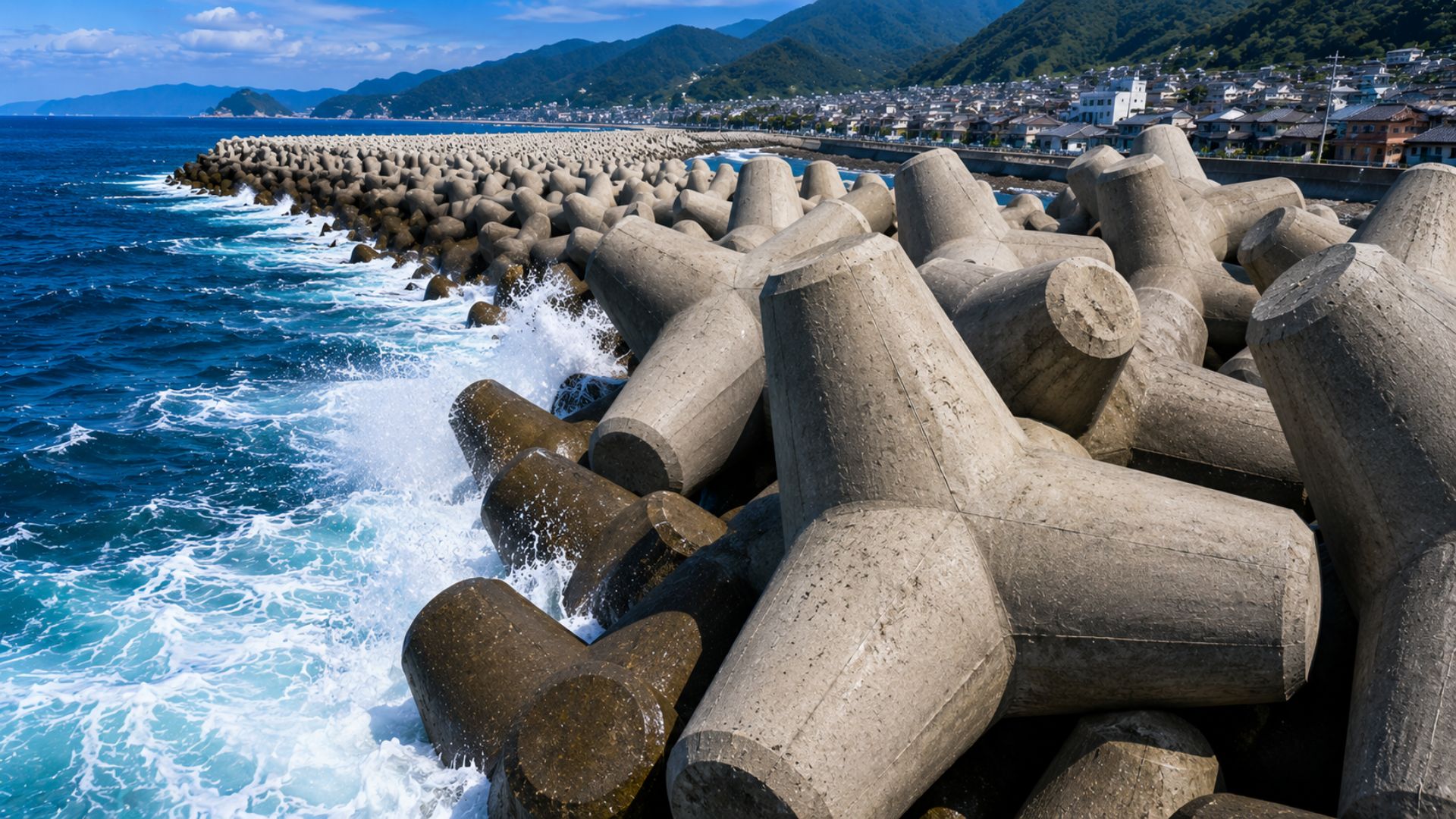


Concrete blocks of up to 80 tons with a four-arm shape have become Japan’s main weapon against the ocean’s fury and today shape much of the country’s coastline. The invention, created in France in 1950, spread to Morocco, Maldives, Brazil, and dozens of other coasts, changing global coastal engineering.
Known as tetrapods, the concrete blocks with a four-arm shape have become Japan’s main coastal defense weapon against the ocean’s force. Each unit can weigh up to 80 tons, and the country has installed millions of them along its extensive coastline of about 35,000 kilometers, to the point where most of the Japanese coast is no longer entirely natural. The centerpiece of this engineering was born in a hydraulics laboratory in the city of Grenoble, France, in 1950, and from there it spread to dozens of countries.
The reason for this rush for protection is straightforward: the ocean exerts constant pressure on coastal zones, with waves carrying energy equivalent to thousands of tons in motion, eroding rocks, destroying structures, and washing away entire beaches. Faced with increasingly intense typhoons and accelerated erosion, the concrete blocks in tetrapod shape have become one of the most replicated coastal engineering solutions on the planet, present in places like Morocco, Maldives, Philippines, Mexico, United States, and Brazil.
How concrete blocks in tetrapod shape emerged

Engineers Pierre Danel and Paul Anglès d’Auriac were working on a problem that traditional straight walls never solved well: how to dissipate the raw energy of the ocean without the defense structure giving way under the repeated impact of the waves. The project was born from a request by the French Navy to reinforce the stability of the breakwaters of a naval base in North Africa.
-
Detroit Microhouse Village Offers Former Homeless Residents Ownership After 7 Years: First 3 Tenants Receive Deeds

-
Brazilian Factory in Ivoti Produces 500 Modular Steel and Fiberglass Concrete Homes Following 2024 Floods, Securing $13 Million Contract
-
Brazilian Startup Develops Recycled Plastic Bricks, Cutting Construction Costs by 40% and Speeding Up Building by 90%

-
Tarcísio Opens New São Paulo Metro Line After 18-Year Wait, Offering Free Rides at 6 Stations and Aiming to Cut Commute to 23 Minutes for 633,000 Daily Passengers



The solution was geometric. Instead of a massive barrier, engineers created a block with four symmetrical arms positioned at calculated angles, capable of interlocking with other units, creating empty spaces, and converting the direct impact of the wave into dispersed turbulence. The design was patented and named a tetrapod, from the Greek tetra, meaning four, and pod, meaning foot, in reference to its shape. The first real application occurred in early 1951, in Casablanca, Morocco, with 256 units of 15 tons each, protecting the water intake of a thermal power plant.
The physics behind the four arms

When a wave hits a conventional vertical wall, all the kinetic energy is returned in a single concentrated rebound, and the pressure accumulates at fixed points, leading the structure to progressive fatigue until it gives way. The tetrapod operates in the opposite way: water penetrates through the spaces between the units, part is diverted laterally, and part loses speed due to internal friction, fragmenting the energy in several directions at the same time.
This principle is called controlled porosity. There is also a second mechanism, geometric interlocking: when stacked, the arms of the units interlock with each other, forming a three-dimensional mesh that resists displacement even under high-energy waves. This is why these concrete blocks can remain stable where massive walls would fail, absorbing the impact of the sea instead of simply trying to block it head-on.
How concrete blocks are manufactured


The production of these structures requires technical rigor. The process begins with mixing cement, sand, aggregate, and water in industrial mixers, with precise control of temperature, consistency, and hydration time. The fresh concrete is poured into steel molds designed to accurately reproduce the four-arm geometry, each at its structurally defined angle, and the curing period takes longer than that of common blocks, precisely due to the large volume of concrete involved.
After curing, each unit undergoes an integrity inspection, as microscopic cracks or angle deviations can compromise the performance of the entire set in the marine environment. The sizes vary greatly: the smaller units weigh about one ton, while the larger ones reach an impressive 80 tons. As they are positioned at sea, their installation requires specialized cranes and large vessels, and thousands of units are needed to cover a single kilometer of coastline.
How much Japan invests in coastal protection
Japan was the country that took this technology to the largest scale ever recorded in the world. However, it is worth clarifying a point that is often circulated imprecisely: it is not that half of the Japanese coastline is literally covered by tetrapods. What surveys show is that about half of the country’s approximately 35,000 kilometers of coastline is no longer completely natural, including sections altered by ports, walls, landfills, and concrete blocks. Tetrapods are an important part of this total, but they do not explain it alone.
The investment numbers are still impressive. It is estimated that Japan spends the equivalent of about 10 billion dollars per year on coastal protection, with the average cost per kilometer exceeding 10 million dollars. This value is justified when compared to the approximately 50 million needed to rebuild a coastal highway destroyed by a typhoon, or the 200 million to repair a strategic port. Studies indicate that every dollar invested in prevention can avoid 5 to 10 dollars in reconstruction, making concrete blocks an economically rational investment.
A family of blocks exported to the world
Since 1950, the original concept has given rise to an entire family of concrete blocks for coastal defense, with more than ten variants developed over the decades. Among the best known are the Dolos, created in South Africa in 1963, the Accropode, developed in France in 1981, and the Xbloc, which emerged in the Netherlands in 2001, each optimized for specific coastal conditions, depth, and wave intensity.
The Japanese model of protection has been exported to various countries, in some cases through Japan’s own external aid programs, as occurred in Malé, the capital of the Maldives. Due to the enormous weight of the pieces, manufacturing is usually done locally, near where they will be installed. Morocco, Maldives, Philippines, Mexico, United States, and Brazil are among the nations that have adopted these concrete blocks to protect ports, beaches, and coastal infrastructures from the advances of the sea.
The controversial side of concrete blocks
Despite their effectiveness, concrete blocks bring side effects that are increasingly being debated. The main one is called leeward erosion: by interrupting the natural flow of sediments along the coast, the structures that protect one beach can prevent the replenishment of sand on neighboring beaches, transferring the erosion problem to another point on the coast. The phenomenon has already been recorded on dozens of coasts around the world.
Japan itself recognized this contradiction. Starting in 2004, the Japanese government began removing concrete blocks in some coastal areas, under a policy of valuing the natural landscape. On a beach in Aichi Prefecture, the removal of the structures resulted in the return of sea turtles to nest there for the first time in decades, a case that became a national reference. Studies also indicate that these blocks have a dual environmental effect: while some species colonize the spaces between the arms as artificial reefs, others lose feeding and breeding routes.
The future of coastal protection
The next generation of coastal defense attempts to unite engineering and nature. A concept created in 2016 by designers from Taiwan and Malaysia, the tetrapot, proposes concrete blocks with biodegradable pots containing mangrove seeds, integrating protection and ecosystem restoration in a single piece. Laboratories are also testing three-dimensional printing with sustainable resins as an alternative to steel molds, which have a high environmental impact in manufacturing.
Countries like Indonesia and Mexico are already combining concrete with the restoration of mangroves and natural reefs, in a hybrid approach. The World Bank projects that, without adequate protection, global coastal damages could exceed 1 trillion dollars by 2050, which maintains the pressure for solutions. The central question, therefore, is no longer whether coasts should be protected, but how to do so without compromising the natural systems on which coastal communities themselves depend.
The concrete blocks in the shape of a tetrapod are a notable example of how engineering can face the ocean’s force, protecting billions of dollars in infrastructure and the lives of millions of people living on the coast. But Japan’s experience, which is now removing some of these structures, shows that no solution is perfect. The future of coastal protection seems to be heading towards a balance between the robustness of concrete and the intelligence of natural ecosystems, uniting the best of both worlds.
Have you ever seen these concrete blocks up close on any beach or port in Brazil? Do you think we should continue protecting the coast with concrete or is the future in solutions closer to nature, like mangroves and reefs? Leave your comment, tell us which city you’re reading from, and share the article with those interested in engineering, oceans, and the environment.