Portuguese
  Spanish


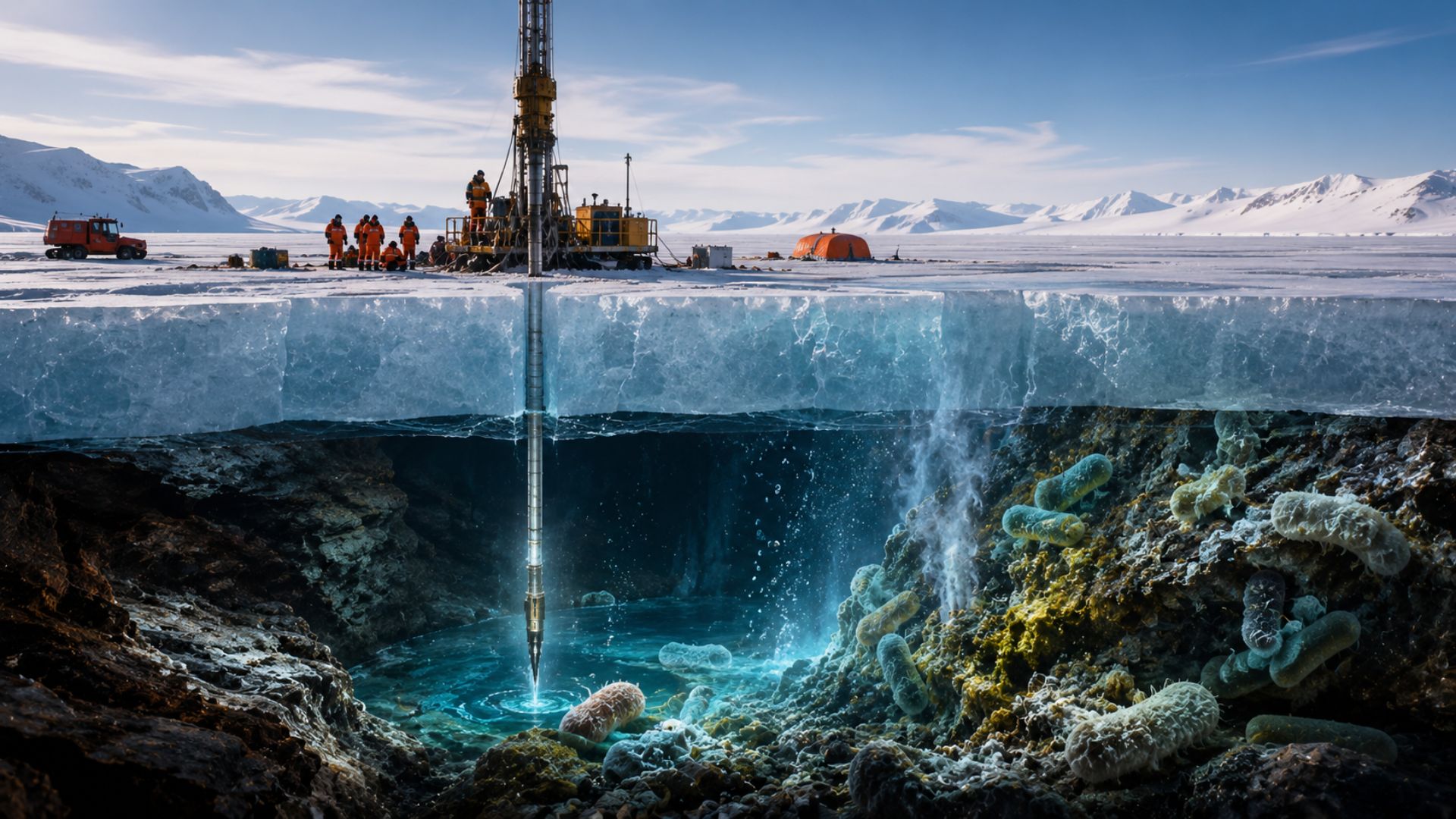

Scientists drilled kilometers of ice in Antarctica in search of hidden life in subglacial lakes sealed from the surface for millions of years. What they found, microbes that eat rock and survive without sunlight, transformed the way science searches for extraterrestrial life on the icy moons of Jupiter and Saturn, such as Europa and Enceladus.
Beneath the vast, seemingly lifeless white expanse of Antarctica, hundreds of liquid water lakes are sealed by kilometers of ice. In January 2013, a team of scientists from the United States drilled about 800 meters of ice to reach Lake Whillans in West Antarctica and found something extraordinary: a living ecosystem of microbes that eat rock and survive in total darkness, without any sunlight, which became the first clean and uncontested proof of life in these isolated environments.
The discovery crowned decades of drilling, radar, and satellite data in Antarctica, the coldest, driest, and windiest continent on Earth. More than a scientific curiosity, these organisms that thrive in extreme conditions have become the key to one of the greatest questions of humanity: the search for extraterrestrial life. The same technology used to drill the Antarctic ice without contaminating it is what may one day investigate the icy moons of Jupiter and Saturn, such as Europa and Enceladus, which hide oceans beneath their frozen crusts.
What lies beneath the ice of Antarctica

But the continent’s ice is much thicker than imagined, reaching almost 4 kilometers thick in some places, comparable in height to mountains like Kilimanjaro. And contrary to what it seems, this ice mantle does not cover a flat terrain: beneath it lies an ancient world, with valleys deeper than the Grand Canyon, mountain ranges rivaling the Alps, and even traces of impact craters and volcanic regions.
-
Orphaned Youth Turns Dismissed Idea into Global Prestige with Innovative Wristwatch

-
English Skills Boost Career Opportunities in the Oil and Gas Industry

-
Brazil Secures Second Place at WorldSkills 2024 in Lyon, with 64 Young Professionals and 8 Medals, Including Gold from a Rio de Janeiro Hairdresser

-
3,000 Military Personnel from 10 Countries, Including US and Chinese Marines, Train Together in Brazil’s Savanna: Operation Formosa Becomes Largest Naval Ground Exercise Before First Cancellation Since 1988



To see this hidden world, scientists have evolved their tools over the decades. In the 1950s, they exploded dynamite on the surface to measure the seismic waves that bounced through the ice. Today, they use lasers fired from satellites and penetration radars installed on planes that cross the continent, creating a detailed portrait of what lies beneath Antarctica. It was with these techniques that, even in the 1960s and 1970s, the first signs of something truly surprising hidden in the depths emerged.
Lake Vostok and the Mystery of Liquid Water

Under about 4 kilometers of ice, it is similar in size to Lake Ontario, approximately 250 kilometers long by 50 wide, placing it among the largest lakes in the world by volume. The most impressive thing is that it has been sealed from the surface for at least 15 million years, isolated from the rest of the planet for an almost unimaginable time.
But how can there be liquid water under so much ice, in one of the coldest places on Earth? The answer lies in two factors. The ice acts as a giant thermal blanket, retaining the heat coming from the planet’s core. Additionally, the weight of the ice layer generates pressure hundreds of times greater than that of the surface, and under high pressure, water remains liquid even at sub-zero temperatures. It was this combination that made the existence of a colossal lake in the frozen depths of Antarctica possible.
The Risky Drilling and the Controversy of Contamination

Soviet, and later Russian, scientists drilled the ice above Lake Vostok for decades. On February 5, 2012, the drill finally reached the lake’s water. When this happened, the pressurized and oxygen-supersaturated water gushed upwards into the borehole, pushing the kerosene and freon that had been used as drilling fluid to prevent the hole from freezing. The scene, recorded on video, was described as frightening by the researchers themselves.
The problem is that this mixture with the drilling fluid compromised the samples. When headlines announced the discovery of a new type of bacteria in Vostok, the scientific community reacted with skepticism because the microorganisms found were suspiciously similar to bacteria present in the kerosene itself. Due to this suspicion of contamination, the Russian discovery remained controversial, and the definitive proof of life beneath Antarctica would have to come from elsewhere, with much cleaner technology.
The definitive proof came from Lake Whillans
The indisputable confirmation of life in a subglacial lake came from Lake Whillans, in West Antarctica, drilled by the American team of the WISSARD project, funded by the United States National Science Foundation, in January 2013. The crucial difference was in the method: instead of kerosene, the scientists used super-clean hot water, filtered and sterilized with ultraviolet light, which prevented contamination of both the lake and the samples collected.
Upon breaking the ice barrier and analyzing the water, the researchers found a flourishing ecosystem, with about 100,000 cells per milliliter. The base of this food chain is the so-called chemolithoautotrophic microbes, bacteria that literally eat rock, obtaining energy from the oxidation of iron, sulfur, and nitrogen compounds, without relying on sunlight. Years later, in 2018, the neighboring Lake Mercer was sampled with similar results, reinforcing that life beneath Antarctica is a reality, not an isolated occurrence.
A system of lakes and rivers beneath the ice
The exploration revealed that Antarctica does not hide just isolated lakes, but an entire subglacial hydrographic system. Today, about 380 to 400 lakes are known beneath the continent’s ice. Satellite images have shown that the ice surface rises and falls in some places, sometimes several meters, as these lakes fill and empty, connected by rivers that run deep, in a true natural plumbing system.
This discovery brings an important nuance to the famous 15-million-year isolation. This number refers to the time Lake Vostok has been sealed off from the surface, but studies indicate that subglacial rivers can partially renew the water in these lakes. In other words, although the environment has been isolated from the external world for millions of years, the water itself may be considerably younger, slowly circulating through the subglacial system over time, which helps explain how life is sustained there.
The key to searching for life on icy moons
This is where research in Antarctica connects to the search for life beyond Earth. Finding organisms thriving in one of the coldest, darkest, and most isolated environments on the planet suggests that life can exist in much more extreme conditions than previously imagined. And several bodies in the Solar System have similar conditions: icy moons like Europa, of Jupiter, and Enceladus, of Saturn, hide oceans of liquid water beneath thick ice shells, just like the Antarctic subglacial lakes.
The technology developed to drill kilometers of ice in Antarctica without contaminating the environment is precisely the type of technique that would be necessary to explore these moons in future space missions. Therefore, the rock-eating microbes found beneath the Antarctic ice are studied as models of what could exist in these extraterrestrial oceans. Antarctica has practically become a natural laboratory to rehearse the greatest of discoveries: that we are not alone in the universe.
The exploration of Antarctica’s subglacial lakes is one of the most fascinating scientific adventures of our time, combining cutting-edge engineering, decades of patience, and the eternal human curiosity about the limits of life. From the liquid water sealed beneath kilometers of ice to the microbes that survive without sunlight, each discovery reinforces that life is more resilient and creative than we imagined, and that understanding the extremes of our planet may be the first step to finding life on other worlds.
Do you believe we will find life on the icy moons of Jupiter or Saturn in the coming decades? What impresses you most about the idea of a living world hidden beneath the ice of Antarctica? Leave your comment, share what you think about this frontier of science, and share the article with those interested in exploration, astrobiology, and the great mysteries of our planet.