Portuguese
  Spanish


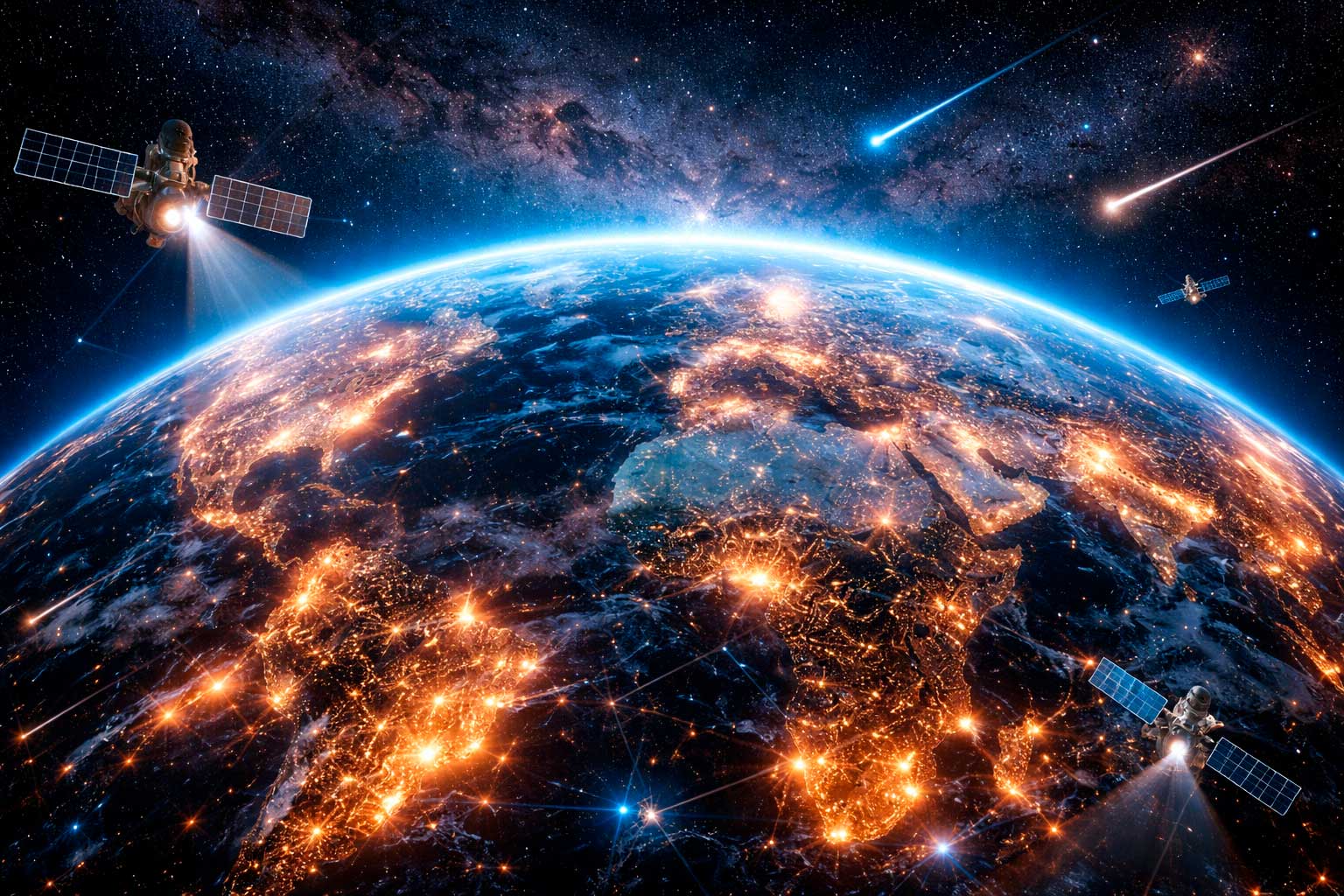

Satellite image survey shows consistent advance of artificial light on the planet, while part of Europe tries to darken the early morning to save energy and contain light pollution
The Earth is undergoing a silent change, but one that is becoming increasingly visible as night falls. A study published in April 2026 in the journal Nature showed that global nighttime brightness generated by artificial light advanced by about 16% between 2014 and 2022, based on 1.16 million daily satellite images.
The result helps explain why the night sky in so many cities appears less dark than before. The phenomenon does not indicate a sudden glare over the planet, but rather a continuous transformation of the human landscape, driven by urbanization, infrastructure expansion, and advances in electrification in various regions.
This change, however, does not occur uniformly across the map. While areas of Sub-Saharan Africa and Southeast Asia became significantly more illuminated during the analyzed period, parts of Europe went in the opposite direction and reduced light emissions at night due to political and technological decisions.
-
Methane, natural fuel lakes, ice, and a nitrogen-rich atmosphere make Titan central to NASA’s plans for the first “space fuel station” to speed up missions beyond Mars.

-
16-Year-Old Kentucky Student Solves Long-Standing Biomedical Challenge, Wins Top Young Scientist Award at $9 Million Science Fair
-
Teen Invents Biodegradable Material from Shrimp Shells That Decomposes 1.5 Million Times Faster Than Regular Plastic
-
Scientists Develop Diving Suit for Cyborg Cockroaches to Survive Underwater for 3 Hours, Navigate Flooded Tunnels, and Aid in Disaster Rescue Missions, with Potential for Mars Exploration



Brazil also stands out in this global picture. In 2022, the country emerged as the fifth brightest in the world at night, behind the United States, China, India, and Canada, a fact that reinforces the impact of urbanization and the electrical grid on the luminous design of the territory.
What satellites saw on the planet during the early morning
The scientific work showed that nighttime human lighting has become more dynamic than previously thought. In total, 3.51 million square kilometers of the analyzed inhabited areas recorded some type of light change between 2014 and 2022, including both regions that became brighter and areas that darkened.
The net increase of 16% does not mean that everything simply brightened. In practice, researchers identified 34% of advancements offset by 18% of reductions, a movement that reveals a planet with simultaneous pockets of urban expansion, energy adaptation, blackouts, crises, and reorganization of built space.
Another important point is the quality of observation. Instead of relying solely on monthly or annual compositions, the survey used daily images, which allowed for more precise detection of gradual changes, such as the replacement of light bulbs, and abrupt changes, such as infrastructure collapses, conflicts, and failures in electrical networks.
Europe shows that reducing light does not mean going backwards
Against the backdrop of global progress, Europe recorded a drop of about 4% in nighttime brightness over the studied period. This decline was associated with measures such as replacing old systems with more efficient lighting, using directed LED, public policies for energy efficiency, and initiatives to reduce light pollution.
The French case caught the authors’ attention for bringing together practical decisions that are already changing the early morning in urban areas. In some places, the partial shutdown of public lighting when the streets empty has become a tool for savings, urban planning, and preservation of the night sky, showing that less light can also be a sign of smarter management.
When darkness signals war, collapse, and crisis
Not all reductions in brightness are positive. The same monitoring recorded sharp losses of brightness in countries such as Ukraine, Yemen, Afghanistan, and Lebanon, as well as declines linked to economic and energy instability in places like Venezuela and Haiti.
In these cases, darkness has a different meaning. It often reflects destruction of infrastructure, prolonged power outages, and social disorganization, which differentiates this blackout from the planned dimming observed in parts of Europe.
Brazil appears among the most illuminated and raises alert about urban growth
Brazil’s presence among the five brightest countries on the planet at night helps to gauge the scale of urban occupation and electrification in the country.
This is not just about stronger public lighting, but a combination that involves urban expansion, economic activity, logistical corridors, and increased energy consumption in densely populated areas.
This picture can be read in two ways simultaneously. On one hand, nighttime light often accompanies material development and access to infrastructure. On the other hand, excessive brightness at inappropriate times can also reveal waste, poor planning, and increased light pollution, a problem that has long received less attention than noise, smoke, or visible waste.
In the Brazilian case, the data tends to gain extra relevance because the country combines extensive metropolises, growing medium-sized cities, and areas of recent expansion of the electrical grid. This broadens the discussion on how to illuminate better, not just illuminate more.
More light at night can affect sleep, animals, and the balance of ecosystems
The impacts go far beyond the appearance of cities viewed from space. The authors of the study themselves highlight that the advance of artificial nighttime light has important ecological consequences, with the potential to disrupt nocturnal ecosystems, interfere with migrations, and alter the biological functioning of different species.
In human health, the alert is also growing. Recent scientific reviews point to an association between exposure to artificial light at night and sleep disorders, as well as changes in the circadian rhythm, which is the biological clock responsible for organizing cycles of wakefulness and rest.
There are also effects on fauna that are beginning to appear more clearly in the scientific literature. Studies indicate that artificial brightness can change activity patterns of ecological communities and even influence stopover areas of migratory birds, which transforms the discussion about poles, facades, and urban lighting into an environmental debate of global scale.
The big question left by this new night map is simple and uncomfortable. The planet is brighter, but that does not necessarily mean it is more balanced, healthier, or better planned.
Should the expansion of nighttime light be treated as a sign of progress or as yet another urban excess out of control? Leave your comment and say whether cities should turn off some lights in the early morning or if this could compromise safety, mobility, and routine.