Portuguese
  Spanish




Technology Released in December 2025 Indicates Chinese Advance in Micropulse Systems Targeting Space Warfare and the Neutralization of Orbital Networks
A technological advancement with strategic implications was recently announced by China, drawing the attention of military analysts and space security experts.
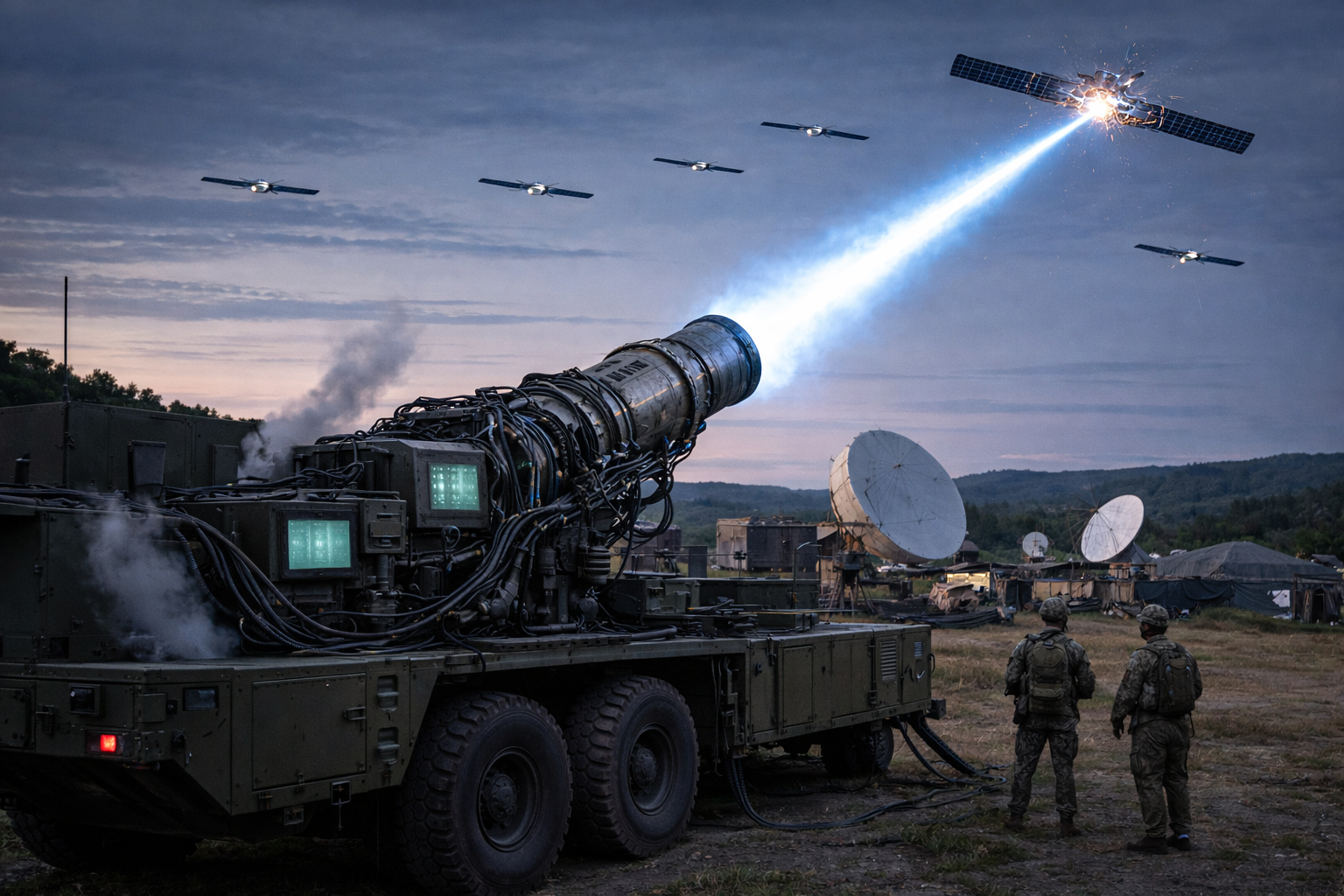
In December 2025, the Northwest Institute of Nuclear Technology (NINT) published a technical study presenting a compact high-power pulse device designed for applications in the context of the so-called space warfare.
According to the report, the equipment may, in the future, be adapted for micropulse weapons capable of disabling satellite networks like Starlink, a system widely used for global communications and connectivity.
-
European Parliament Approves Digital Euro, Aiming to Challenge Visa and Mastercard’s Dominance and Transform Payments Across Europe by 2029

-
Israel finds Hezbollah militarized tunnel over 200 meters long under village, with 4 missile launch shafts, 12 chambers, anti-tank missiles, drones, and weapons depots at a depth of 25 meters.

-
Ukraine launches largest drone attack on Moscow since 2022, Russia claims to have intercepted nearly 200 aircraft near the capital, Kapotnya refinery targeted again, and offensive reignites alert about war reaching the Russian energy heart just a few kilometers from the Kremlin.

-
Truck drivers, freight, and fines from 2022 take center stage in politics: Chamber approves MP with amnesty, mandatory tracking by CIOT, million-dollar penalties, and new minimum wage for those who spend more than 24 hours on the road.





According to NINT, an institution linked to the Chinese military establishment, the development demonstrates significant technical advancement in a domain considered strategic by major powers.
Technical Advancement Focused on Portability and Pulse Duration
The main innovation highlighted in the study is the small size of the device.
Comparatively, the system is significantly smaller than similar known technologies, allowing for its installation on more portable platforms.
Moreover, according to the report released in December 2025, the equipment can operate with sustained pulses exceeding one minute.
In contrast, comparable technologies typically achieve only a few seconds of operational duration.
This technical differentiator expands the potential strategic application of the system, according to the institute’s own publication.
Micropulses as an Alternative to Anti-Satellite Missiles
Military experts have been discussing the use of micropulse weapons as an alternative to conventional anti-satellite missiles for years.
Unlike kinetic systems, which physically destroy the target, the micropulse aims to temporarily or permanently disable the electronic components of satellites.
This approach, as analysts point out, reduces the risk of generating space debris.
The creation of orbital fragments is considered one of the main risks to space security, as it can even affect the assets of the attacking country itself.
Additionally, micropulse systems tend to be more difficult to detect than traditional missiles.
This characteristic adds a significant strategic layer to the debate over power balance in space.
Space as a New Strategic Frontier
Various defense experts argue that space is becoming the next frontier of strategic competition.
This is occurring because the global economy increasingly depends on space infrastructure, communication satellites, and orbital navigation systems.
In this context, any technology capable of interfering with these networks gains geopolitical significance.
The study released by NINT in December 2025 suggests that China seeks to expand its presence in this emerging domain.
Although the report presents technical data, it does not detail operational timelines or immediate practical applications.
Still, the advancement reinforces the perception that the space environment is undergoing significant strategic transformation.
A New Era of Orbital Competition?
The development of technologies aimed at neutralizing satellites broadens discussions on international regulation and strategic stability.
Analysts emphasize that the responsible use of space remains a central theme in multilateral forums.
At the same time, the emergence of compact high-power pulse devices shows that technological competition continues to progress.
In light of this scenario, is the world moving towards a phase where orbital security will become one of the main pillars of global strategy?