Portuguese
  Spanish


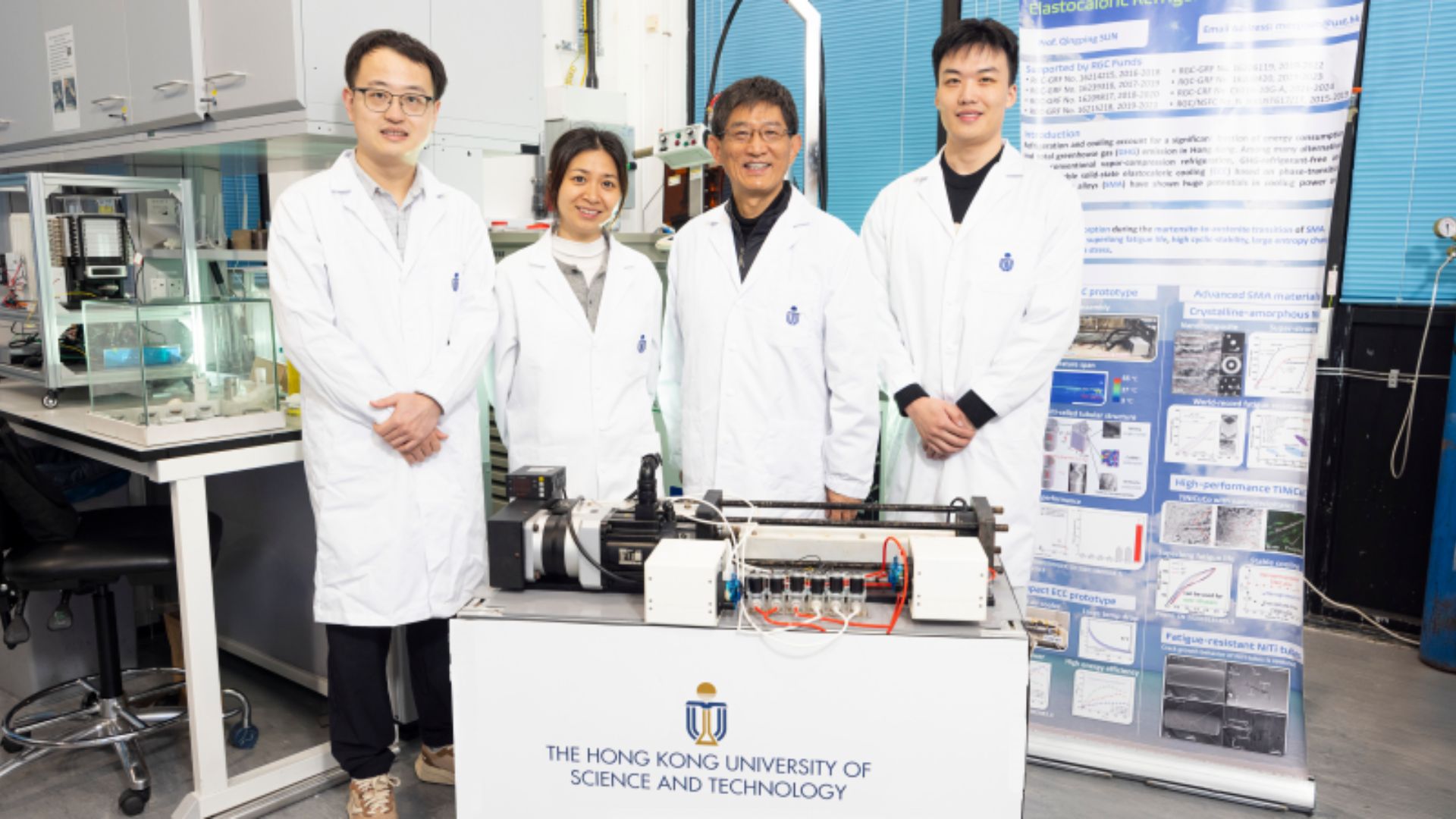

HKUST creates elastocaloric cooling with nickel-titanium alloy, without compressor and without HFCs, reaching 1,284 watts in prototype.
Researchers from the Hong Kong University of Science and Technology, HKUST, have developed a elastocaloric cooling device at kilowatt scale, without compressor and without HFC refrigerant gases. The prototype uses only 104.4 grams of nickel-titanium alloy tubes, a material known as shape memory alloy. According to HKUST, the system achieved 1,284 watts of cooling power and 12.3 W/g of specific power. In tests, the equipment cooled a 2.7 m³ model house, in an outdoor environment of 30°C to 31°C, to 21°C to 22°C in about 15 minutes. The breakthrough was published in the journal Nature and is regarded as a milestone for clean refrigeration.
Elastocaloric cooling can replace air conditioning with HFCs
Elastocaloric cooling emerges as an alternative to conventional air conditioning, which relies on a compressor and refrigerant fluid. The technology uses materials that heat or cool when subjected to mechanical compression and relief. In HKUST’s system, the nickel-titanium alloy releases heat when compressed and absorbs heat when the pressure is removed. This cycle creates cooling without the need to circulate HFCs, fluids used in many current devices.
The environmental relevance lies precisely in the HFCs. These gases do not destroy the ozone layer like the old CFCs, but they have a high global warming potential and are being gradually reduced by the Kigali Amendment to the Montreal Protocol.
-
The Trap of Modern Technology: How Screen Overload and Digital Connections Can Impact Your Mental Health and Well-being

-
Wyoming Couple Grows Tropical Fruits Year-Round in -40°C Using Geothermal Greenhouse, Demonstrating Earth’s Heat Can Produce Oranges and Lemons in Snow Without Traditional Heating

-
Ship Returns from Brazilian Coast with Thirty Newly Discovered Life Forms
-
Nigerian Professor Invents Electricity-Free Refrigerator Using Clay Pots and Wet Sand, Extending Shelf Life of Vegetables to 27 Days; 7,000 Units Distributed in Energy-Deprived Villages



Air conditioning without refrigerant gas uses nickel-titanium tubes
The core of the prototype is formed by thin nickel-titanium tubes, also called NiTi. This material changes its crystalline structure when compressed, undergoing a phase transition that releases or absorbs heat.
The team led by professors Sun Qingping and Yao Shuhuai created an architecture called “SMAs in series — fluid in parallel.” The system connects ten elastocaloric units in series, each with four thin NiTi tubes.

This architecture allowed for an increase in active mass without excessively raising the system’s pressure. According to HKUST, the fluid pressure remained below 1.5 bar, maintaining stable operation at high frequency.
Power of 1,284 watts breaks the kilowatt barrier in clean cooling
The biggest technical advance was overcoming the 1-kilowatt cooling power barrier. Until then, elastocaloric devices had been limited by low power, which hindered commercial application.
The prototype achieved 1,284 watts of power on the fluid side, using 104.4 grams of active material. This generated a specific power of 12.3 W/g, almost three times the previous record cited by researchers.
This number does not mean that the product is ready for sale. It means that, for the first time, the technology demonstrated performance on a scale much closer to real air conditioning applications.
Graphene nanofluid improves heat transfer in the system
Heat transfer was one of the main bottlenecks of elastocaloric cooling. To solve this, researchers used thin-walled tubes with a large contact area relative to the material’s volume.
Additionally, the team replaced distilled water with graphene nanofluid as the thermal transfer fluid. According to published data, this nanofluid showed 50% higher thermal conductivity than pure water.
The combination of tubular geometry, operating frequency of 3.5 Hz, and graphene nanofluid allowed for more heat to be removed per second. This combination explains the performance leap of the prototype.
Compressor-free technology reduces dependence on moving parts and climatic gases
Traditional air conditioning uses a compressor, condenser, evaporator, and refrigerant fluid. This system works well but depends on gases that can leak and cause climatic impact.
The HKUST device eliminates the vapor compression cycle. Instead of compressing a refrigerant gas, it mechanically compresses a metallic alloy that absorbs and releases heat during the phase change.

This design can reduce the dependence on high GWP fluids and pave the way for solid-state cooling devices. Still, fans, controls, casing, electrical safety, and certifications remain necessary in a commercial product.
HKUST also advances in below-zero refrigeration without HFCs
The same line of research also advanced to below-zero refrigeration. In 2026, HKUST unveiled an elastocaloric device capable of reaching negative temperatures and demonstrating water freezing in real tests.
In this experiment, the system cooled an isolated chamber to about -4°C in 60 minutes and froze 20 ml of distilled water in up to 2 hours. The demonstration expands the technology’s potential for food and cold chain.
I cannot confirm, from the open sources consulted, that this second prototype reached -12°C as the main demonstrated result. The public source from HKUST/EurekAlert reports a chamber at -4°C in an external test.
What still prevents the elastocaloric air conditioner from reaching the market
The prototype published in Nature is still a laboratory demonstration. The first challenge is the cost of the nickel-titanium alloy, which is more expensive than common materials used in conventional compressors and heat exchangers.


The second challenge is the lifespan in cycles. A residential air conditioner can operate for thousands of hours, and a high-frequency elastocaloric system needs to withstand millions or hundreds of millions of compressions.
The third challenge is industrial integration. To become a product, the technology needs electronic control, reliable mechanical design, scale production, maintenance, certifications, and proof of safety in continuous use.
The air conditioner of the future may be cleaner, but it is not yet for sale
HKUST’s advancement shows that an air conditioner without refrigerant gas is no longer just a scientific hypothesis. The team demonstrated cooling on a kilowatt scale, with performance sufficient to put the technology on the industry’s radar.
This does not mean that elastocaloric devices will immediately replace conventional models. The transition depends on cost, durability, real efficiency, regulation, and the ability to manufacture on a large scale.
Even so, the milestone is important: after more than a century of vapor compression cycle dominance, solid-state cooling is beginning to emerge as a concrete alternative to reduce HFCs, emissions, and the climate impact of air conditioning.