






 Portuguese
  Spanish
  6 min of reading
  0 comments


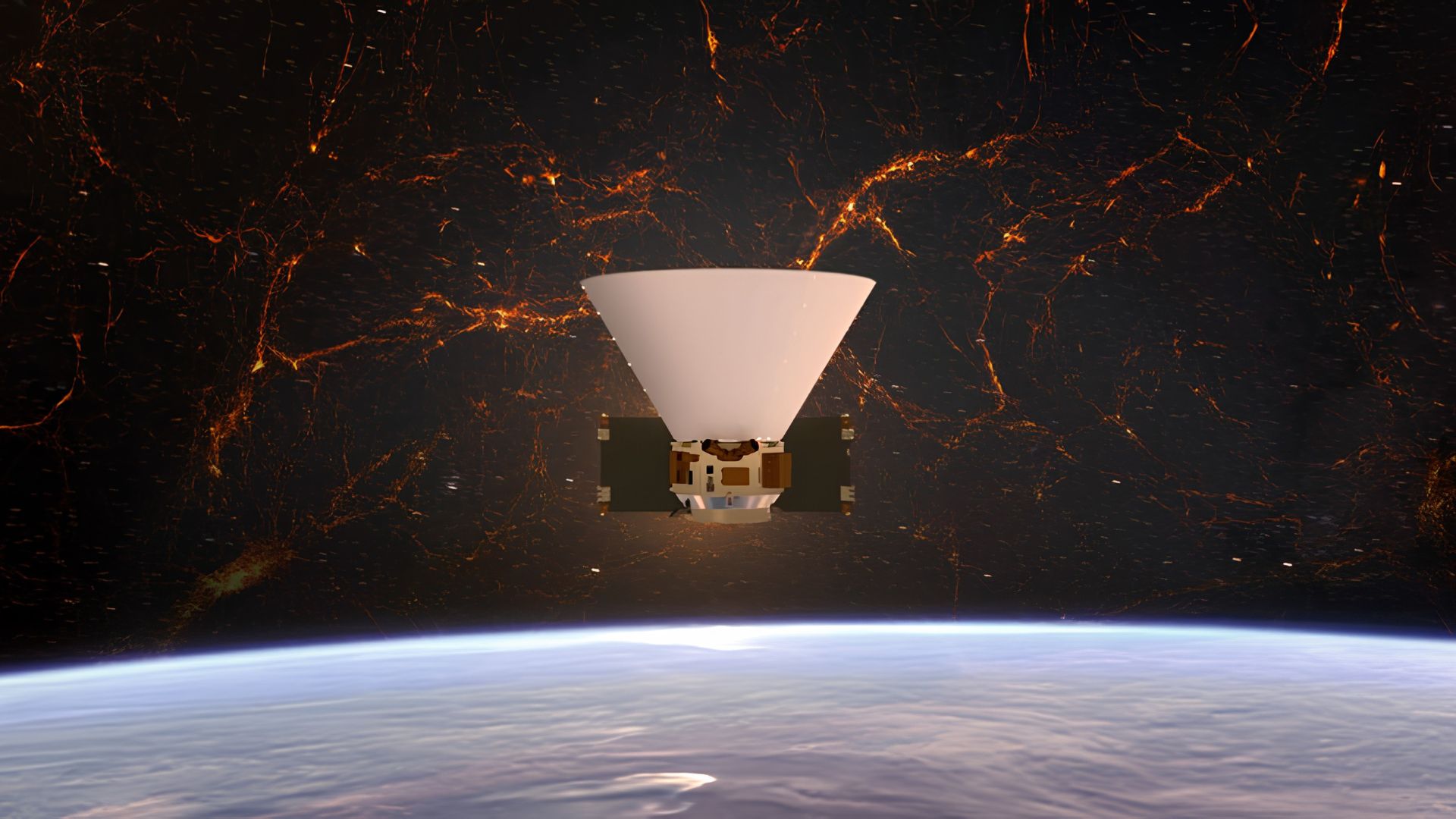
SPHEREx will map the entire sky in 102 wavelengths and investigate galaxies, cosmic ice, and the beginning of the Universe.
In March 2025, NASA launched the SPHEREx, a space telescope designed to map the entire sky in 102 infrared wavelengths, collecting data from more than 450 million galaxies and over 100 million stars in the Milky Way. The mission was developed to investigate three major fronts: what happened right after the Big Bang, how galaxies evolved over time, and where frozen water molecules and compounds essential to planet formation are located.
SPHEREx will transform the entire sky into a chemical and three-dimensional map of the Universe
SPHEREx, short for Spectro-Photometer for the History of the Universe, Epoch of Reionization and Ices Explorer, was not created to observe just a specific region of space. Its proposal is to sweep the entire sky repeatedly, creating a complete infrared spectral survey.
This means that the telescope will not just record luminous points. It will separate the light into different bands, as if dismantling each glow into a physical and chemical signature.
-
Helicopter Drops 180 Tons of Sand and Gravel on Swedish River to Revive Ecosystem Damaged by Decades of Exploitation

-
Brazilian Company Launches Retro Smartphone with 48 MP Camera, T9 Keyboard, and Privacy Features for Social Media-Free Use

-
Self-Taught Chinese Farmer Builds 5-Ton Submarine from Scrap, Launches It in Anhui River
-
Invisible Induction Technology Enables Wireless Power for Blenders, Coffee Makers, and Air Fryers, Reducing Countertop Cables







With this, scientists will be able to estimate distances, composition, and properties of millions of cosmic objects. The great difference of SPHEREx is that it combines colossal scale with spectral information, something that traditional sky surveys cannot do at the same level.
NASA reports that the observatory will create a map of the entire sky in 102 color bands, surpassing the color resolution of previous full-coverage infrared maps.
Telescope will observe more than 450 million galaxies to search for signs of cosmic inflation
One of the most ambitious objectives of the mission is to study cosmic inflation, an extremely rapid expansion phase that, according to current cosmological models, would have occurred right after the Big Bang.
This event would have happened in a tiny fraction of a second, amplifying small variations of the primordial Universe until forming the seeds of structures that today appear as galaxies, clusters, and cosmic filaments.
SPHEREx will attempt to investigate this remote past by measuring the distribution of hundreds of millions of galaxies. The logic is that the current organization of these galaxies may preserve statistical traces of the physics that acted at the beginning of the Universe.
According to Reuters, the mission was launched precisely to investigate the origins of the Universe and create a three-dimensional map of the cosmos in 102 wavelengths.
The observatory will search for frozen water and organic molecules within the Milky Way
Besides cosmology, SPHEREx will also look within our own galaxy. The mission will seek signs of frozen water, carbon dioxide, carbon monoxide, and organic compounds in interstellar clouds.
These molecules can become trapped in small grains of cold dust, within regions where new stars and planets begin to form. The scientific interest is straightforward: to understand how important chemical ingredients are distributed before the birth of planetary systems.

NASA states that the mission will study more than 100 million stars in the Milky Way, as well as hundreds of millions of galaxies outside it. This makes SPHEREx a bridge between two giant themes: the origin of the Universe on a large scale and the origin of the ingredients that form planets on a galactic scale.
The strongest point of the agenda is that the same telescope will investigate the Big Bang and, at the same time, search for cosmic ice associated with the formation of worlds.
SPHEREx will map the entire sky every six months during its scientific mission
The mission was planned to operate for about two years. During this period, SPHEREx should map the entire sky repeatedly, completing a full sweep approximately every six months.
This pattern allows scientists to obtain four complete maps of the sky throughout the main mission. The repetition improves the accuracy of measurements and enhances the ability to cross-reference data with other observatories.
The Jet Propulsion Laboratory reports that the complete sky survey in 102 bands will be conducted with technologies adapted from terrestrial satellites and interplanetary spacecraft.
The mission should also identify promising targets for more detailed studies conducted by telescopes like the James Webb and the future Nancy Grace Roman Space Telescope. SPHEREx finds large-scale patterns; more powerful telescopes can investigate specific objects in greater depth.
The mission uses infrared to see what optical telescopes cannot detect
SPHEREx observes the Universe in near-infrared, a range of light invisible to the human eye. This choice is essential for studying cold objects, cosmic dust, frozen molecules, and very distant galaxies.
When light from ancient galaxies travels for billions of years, the expansion of the Universe stretches its wavelengths. Part of this light reaches us shifted to the infrared.

This is why infrared missions are so important for modern astronomy. They can access phenomena that would remain hidden in common visible light images.
In the case of SPHEREx, the mission is not just about beautiful images. It seeks mass spectral data, capable of revealing the composition, distance, and evolution of objects on a gigantic scale.
The telescope completes NASA’s strategy alongside James Webb and Roman
SPHEREx does not replace James Webb. It has a different function. James Webb observes specific targets with enormous sensitivity and resolution. SPHEREx, on the other hand, will map the entire sky, creating a broad catalog so that other telescopes know where to look in more detail.
This logic transforms SPHEREx into a kind of cosmic tracker. It can identify regions with interesting signals, rare objects, unusual concentrations of molecules, or galaxies that deserve further observation.
NASA already describes the survey as a way to select targets for future missions. This increases the scientific value of the telescope even after the end of the main mission.
First complete map of the sky in 102 colors began to show the size of the database
In December 2025, the Jet Propulsion Laboratory reported that SPHEREx completed its first infrared map of the entire sky in 102 colors, after its launch in March of the same year. The agency highlighted that these colors are not visible to the human eye but are abundant in the cosmos and allow us to answer questions about the history of the Universe.
This first survey confirms the scale of the project. Each observation cycle adds a new layer of data to the overall map, refining measurements and allowing comparisons between different regions of the sky.
The mission is expected to generate a scientific collection used by astronomers worldwide. As with large astronomical surveys, some of the most important discoveries may arise from questions that have not yet been formulated. The value of SPHEREx lies precisely in the volume and diversity of the data: galaxies, stars, interstellar ice, cosmic dust, and the structure of the Universe will be analyzed within the same survey.
SPHEREx places astronomy in the era of large cosmic maps
The mission represents a change of scale in space observation. Instead of focusing only on a few spectacular objects, NASA’s telescope was created to transform the entire sky into a physical, chemical, and cosmological database.

With 102 wavelengths, more than 450 million galaxies, and over 100 million stars, SPHEREx attempts to connect questions that seem distant from each other: how the Universe began, how galaxies evolved, and how essential ingredients for planet formation spread through space.
If the data confirms the expected potential, the telescope could become one of NASA’s most important missions for understanding the Universe on a large scale. And the most intriguing part is that by mapping everything, it may also reveal phenomena that no one was looking for.





Be the first to react!