Portuguese
  Spanish


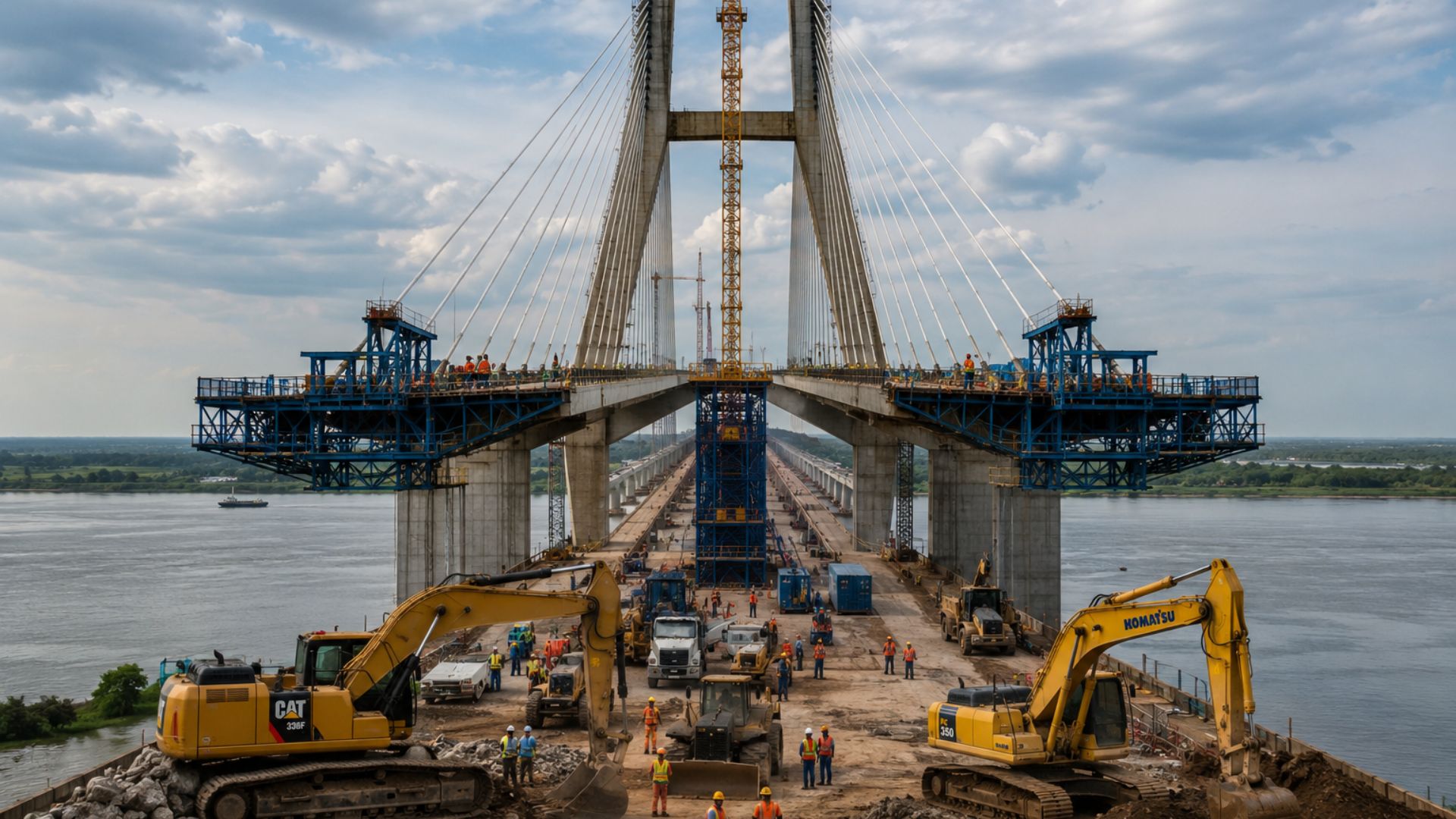

Megastructure over the Paraguay River advances to the final phase while Brazil, Paraguay, Argentina, and Chile still face customs barriers, lack of regulatory integration, and operational difficulties that could delay the consolidation of the Bioceanic Route as a strategic corridor for exports and imports between South America and Asia.
With about 90% of the works completed, the Bioceanic Route International Bridge entered its final stage between Porto Murtinho, in Mato Grosso do Sul, and Carmelo Peralta, in Paraguay, although the full operation of the corridor still depends on customs agreements and common regulations among four countries.
Erected over the Paraguay River, the 1,294-meter-long structure has come to symbolize the main Brazilian link of the Capricorn Highway Corridor, a route over 2,400 kilometers long created to connect the Atlantic and Pacific oceans and expand South American trade with Asia.
Even with the accelerated progress of the works, the Secretary of Semadesc of Mato Grosso do Sul, Artur Falcette, believes that the physical completion of the bridge represents only a part of the challenge faced by the governments involved in the international logistics project.
-
Tesla injected an additional $250 million into the German factory, doubled the battery cell target, and opened its own production line for startups.

-
A 180-meter ship with a deck the size of a football field was christened to carry 25,000 tons of giant energy modules around the world.
-
To erect the “Baleia” building on the richest avenue in Brazil, he bought 35 houses, paying with trips to Disney, a truck, and even an apartment, waited over 20 years, and today the complex is valued at R$ 2.5 billion.
-
The land belonged to her great-great-grandfather and was worth R$ 25 per square meter during the pandemic; the couple sold 250,000 m² for the nearly R$ 30 billion project that is transforming the “neighbor of Jericoacoara,” and today a house in the region goes for R$ 4.2 million.


“The forecast for the bridge’s completion remains for the second half of 2026. However, there is still a long way to go until we can fully enjoy the benefits of the route. There are customs issues and legislation to be resolved among the countries involved,” he said.
Customs bottlenecks hinder Bioceanic Route operation
At the center of discussions is the creation of an integrated system for inspection, customs control, and legal certainty at the borders, considered essential to ensure predictability for the international flow of goods and stability for commercial operations.
Without this coordinated structure among the countries, the route may be physically ready, but will remain limited for operating cargo on a competitive scale and meeting the projected logistics demand for the coming years.
According to a study on trade facilitation in the Bioceanic Corridor, supported by the BID, the consolidation of the route directly depends on the institutional capacity to integrate processes, harmonize regulations, qualify border agents, and increase the confidence of economic operators.
Currently, only the crossings located between Argentina and Chile are enabled for international cargo transport, although the technical survey also identified an immediate need for improvements at these crossing points.
Among the main problems identified are the low participation of private users in operational decisions and the absence of standardized procedures capable of reducing delays and increasing efficiency in the movement of goods.
Meanwhile, the stretches between Brazil and Paraguay and between Paraguay and Argentina remain without full operation, a situation considered strategic because the connection between Porto Murtinho and Carmelo Peralta will be the main Brazilian entry point of the logistics corridor.
Private sector demands participation in corridor decisions
In addition to customs obstacles, the study also highlights the reduced influence of the private sector in decisions considered strategic for the future operation of the Bioceanic Route.
Exporters, importers, transporters, customs brokers, freight forwarders, and logistics operators appear as central users of the corridor, but still have limited participation in the formulation of operational and regulatory rules.
According to the report, these groups daily face foreign trade bottlenecks and could contribute directly to defining the works, the Integrated Control Areas, and the inspection procedures adopted at the borders.
In the case of Porto Murtinho and Carmelo Peralta, the customs section is treated as sensitive.
The construction of an Integrated Control Area was approved by Dnit, but resources are still lacking to complete the structure on the Brazilian side.
The absence of broad technical consultation with the private sector may hinder the incorporation of practical elements into the project, such as waiting areas, separate vehicle flows, technological systems, estimated crossing times, and specific inspection needs.
Bridge access works proceed at a different pace in Brazil
Although the bridge is moving towards structural completion, road accesses in Brazilian territory are progressing at a different pace and still depend on new stages planned in the federal schedule.
The project includes 13.1 kilometers of connection in Porto Murtinho and receives an approximate investment of R$ 472 million through the Novo PAC, with execution coordinated by the federal government.
According to Dnit information, the works already include earthworks, drainage structures, wildlife crossings, fences, and wire fences installed along the right-of-way.
Even so, the forecast indicates that the Brazilian access to the bridge should only be completed in 2027, a scenario that could cause operational misalignment in relation to the delivery of the main structure.
The bridge is financed by Itaipu Binacional, on the Paraguayan side, and is part of the package of works aimed at the physical connection between the two countries.
The expectation is that the structure will reduce logistical distances and increase the competitiveness of Brazilian products in Asian markets.
Governments and companies project that the route could reduce transport costs by up to 30% and shorten deadlines by up to 15 days compared to traditional routes, such as those passing through the Panama Canal.
These gains, however, depend on the integrated operation of the borders.
Integration between Brazil, Paraguay, Argentina, and Chile still challenges the project
Institutional coordination also appears as one of the main challenges for the consolidation of the corridor, as the route brings together countries subject to different commercial rules and regulatory structures.
While Brazil, Paraguay, and Argentina are part of Mercosur, Chile participates directly in the Bioceanic Route without being part of the economic bloc, a condition that increases the complexity of multilateral negotiations.
Given this scenario, specialists advocate for the creation of a dedicated technical-operational governance for the corridor, based on permanent channels between governments, shared information systems, and integrated procedures for cargo, vehicles, and passengers.
The exclusive use of Mercosur as a decision-making forum may not be sufficient, as specific measures for the route may not be a priority for other countries in the bloc or may encounter the need for multilateral consensus.
The report supported by the IDB brought together virtual and in-person discussions with representatives from the private sector, companies, business associations, public bodies, and educational institutions.
In total, 231 improvement opportunities were identified and 264 consensual proposals were developed.
Mato Grosso do Sul bets on new investments with the corridor
At the state government level, the route is seen as a driver for attracting business, but there is still no forecast of new local public investments directly linked to the full operation of the corridor.
Falcette states that companies are already looking at the Bioceanic Route as an alternative for outflowing production, although this movement is still in its initial phase.
According to him, private interest can become an attraction factor for new ventures in the State.
In addition to logistics, Mato Grosso do Sul seeks to diversify its productive matrix with chains such as citrus farming, peanuts, and technology-based industries.
The intention is to expand the regional economic agenda to better leverage the future international connection.
The bridge, therefore, represents the most visible advance of the Bioceanic Route, but the transformation of the corridor into an effective commercial route still depends on customs, access, financing, governance, and coordination among the four countries involved.