






 Portuguese
  Spanish


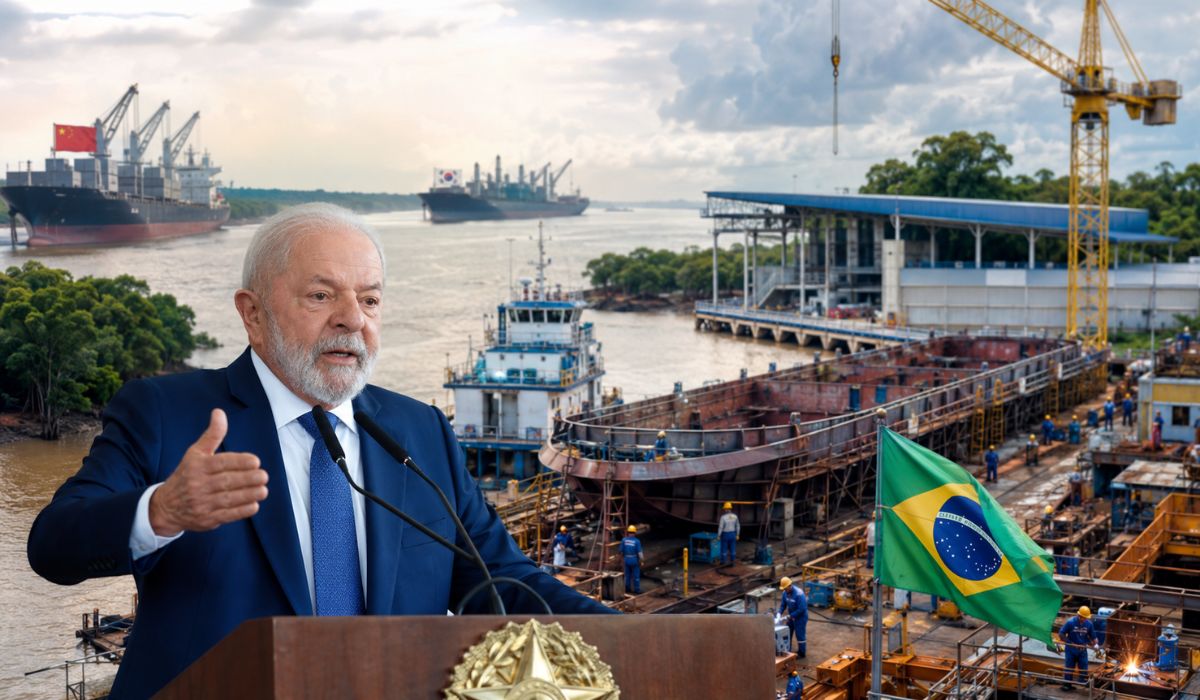

Declaration occurred during agenda in Amazonas, amid announcements of investments in barges, pushers, and waterway infrastructure, with resources from BNDES, Petrobras, Transpetro, and New PAC.
President Luiz Inácio Lula da Silva (PT) stated on May 27, 2026, that the Brazilian naval industry could compete with Asian manufacturers as it expands national production of vessels.
The statement was made during an agenda in Amazonas, at a ceremony at the Juruá Shipyard in Iranduba, in the Metropolitan Region of Manaus, marked by announcements of investments in naval infrastructure and waterway logistics.
Speaking about the capacity of Brazilian shipyards, Lula said that the country needs to trust its own production to gain competitiveness.
-
At 14 years old, she worked in a factory in Hong Kong, studied economics abroad, and then entered the Chinese real estate market, which helped change the landscape of Beijing.

-
While NATO secured more than $10 billion in missiles and space surveillance at a single forum, Brazil still spends 1.1% of its GDP on defense and is stalling its own anti-aircraft system.

-
Corn ethanol attracts R$ 23 billion in 21 new plants and prepares for a nearly 50% jump in Brazilian production by 2027, even with high interest rates.
-
A newly opened terminal in the middle of the Amazon has begun transporting soy and corn through Amapá, eyeing the queue of ships that is congesting the ports in the South.


The president mentioned the difference in timeframes compared to vessels made abroad but stated that Brazil can advance in quality and production capacity.
“Our barge may take 10 days longer than the Korean one because we are just starting now. But, in a month, we will beat the Koreans, the Chinese, because we will produce with more quality and competence,” declared Lula, according to a report published by Poder360.
Lula defends Brazilian naval industry in Amazonas
The statement was made at an event focused on the naval sector and river transport, areas associated by the federal government with the logistics of the Northern Region.
In the speech, Lula linked investments in shipyards to the expansion of productive activity outside the more consolidated economic centers.
According to the president, Brazil “is only not competitive” in the international market if it does not believe in its own capacity.
The statement was made when commenting on the decision of entrepreneurs to hire barges built in Amazonas, instead of seeking foreign suppliers.
During the ceremony, Lula thanked entrepreneurs who decided to order vessels in the region.
“When an entrepreneur like this comes to Amazonas, 4 hours away from the most developed business center in Brazil, to hire a barge, I am obliged to say thank you,” he said.


BNDES finances barges and pushers
The agenda also involved projects financed by the National Bank for Economic and Social Development.
According to BNDES, financing of R$ 3.2 billion was approved, with resources from the Merchant Marine Fund, for LHG Logística to build 400 barges and eight pushers intended for the waterway transport of iron ore and manganese.
The barge launched into the river in the Amazon is part of this financing.
The bank reported that it has already disbursed R$ 1 billion of the total approved.
Of this amount, R$ 230 million were released to Estaleiro Juruá, responsible for 128 mineral barges planned in the project.
Until the data was released by BNDES, 27 units had been delivered and another 51 were under construction.
Considering the entire contract, BNDES reported that 72 barges had already been delivered and put into operation.
Another 98 barges and six pushers were in different stages of production and transport.
The vessels will be built over four years in four national shipyards located in the North and Northeast regions.
The financing is done with resources from the Merchant Marine Fund.
According to BNDES, the fund is managed by the Ministry of Ports and Airports through the Merchant Marine Fund’s Board of Directors and aims to support the development of the Merchant Marine and the Brazilian shipbuilding and repair industry.
Manaus Moderna Terminal receives resources from the New PAC
In addition to the agenda at Estaleiro Juruá, the federal government announced investments related to waterway transport and port infrastructure in Amazonas.
The Civil House reported that the Manaus Moderna Terminal will receive R$ 875.9 million in resources from the New PAC.
The project will be conducted by the Ministry of Ports and Airports in partnership with the National Department of Infrastructure of Transport.
According to the government, the contract for the works was signed in March 2026, with completion expected by 2029.
The new terminal will be able to handle about 3.5 million passengers per year and directly serve 61 riverside municipalities, in addition to Manaus.
The official estimate is that the structure will reach approximately 4.5 million people in the Amazon.
The project includes floating docks, movable bridges, passenger and cargo terminals, operational areas, parking lots, a sewage treatment plant, a power substation, and accessibility and security structures.
The works also include interventions around the Banana Market, a popular shopping center in Manaus, according to information released by the Civil House.
In the same agenda, Lula announced investments of R$ 2.8 billion from Petrobras and Transpetro in Amazonas.
According to the Civil House, the resources include the construction of barges at the Bertolini Shipyard and the drilling of wells by Petrobras.
Speech mentions national production and Brazilian shipyards
The comparison made by Lula with China and Korea occurred in a speech defending the hiring of vessels produced in Brazil.
The president stated that the Brazilian naval industry should receive orders and investments to increase job creation and the participation of national suppliers.
Although he used an informal expression when mentioning Koreans and Chinese, Lula presented the comparison as part of an assessment of timeframes, quality, and productive competence.
The speech was directed at entrepreneurs and representatives of the naval sector who participated in the ceremony in Amazonas.
In another part, the president said that productive activity should not be concentrated in the economically more developed regions.
At the event in Iranduba, he stated that industrial investments should also reach states further from the main business centers of the country.
The agenda brought together members of the federal government, representatives of public companies, and agents linked to inland navigation.
According to data released by official bodies, the announcements involved the construction of barges, pushers, port works, and projects associated with the circulation of cargo and passengers in areas dependent on river transport.
The dispute mentioned by Lula involves countries with a strong presence in global shipbuilding, such as China and South Korea.
In the Brazilian case, the projects announced by the government and BNDES indicate a bet on national orders financed with public and private resources to expand production in shipyards in the North and Northeast.
The results of these investments will depend on the execution of the contracts, delivery deadlines, and the shipyards’ ability to fulfill the planned orders.








