Portuguese
  Spanish


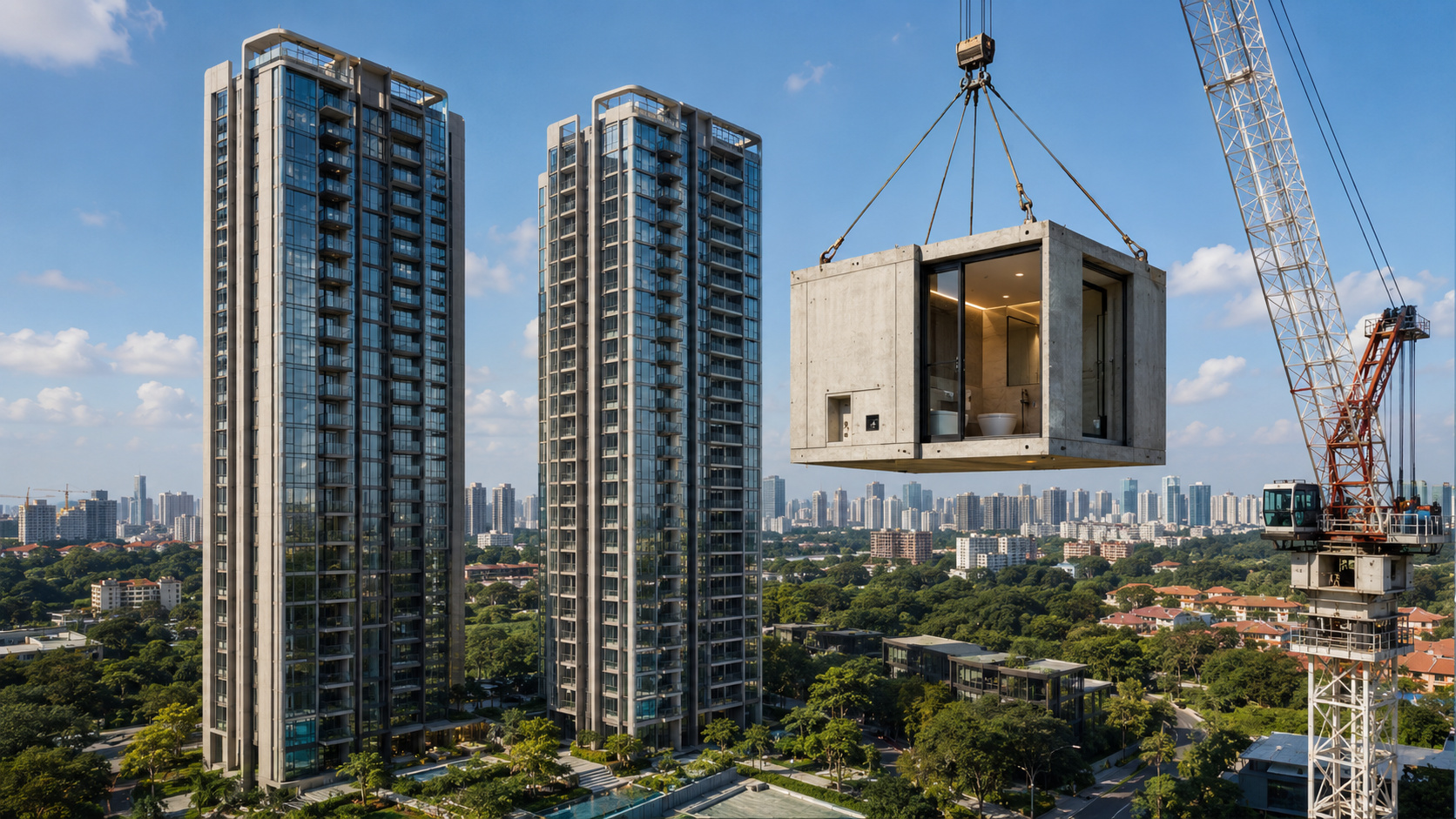

Modular construction in Singapore transformed the Clement Canopy into an urban landmark, with 1,866 concrete modules hoisted by cranes, nearly ready apartments, less concentrated work on-site, and two 40-story residential towers that show how tall buildings can arise from giant pieces prepared before final assembly
The Clement Canopy, in Singapore, draws attention because it seems to have taken the logic of a giant building toy to real-scale civil construction. The development used 1,866 concrete modules, formed two 40-story residential towers, and brought 505 apartments to the top.
The report was published by ArchDaily, an international architecture and civil construction portal. The case gained prominence for showcasing the strength of modular construction, a method where entire parts of the building are produced off-site and arrive at the site almost ready to be assembled.
The impact goes beyond visual curiosity. In a dense city like Singapore, this model helps explain why industrialized construction can reduce the dependence on large sites, improve project predictability, and better organize each stage.
-
Brazilian Students Turn Recycled Plastic Bottles into Synthetic Yarn for Scarves to Aid Needy Families

-
Why the Same Citrus Fruit Has Different Names Across Brazil and How Varieties Differ
-
India Paints Road Red and Uses Smart Asphalt to Slow Drivers and Protect Wildlife in Nature Reserve

-
Yellow vs. White Fat: The Little-Known Difference That Can Impact the Quality and Flavor of Your Barbecue






Modular construction made nearly ready apartments rise by crane in Singapore
The modular construction used in the Clement Canopy starts from a simple idea. Instead of doing everything on-site, an important part of the apartments is created elsewhere, with structure, bathrooms, finishes, and internal areas already prepared.
These parts are called modules. In the case of Singapore, there were 1,866 concrete modules transported to the site and hoisted to form the floors of the two towers.
The image is striking because it changes the way many people imagine a construction site. The building does not grow only with workers assembling each detail on-site. It also grows with large pieces arriving ready to take their place in the structure.
This process made the Clement Canopy a visual reference for modular concrete construction, especially by involving tall towers and real apartments, not just a small or isolated experiment.
PPVC is the method that transforms parts of the building into large pieces before the final construction
The system used in Clement Canopy is known by the acronym PPVC. In English, the concept can be understood as pre-fabricated and pre-finished volumetric construction.
This means that the modules are not just empty blocks. They can arrive with internal parts already finished, including important areas of the apartment, such as bathrooms, finishes, and sections of the structure.
In common construction, many tasks happen sequentially on-site. First one stage, then another, and thus the construction progresses little by little on the actual site.
In modular construction, part of the work happens in parallel. While the site is being prepared, the modules can also progress elsewhere. This point helps explain the pursuit of more productivity and control in urban projects.
Two towers of 40 floors and 505 apartments placed Clement Canopy at the center of modular construction
Clement Canopy comprises two residential towers of 40 floors and 505 apartments. The scale of the project helps to understand why it became an important case for modular concrete construction.
Dragages Singapore reported that the installation of the modules was completed in April 2018. In total, there were 1,866 modules installed in one year, a number that reinforces the size of the operation.
Each module needed to arrive at the site, be hoisted, and occupy the correct space within the complex. The assembly depended on coordination between manufacturing, transportation, and final fitting.
ArchDaily, an international architecture and construction portal, provided the numbers and deadlines mentioned. The publication recorded the project as a milestone among the tallest modular buildings completed during that period.
Singapore invests in industrialized construction because urban space has become a valuable resource
Singapore is a territory with little available space. Therefore, methods that reduce pressure on the site gain importance in large-scale residential projects.

Clement Canopy shows a possible response to this challenge. The project brought ready-made parts to the site and reduced the number of tasks that needed to happen on-site.
This model can bring advantages to dense cities, as it helps to better organize the use of space, reduces waste, and increases the predictability of the project.
The main change is in the production logic. The building no longer relies solely on the traditional construction site and starts to resemble an assembly line, with large pieces manufactured before the final stage.
The building assembled by modules shows why construction can function like a factory
The case of Clement Canopy is strong because it brings construction closer to an industrial logic. The apartment ceases to be just a sum of stages on the site and becomes part of a process planned before assembly.
This does not make the work simple. On the contrary, it requires rigorous planning, careful transportation, and precise fitting. Each module needs to arrive in suitable condition to occupy its place in the towers.
Even so, the idea of almost ready apartments hoisted by crane makes the subject easy to visualize. The building grows like a vertical assembly of large concrete pieces.
For those observing from the outside, the result seems almost like a giant toy. For engineering, however, the project shows a real alternative for building housing in urban areas with limited space.
The impact of Clement Canopy is in the future of housing in dense cities
Clement Canopy shows that modular construction is not just about erecting buildings quickly. The central point is to take more stages out of the site and arrive at the land with parts of the property already prepared.
With 1,866 concrete modules, two 40-story towers, and 505 apartments, the project became an example of how dense cities can rethink housing construction.
The strength of the case lies in the combination of scale, method, and urban necessity. In places where space is limited, building with less improvisation on the site can make a difference.
In the end, Clement Canopy shows that tall buildings can also be born from giant pieces, with organized manufacturing, vertical assembly, and more control over each stage of the work.
If entire apartments can already arrive almost ready at the site, do you believe this model can change the way big cities build housing?