






 Portuguese
  Spanish


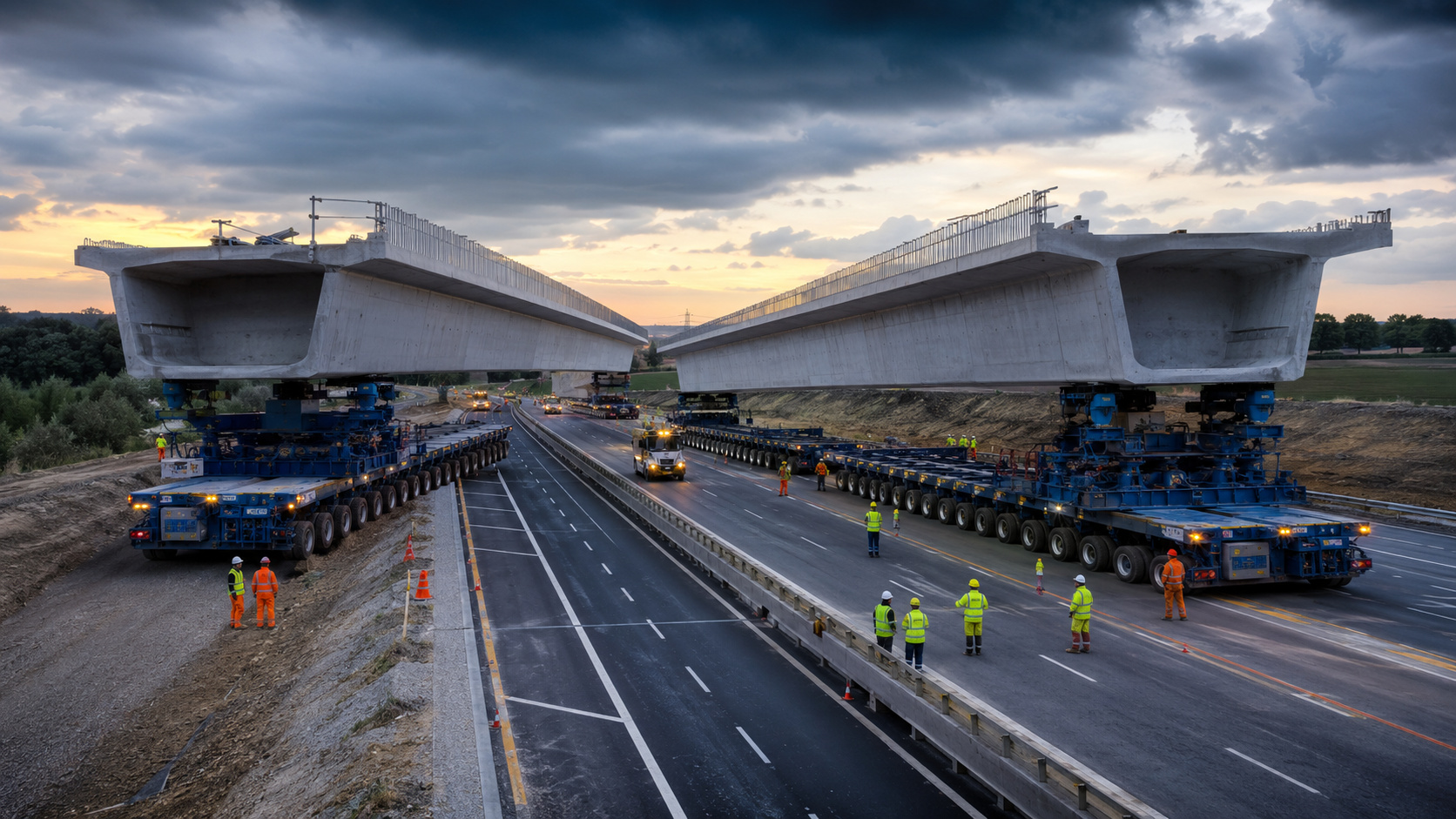


The work on the A14 showed how 1,000-ton bridges can be built off-site, moved by giant mobile platforms, and installed in a few days to reduce blockages, traffic delays, and impacts on drivers’ routines
Engineers in the United Kingdom made two bridges of about 1,000 tons move on mobile platforms and cross the A14 in a few days, in an operation planned to avoid months of disruptions on a busy highway.
The information was released by GOV.UK, the official portal of the British government. The installation was concentrated between the night of Friday, September 14, and the morning of Monday, September 17, during the A14 improvement project.
The solution draws attention because it changes the logic of a major roadwork. Instead of assembling the entire structure over the road for long periods, the bridges were prepared off the final point and taken ready to the installation site.
-
Engineers spend a decade building a $2.3 million bridge, but the project features a surreal curve, becomes a joke, and ends with seven suspended.

-
7-year-old boy acts without hesitation and saves his 1-year-old brother from drowning in the family pool in Texas: the boy’s courage impressed the sheriff and he may now receive an official police commendation.

-
The forgotten Atari stock that seemed like something out of a movie: millions of sealed cartridges were buried underground and were sold for very low prices.

-
Collector adapts forklift electric motor in a Kombi Corujinha pickup, hides 16 batteries under the bed, and makes the Brazilian classic run silently with up to 90 km of range.


How two 1,000-ton bridges left the site and reached the A14 without long construction over the road
The two bridges were built away from the point where they would permanently stay. Then, they entered the highway with the help of special equipment designed to carry huge structures.


This method reduces the time of direct intervention on the road. The longest part of the construction takes place away from the main vehicle flow, while the final fitting is concentrated in a smaller window.
In practice, the most visible stage was the movement of the bridges. Structures of about 1,000 tons were moved on platforms with many wheels, controlled precisely to reach the correct point.
The result was an operation of high visual impact: giant bridges moving as ready pieces, instead of a construction slowly growing over the highway.
Giant mobile platforms made the bridge move on wheels with precise control
The platforms used in the operation are called self-propelled modular transporters. In simple terms, they are mobile bases with several wheels, created to transport very heavy loads.
These pieces of equipment can move large structures carefully, at low speed, and with precise control. This is essential when the load weighs hundreds of tons and needs to be positioned in the right place.
In the case of the A14, the platforms allowed the ready bridges to be taken to the highway. The technique avoided the installation depending on a long sequence of blockages during construction over the track.
The main difference for the driver is the impact. Less construction time over the road means less detour, less queue, and less delay for those who depend on the road.
GOV.UK recorded that the closure was concentrated between September 14 and September 17
GOV.UK, the official portal of the British government, recorded that the necessary closure occurred between the night of September 14 and the morning of September 17. This period was used to safely complete the installation of the two bridges.
The choice to concentrate the operation over a weekend reduced the impact on a busy highway. In major roadworks, each blockage interferes with the lives of drivers, transporters, workers, and merchants.
The logic of the operation was simple to understand but difficult to execute. The bridge was prepared outside its final location, transported by mobile platforms, and installed in a few days.
This type of planning shows how engineering can reduce disruption without eliminating the complexity of the work. The bridge remains huge, heavy, and delicate to move, but the method reduces the time of interference on the road.

Building off-site has become a solution to reduce months of detour in major works
The work on the A14 shows an increasingly important principle in modern infrastructure: building off-site and installing quickly. This model is useful when the work takes place in busy areas.
When a bridge is made next to the track, the highway suffers less during the preparation phase. The major blockage is reserved for the moment when the structure needs to be transported and fitted.
This change helps protect the city’s routine. Long works can cause delays, increase indirect costs for drivers, and hinder the circulation of services.
Therefore, the installation of the 1,000-ton bridges in a few days has become a strong example of public work with less urban impact.
The technique does not eliminate complexity, but changes the impact on drivers and cities
Moving a ready bridge requires calculation, organization, and appropriate equipment. The weight of the structure, available space, and highway safety need to be considered before the operation.

Even so, the advantage is clear. Construction no longer depends on months of blockages at the same point and instead focuses the critical part in a smaller window.
For the driver, this means less time stuck in detours. For the city, it means less pressure on alternative routes and less disruption to the routine of those who need to travel through the region.
The installation on the A14 showed that the way of executing the work can be as important as the work itself. The goal was not only to place bridges in position but to do so with the least possible impact.
Bridges moving on wheels show a new way of thinking about roadworks
The scene of two huge bridges moving on giant platforms helps explain why the case draws so much attention. It is a rare image, simple to understand, and powerful to show the advancement of engineering.
At the same time, the story goes beyond visual curiosity. The operation reveals a more efficient way of dealing with works that pass through busy highways.
The A14 received two structures of about 1,000 tons without a long sequence of blockages. This shows how planning can reduce the suffering caused by major traffic interventions.
The case also reinforces that public works need to consider the impact on those who use the city every day. A bridge is not just concrete and steel; it is also travel time, routine, and economic circulation.
The installation of the bridges on the A14 showed that large structures can be prepared off-site and fitted in a few days, provided the work has planning, appropriate equipment, and strict control.
The result was a remarkable operation: two 1,000-ton bridges crossed the highway on mobile platforms, while months of potential disruptions were reduced to a weekend.
Do you think public works in Brazil should use more of this type of rapid assembly to reduce detours, queues, and disruptions in city routines?





I used to watch the old Pickfords heavy lift transporters with awe but this is a whole step up. Brilliant.