Portuguese
  Spanish


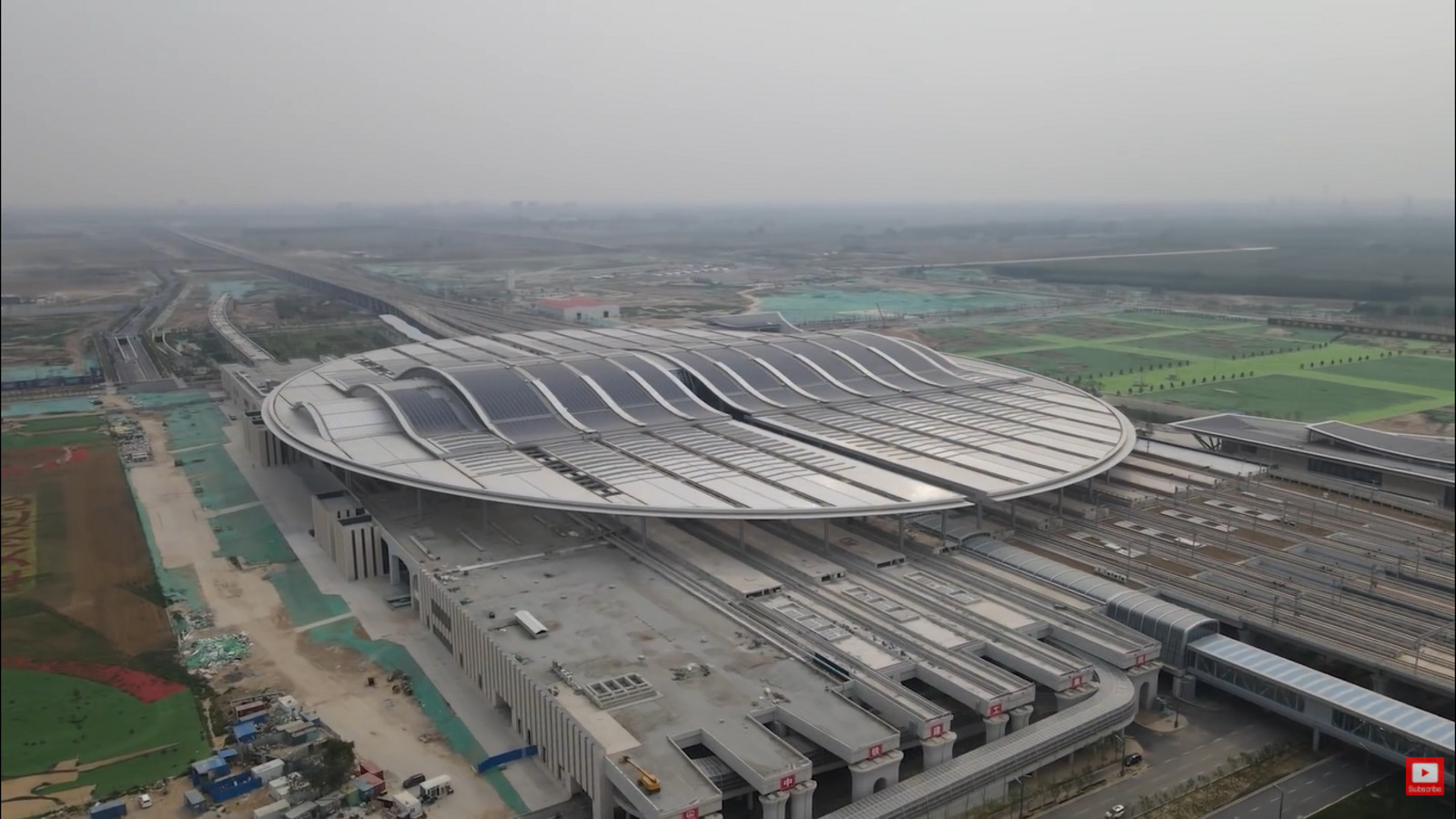


Built in just two years near Beijing, the Xiong’an station covers 475,200 m², solar energy, BIM, welding robots, and smart systems to reduce travel and integrate the new Chinese area
In just two years, the Xiong’an railway station, near Beijing, in China, went from concept to completion and was inaugurated in December 2020 as the largest railway station in Asia, featuring smart technology and gigantic dimensions.


Xiong’an project completed in record time
The speed of construction is remarkable. The railway complex was delivered in a very short timeframe for a project of this scale, combining large-scale structure, smart systems, and energy efficiency.
The station was officially opened on December 27, 2020, with the departure of the Fuxing C2702 bullet train. It began operations along with the section between Daxing Airport and the New Area of Xiong’an.
-
Innovative Vertical Cistern Becomes Water Tank in Container Home Amid Pressure Issues, Offering a Compact 1,000-Liter Solution Without a Tower or Underground Tank

-
Rio de Janeiro Traffic Relief: Long-Awaited Change Promises to Cut 15-30 Minutes from BR-040 Commute, Easing Access to Avenida Brasil.

-
China Installs Massive Domes Over Urban Construction Sites, Blocking Up to 99% of Dust

-
Brazil’s Minas Gerais Government Signs Agreement for Ring Road to Divert Heavy Trucks Away from Urban Center




The project was considered the first major infrastructure project of the new area, created to accommodate non-essential functions of Beijing and strengthen regional integration between Beijing, Tianjin, and Hebei.

Largest railway station in Asia
The Xiong’an railway station has 475,200 m² of built area, equivalent to 66 football fields. The area was also compared to three central stations in Berlin.
Despite the enormous scale, the construction took only two years and resulted in a world-class transportation hub, delivered in record time.
The building is shaped like a dewdrop on a lotus leaf, combining striking architectural design with the function of a major railway terminal.
Railway reduced travel time
The station is part of the Beijing-Xiong’an intercity railway, with about 91 km to 92.79 km in length, and was designed for a maximum speed of 350 km/h.
With the operation, the journey between Beijing and Xiong’an has been reduced to about 50 minutes. The travel between Xiong’an and Beijing Daxing International Airport now takes about 19 minutes.
The station was designed to shorten travel times and integrate the new area into the high-speed rail network, enhancing the connection with Beijing and Daxing.

Intelligent technology accelerated execution
During construction, the team prioritized management and quality control. The project used intelligent construction techniques, including cloud computing, the internet of things, big data, and artificial intelligence.
Mobile internet and building information modeling technology, known as BIM, were also applied. This set allowed for 3D and intelligent management in design, construction, and operation.
BIM enabled intelligent beam manufacturing yards, automatic rebar processing, and intelligent railway bed compaction.
The automated production of rebar, after virtual simulation in a 3D environment, increased efficiency by 25%.
The structure also extensively used exposed concrete, with a single molding and concreting process.
Automatic robots were used in the metal structure to standardize welding and reinforce industrial methods in execution.
Solar energy and real-time management
The Xiong’an station was also planned with a green focus. The oval roof functions as a photovoltaic generation system, with 42,000 m² of solar panels.
The plant can generate, on average, 5.8 million kWh per year. The system allows for a reduction of 4,500 tons of CO₂ and saves 1,800 tons of standard coal annually.
The connection to the network occurred on December 25, 2020, two days before the official start of operation. The station also has energy self-sufficiency for lighting and 15-meter solar light strips.
These strips enhance natural lighting in the waiting hall. The complex also uses platform walls with sound insulation and artificial intelligence for real-time building management.
With information from Emerald.