






 Portuguese
  Spanish


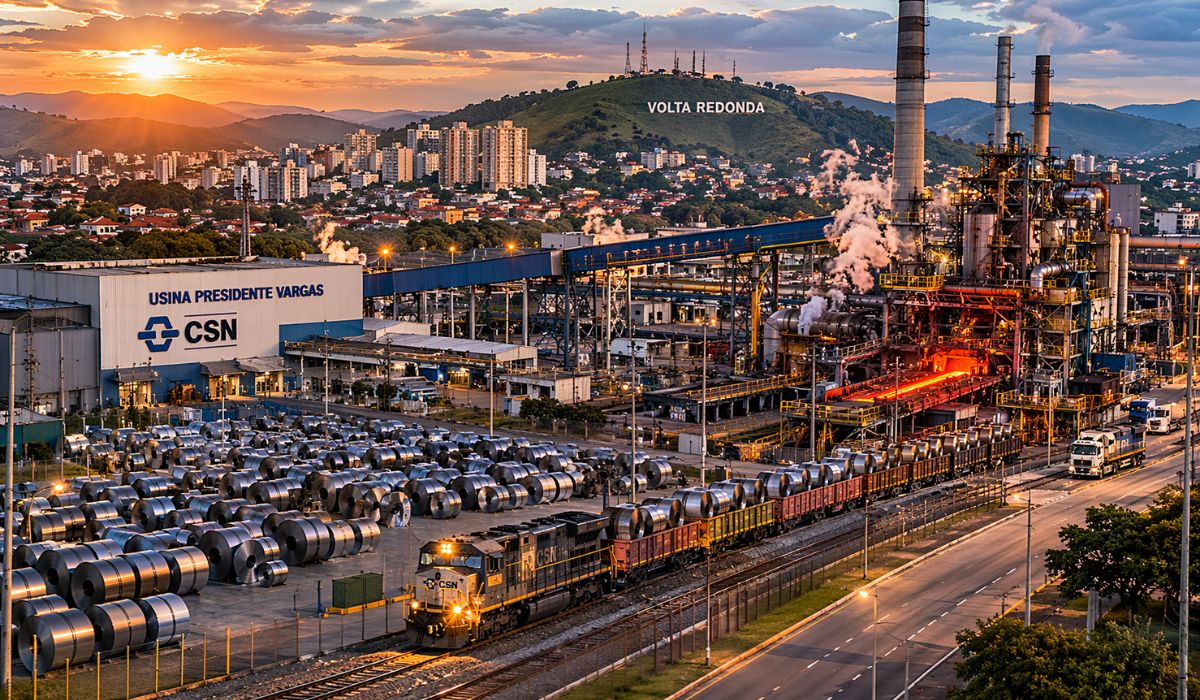

Between power plant, tracks, and urban expansion, Volta Redonda established itself as a symbol of Brazilian heavy industry and still today concentrates a relevant part of national steel production.
Volta Redonda remains at the center of Brazilian steelmaking because its urban, economic, and industrial history developed around the Presidente Vargas Plant of CSN.
The unit has a installed capacity of 5.6 million tons per year.
According to the most recent data consolidated by the Instituto Aço Brasil, the country produced 33.88 million tons of crude steel, while the state of Rio de Janeiro accounted for 8.627 million tons.
-
A Dutchman created a ‘box’ that makes trees grow in the desert almost without water and without irrigation: the invention has already brought seedlings to dozens of countries and achieves up to 90% survival where common planting did not exceed 10%.

-
Abandoned warehouse hid a giant collection of rare computers, with over 2,000 artifacts from the 1930s to the 1980s.

-
Scientists warn that melting ice is triggering an alarming chemical transformation in preserved areas, and the first signs are already concerning researchers worldwide.
-
China placed 198 robotic legs under a 7,600-ton school and made the building walk 62 meters in 18 days, rotating the historic structure as if a concrete structure had gained feet to escape demolition.





These numbers help to gauge the significance of a city that grew connected to steel and that, decades after the plant’s establishment, remains integrated into the industrial chain of the sector.
More than just hosting a large steel plant, Volta Redonda has structured itself around three fronts that explain its permanence on this map: production, logistics, and technological modernization.
It was this combination that transformed the municipality into a historical reference of Brazilian industry and maintained its relevance over time.
How Volta Redonda became centered around steel
Steel production in Volta Redonda officially began in 1946, with the inauguration of Blast Furnace I.
Since then, the city has expanded neighborhoods, services, public facilities, and infrastructure directly linked to the routine of the plant.
The impact was not limited to the factory space.
With the establishment of Companhia Siderúrgica Nacional, the municipality gained a new economic and urban rhythm, attracting workers, increasing housing availability, and consolidating a dynamic associated with heavy industry.
Records from CSN itself show that the company incorporated, throughout its formation, the mines of Casa de Pedra in Congonhas and Arcos in Minas Gerais.
This structure ensured the supply of inputs such as iron ore, limestone, and dolomite for the steel chain linked to the Fluminense plant.
At the same time, urban growth accompanied this industrial expansion.
Institutional materials and historical records of the municipality indicate that the occupation of the territory was reorganized to meet production, transportation, and housing linked to work in steelmaking.
Production, logistics, and technology shape the steel pole
The most visible base of this arrangement is the steel production.

CSN maintains its main operational hub in the sector in Volta Redonda, manufacturing flat steels and products aimed at areas such as industry, construction, and consumer goods.
Around this activity, the group also operates in an integrated manner in mining, logistics, and energy.
This model reduces dependencies in relevant stages of the chain and connects the plant to other strategic fronts of the business.
The second base is logistics.
Even before the consolidation of the industrial city, the region already occupied an important position in the axis between Rio de Janeiro, Minas Gerais, and São Paulo, first through routes linked to the Paraíba do Sul River and later by railway.
With the arrival of CSN, this advantage gained scale.
Rail and road transport began to play a direct role in both supplying the plant and in the distribution of production, reinforcing Volta Redonda’s connection with the main economic corridors of the Southeast.
The third base is technological.
According to the company, the operation in Volta Redonda integrates a chain that goes from the extraction of ore to the production of coated, galvanized, pre-painted steels, metal sheets, and long steels.
In addition, the company maintains the CSN Inova platform, created in 2018, focused on technological solutions and the Industry 4.0 agenda.
As a result, automation, data integration, and process monitoring have increasingly occupied space in the local steelmaking routine.
What existed in the territory before the Steel City
The importance of Volta Redonda does not begin at the plant.
The area where the municipality is located also has its own geological context, described in studies and local technical materials as part of the Volta Redonda sedimentary basin, with formations of sandstones and claystones within the Continental Rift of Southeast Brazil.
This framework helps to situate the city in the Paraíba Valley.
Still, there is no solid basis to assert that the local geology alone determined the establishment of steelmaking.
The creation of CSN was linked to Brazilian industrial policy and state planning in the first half of the 20th century.
In the historical field, municipal documents record the presence of indigenous peoples, among them puris, acaris, and coroados, before colonial occupation.
This data shows that the territory had human occupation long before the formation of the industrial city, although the consulted material does not establish a direct relationship between this past and the implementation of the plant.
Urban planning helped shape the identity of Volta Redonda
The transformation of Volta Redonda also went through urban planning.
Records from the municipality and the local tourism sector indicate that the urban planner Attilio Corrêa Lima participated in the design of the worker city aimed at housing CSN workers, with housing and services linked to the new economic dynamics.
This model ensured that urban growth followed the structure of production.
Instead of spreading out in a disorganized manner, the city began to organize around residential areas, public facilities, and roads associated with industrial daily life.
It was in this process that the local identity linked to steel was consolidated.
The nickname City of Steel, recurring in institutional materials and in journalistic coverage, arises precisely from this link between the plant and the economic formation of the municipality.
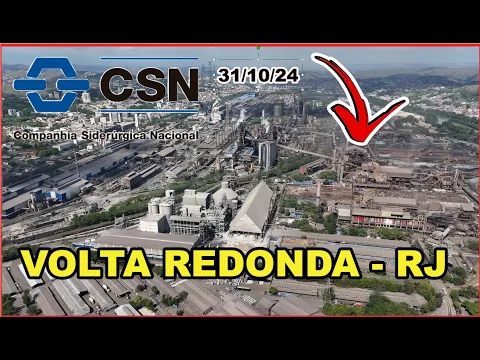

Environmental modernization keeps the plant at the center of the sector
Today, Volta Redonda’s permanence on the steelmaking map also involves environmental and technological demands.
CSN reports that the Presidente Vargas Plant has ISO 14001 certification and operates with real-time monitoring of emissions and air quality through nine stations installed in the city.
The company also claims to develop actions aimed at decarbonization and monitoring greenhouse gas emissions.
This type of investment has increasingly gained weight in the base industry, especially in large-scale and high operational intensity sectors.
On another front, BNDES approved R$ 1.13 billion to make the Volta Redonda plant more sustainable.
According to the bank, the resources include machinery, equipment, and technology services related to digitalization and the Internet of Things.
In practice, this shows that the current relevance of the complex does not depend solely on its historical trajectory.
It is also associated with the ability to update processes, maintain competitiveness, and respond to the new demands surrounding the steel industry.
Volta Redonda has reached the present with its productive structure still linked to CSN, a consolidated logistics network, and a modernization agenda underway.
This set of factors helps explain why the municipality remains one of the main points of Brazilian steelmaking and why its trajectory still sparks interest when the topic is industry, infrastructure, and development.





