






 Portuguese
  Spanish
  4 min of reading
  0 comments


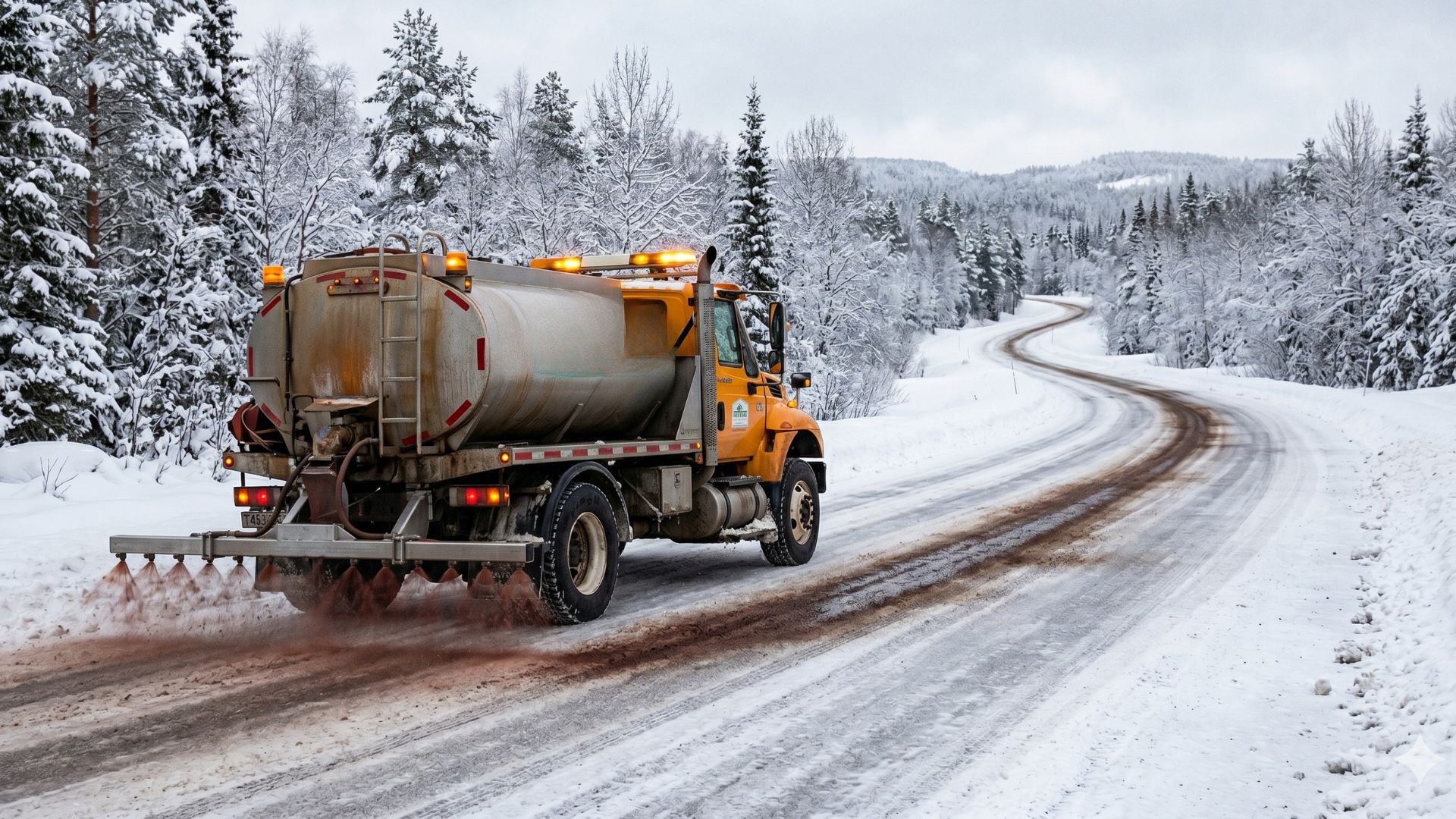
Lack of road salt in Massachusetts reignites debate on pickle juice, molasses, and beer residue as less aggressive alternatives for road de-icing.
According to WBUR, in mid-February 2025, after a series of heavy snow, rain, and ice in western Massachusetts and throughout New England, stores ran out of road salt and municipalities themselves began to lose stock. In Chicopee, a delay of several days in the delivery of 40 tons of de-icer created difficulty in street cleaning, and city trucks had to go to Albany, New York, to fetch regular salt. The crisis exposed a larger problem. According to the Pioneer Valley Planning Commission, Massachusetts uses about 500,000 tons of salt per year just for road treatment, and this volume is already associated with increased salinity in the region’s surface and groundwater.
In this context, pickle juice, molasses, and beer by-products have moved from curiosity to becoming a stronger part of the debate on winter alternatives.
Pickle juice and molasses work because they lower the freezing point of water
According to WBUR, the physical principle behind road salt is freezing point depression. When an ionic substance dissolves in water, the freezing point of the solution drops below zero, which allows ice to melt and makes it harder for new frozen patches to form.
-
She panicked when she saw her daughter fall from the crib; years later, she turned the experience into a factory generating R$ 9 million per year.

-
At 75 years old, João José de Carvalho, known as Mr. Janjão, was accepted for the second time by Sisu after overcoming distance, physical limitations, and years away from school, to fulfill his dream of studying Biological Sciences at UFPI.

-
A thrift store that started with children’s clothes and a loan from grandma turned into a network worth R$ 300 million per year: Peça Rara grew to 130 stores, sold 4 million items, and transformed used items into a national circular economy business.

-
The German fund created to compensate victims of Nazi forced labor paid billions, but the responsible parties themselves admit that the money did not come close to compensating 26 million people.





State geologist Brian Yellen explained that pure water freezes at 32 degrees Fahrenheit, but a solution of water and salt freezes at lower temperatures.
The problem is that regular salt loses efficiency below about minus 9°C, a limit where its performance drops significantly.
According to WBUR, pickle juice contains vinegar, salt, and organic compounds that help lower the freezing point to lower temperatures. Molasses is rich in sugars and mineral salts, while beer residue may contain residual alcohol, fermented sugars, and salts with a similar effect.
Road salt is salinizing rivers, lakes, and aquifers in Massachusetts
According to WBUR, the big problem is that the salt used on roads does not stay on the roads. It runs off into rivers, lakes, streams, and aquifers that supply cities, increasing the salinity of the water over time.
NEIWPCC states that the salinity of Massachusetts’ rivers and lakes has been consistently increasing over the past decades, correlating with the expansion of road salt use. Since sodium chloride does not biologically degrade nor is it easily absorbed by the soil, it tends to persist and accumulate.
According to WBUR, this accumulation affects freshwater fish, amphibians, and invertebrates, as well as compromising the quality of drinking water. The paradox is straightforward: the state uses salt to keep roads safe in winter, but in doing so, it puts pressure on the very water resources that the population consumes.
Other American states already use beet juice, molasses, and cheese brine
According to WBUR, Massachusetts is not discussing these alternatives in a vacuum. Other American states have been using mixtures with beet juice, molasses, cheese brine, pickle brine, and brewery waste for road treatment for years.

New Jersey and North Dakota adopt mixtures with beet juice. New Hampshire and Maine use molasses. Wisconsin uses cheese brine. According to the report, these combinations do not completely eliminate salt but help reduce consumption and improve the product’s adherence to cold asphalt.
The operational logic is to pre-treat roads with organic liquids before storms. Since these materials adhere better to asphalt, the use of solid salt during and after the event can decrease.
Salt still dominates in Massachusetts due to cost and logistics
According to WBUR, even with documented environmental issues and examples from other states, road salt continues to dominate in Massachusetts due to two central factors: price and logistics.

Salt costs between $50 and $80 per ton, while alternative de-icers vary more and require different infrastructure. Municipalities accustomed to working with solid salt would need to store liquids in large volumes and adapt trucks with spraying systems.
Moreover, suppliers of molasses, brewery waste, or brine do not have the same network of contracts and consolidated delivery that the salt market has built over decades. In other words, the obstacle is not only technical but also operational and institutional.
The real cost of road salt goes beyond the price per ton
According to WBUR, the discussion became more serious because some experts began to look not only at the direct price of salt but at its total hidden cost. State geologist Brian Yellen summarized the dilemma by saying that it is necessary to balance driver safety with environmental protection.
This invisible cost includes salinization of aquifers, damage to roadside vegetation, corrosion of bridges and metal structures, and increased pressure on drinking water treatment systems. When this package is considered, organic alternatives that seem more expensive per liter start to appear more competitive.
According to WBUR, the February 2025 crisis did not solve the problem, but it pushed public managers in New England to ask a question that had been postponed: what happens to the roads, and the water, when the salt runs out.






-

-

-

-

-

-

10 people reacted to this.