Portuguese
  Spanish


In the city of Baoding, in northern China, a 46,000-ton and 263.6-meter bridge was precisely rotated over the Beijing–Guangzhou Railway. The maneuver, completed in 68 minutes, broke world records for weight and span for a rotating structure, all without interrupting the trains.
There are works that impress by size and others that impress by boldness. The bridge rotated in Baoding, in Hebei province, northern China, combines both: it is 46,000 tons of concrete and steel that were literally spun in the air until they fit over a railway line that could not stop functioning. According to the portal CGTN and the China Daily newspaper, the feat set new world records.
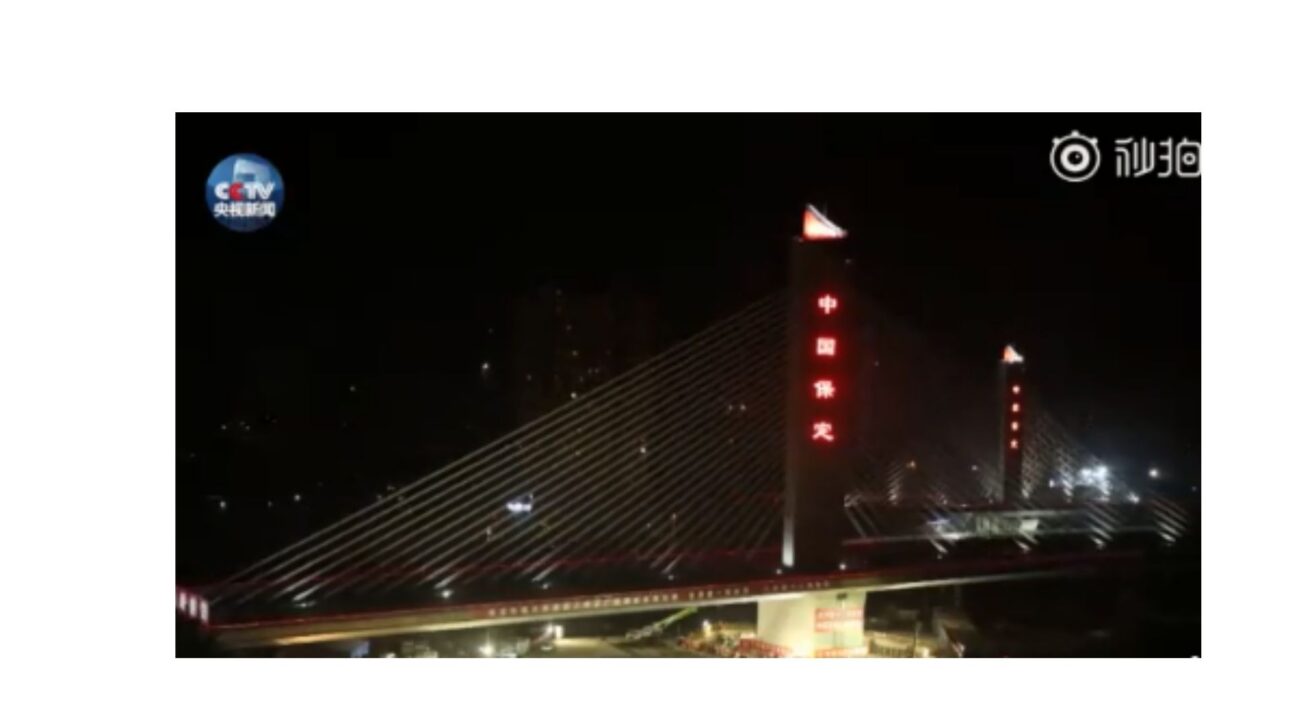
The scene, which seems straight out of an engineering movie, happened on Tuesday, July 30, 2019. In just over an hour, a structure the size of a laid-down building slowly slid over the Beijing–Guangzhou Railway until it assumed the exact position planned in the project while trains continued passing right below, almost without noticing what was happening above their heads.
The 52.4-degree rotation that fit 46,000 tons over the tracks
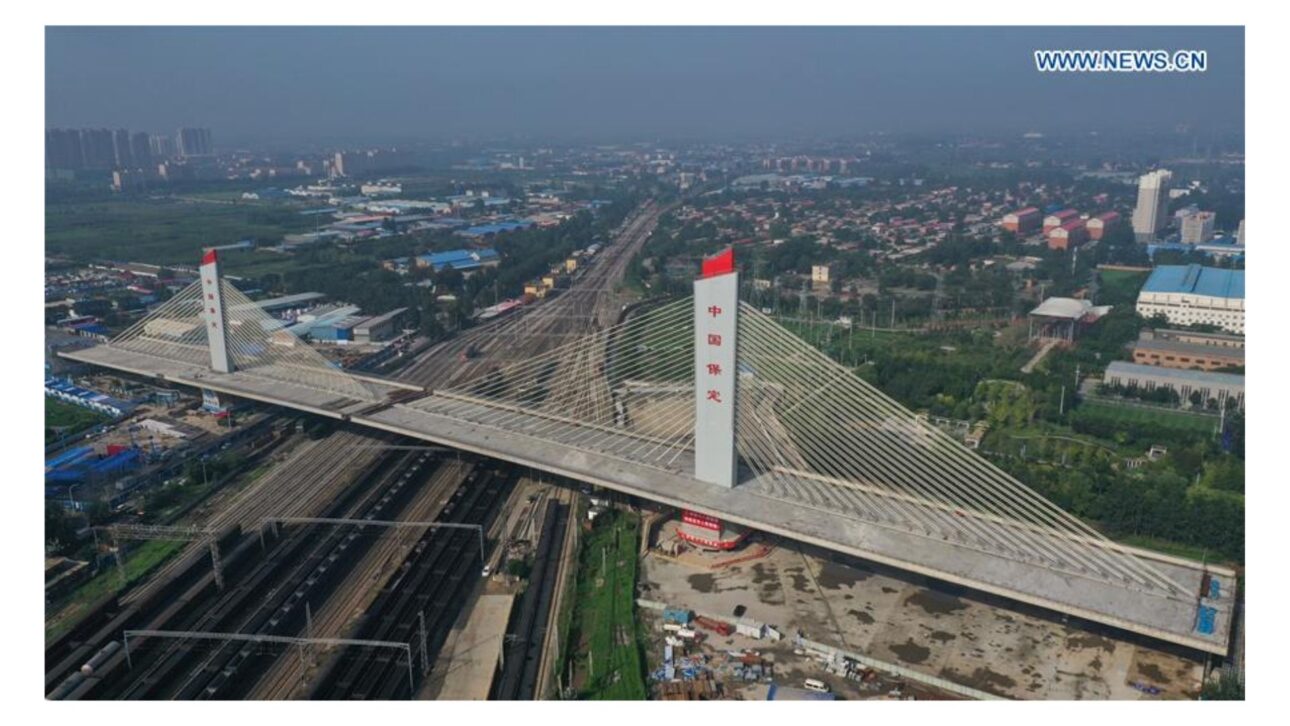
The number that sums up the feat is precise: the bridge rotated exactly 52.4 degrees in 68 minutes, until it settled over the Beijing–Guangzhou Railway, one of the busiest in all of China. The operation was conducted in Baoding, in Hebei province, and minimized interference with the rail traffic running below as much as possible.
-
The only country that is actually ending homelessness: Finland provides the apartment FIRST, without demanding anything in return.

-
Senna Tower has already consumed concrete and steel to erect two 50-story buildings, with 798 piles up to 40 meters, 1,600 tons of ice, and unprecedented technology that reduced the foundation time from 120 to 70 working days in Balneário Camboriú for the tallest residential building in the world.

-
A 350 km/h bullet train will connect Kenitra to Marrakech in a $10 billion plan in Morocco, reducing the trip to Tangier to 2h40 and taking passengers from Rabat to Casablanca airport in 35 minutes before the 2030 World Cup with 168 trains.
-
Advancements in construction materials place thermal tiles among the main solutions for tackling high temperatures, offering superior insulation and a direct impact on the comfort and energy efficiency of homes.


The official data gives the scale of the challenge. The structure is 263.6 meters long and weighs 46,000 tons, equivalent to thousands of stacked cars. Moving it required absolute control: any deviation of a few centimeters would compromise the final fit and endanger the safety of the railway just below.
The most impressive thing is the contrast between the colossal weight and the delicacy of the maneuver. The bridge was neither lifted nor pushed haphazardly: it was rotated like a clock hand, supported on a central axis, until its two ends met exactly the pillars waiting for it on the other side of the railway.
Why China Rotates Entire Bridges in the Air
The question that arises is simple: why not build the bridge in its final position? The answer lies precisely in the railway below. Assembling the structure directly over active tracks would require stopping train circulation for long periods, something unthinkable on such a busy line.
That’s why engineers resorted to the so-called rotational construction method. The idea is ingenious: the bridge is erected in a position parallel to the track, away from train flow, and only at the end is it rotated to fit into its final place. Thus, almost the entire construction takes place without touching the railway.
According to sources, China has been adopting this technique in the construction of many bridges. The method helps overcome environmental and traffic restrictions and also reduces the total construction time — a valuable combination in a country that builds infrastructure at an accelerated pace and cannot afford to halt its major transportation arteries.
The 6.5-Meter Spherical Hinge: The Axis of Everything
All this engineering depends on a central piece, almost invisible to the outside observer. It is the spherical hinge, the “axis” that supports the rotating body of the bridge and allows a mass of 46,000 tons to rotate smoothly.
In this project, the component also made history. The spherical hinge used reached 6.5 meters in diameter, a new world record for this type of structure. It is on this that all the weight balances and slides during rotation.
Think of the piece as the center of a massive controlled spinning top. It is this pivot point that transforms a rigid and extremely heavy block into something capable of rotating millimeter by millimeter, under the engineers’ command, until it stops exactly where it needs to stop. Without it, the maneuver would simply not be possible.
68 minutes between the passage of one train and another
In a project like this, time is not just a detail: it is part of the challenge itself. The complete rotation took 68 minutes, a short and carefully planned window to minimize the impact on train circulation on the Beijing–Guangzhou Railway.
Every minute was calculated. Rotating a 46,000-ton bridge too quickly would be dangerous; too slowly, unfeasible given the intense railway traffic. The pace needed to balance safety and speed, keeping the structure under absolute control from start to finish of the movement.
It was this precision that allowed for the most surprising result of all. The railway below continued operating, with minimal interference in traffic, while the gigantic structure moved well above the tracks. What might seem impossible to many was resolved in just over an hour.
Two world records in a single maneuver
The Baoding bridge did not make history for a single reason, but for several at the same time. The weight and span of the rotating structure set a new world record, surpassing previous marks for this type of construction.
To these achievements is added the central piece. As already seen, the 6.5-meter diameter spherical hinge also broke the world record, reinforcing the unprecedented nature of the project. Two historical milestones, therefore, were born from a single operation.
It’s not just about collecting records out of vanity. Each mark represents a technical limit pushed a little further, paving the way for even larger and heavier structures to be built and rotated in the future with the same logic over difficult obstacles.
Who designed and built the structure
Behind the achievement is one of the major Chinese infrastructure contractors. The bridge was built by the southern branch of China Construction Communications Engineering Group Corporation, responsible for conducting each stage of the work up to the final rotation.
Projects like this involve months of preparation, exhaustive calculations, and rigorous testing before the big moment. The 68-minute rotation is just the visible part of work that begins much earlier, with the design of the structure, the assembly of supports, and the installation of the spherical hinge.
The success of the maneuver also carries symbolic weight. It shows the degree of maturity that Chinese engineering has achieved in bridge construction, especially in situations where it is necessary to overcome obstacles like railways, highways, and rivers without interrupting what is already in operation.
The Beijing–Guangzhou Railway, a line that cannot stop
To understand the size of the challenge, it’s necessary to look at what was running under the bridge. The Beijing–Guangzhou Railway is among the busiest in China, cutting across the country and connecting the capital, Beijing, to the south, in the Guangzhou region.
A line like this carries a huge volume of passenger and freight trains every day. Interrupting this flow, even for a few hours, would generate chain effects across much of the railway network, affecting travel and merchandise transport in various regions.
This is exactly the scenario that makes the rotating method so valuable. By building the bridge next to the track and only rotating it at the end, the construction preserves the railway’s operation and avoids disruptions that would spread far beyond Baoding. The technique is not only ingenious: it is a solution designed for the real world.
A technique that China has been mastering
The Baoding bridge is not an isolated case, but part of a larger trend. China has frequently resorted to the rotating construction method in different bridges, perfecting the technique with each new project carried out in the country.
This repetition does not happen by chance. The more the technique is applied, the more engineers learn to control variables such as weight, balance, rotation speed, and material behavior, making each maneuver safer and more predictable than the previous one.
The practical gain is evident. Mastering the rotation of large structures allows construction over railways, avenues, and waterways without paralyzing what already works — a huge advantage for a country that continues to expand roads, railways, and urban connections on a large scale.
Millimetric precision: how to get such a rotation right
Rotating 46,000 tons may seem like brute force, but the secret lies in the opposite: fine control. Each degree of rotation needs to be monitored so that the two halves of the bridge fit exactly on the pillars on the other side of the railway.
That’s why such a construction combines heavy engineering with meticulous measurement. A small angle error, multiplied over more than 260 meters of structure, would turn into a dangerous misalignment at the end — hence the need to monitor the movement centimeter by centimeter.
When everything goes right, the result has the elegance of a clock. The ends meet the planned supports, the rotation stops at the exact point, and the structure assumes its final shape, ready to receive, later on, the traffic that will pass over it.
What this bridge reveals about modern engineering
More than just a record, the Baoding bridge serves as a portrait of where the construction of large works is heading. The priority is no longer just to erect structures but to build them without halting life around them, whether it’s traffic or a strategic railway.
This type of solution tends to spread. As cities become denser and transportation networks more interconnected, the need to build without interrupting what already exists grows — and methods like rotation become increasingly in demand.
In the end, the image of a 46,000-ton bridge slowly rotating over moving trains carries a clear message. The most impressive engineering might not be the one that is visible, but the one that solves major problems without anyone needing to stop for it to happen.
A feat that still resonates in engineering
Years later, the Baoding rotation continues to be cited as a reference when it comes to large-scale rotating construction. The project combined, in a single work, the records of weight, span, and spherical hinge, something rare even in a country accustomed to surpassing its own limits.
Such cases help to understand why China has become a powerhouse in infrastructure. It’s not just the number of works, but the willingness to test bold techniques to solve concrete problems, turning each challenge into an opportunity to advance technically and set new global standards.
And you, what did you think of this rotating bridge?
From a 46,000-ton structure rotated in the air to a millimetric fit over one of the busiest railways in the world, the Baoding bridge shows how far engineering can go when precision and boldness walk together.
And you, had you ever imagined it was possible to rotate an entire bridge without stopping the trains? Do you think we would see such a work here? Tell us in the comments what surprised you the most in this story and tag that friend who is passionate about engineering.