Portuguese
  Spanish


The giant dredger Galileo Galilei, with 166 meters and capacity for 18 thousand cubic meters per trip, arrives in Navegantes to widen Gravatá Beach by up to 70 meters. The project, costing R$ 31.5 million, will operate 24 hours a day and completely close the beach.
A true floating city of steel is on its way to the coast of Santa Catarina. The giant dredger Galileo Galilei, one of the largest vessels of its kind operating in Brazil, has been assigned to transform Gravatá Beach in Navegantes, on the Northern Coast of Santa Catarina. According to the portal NSC Total, the ship is expected to arrive in the state later this week to begin work.
The mission is ambitious: to widen by up to 70 meters a strip of sand that is currently almost nonexistent in some sections. For this, the operation will cost R$ 31.5 million, operate non-stop 24 hours a day, and keep the beach completely closed to the public, a radical change in the routine of residents and tourists in the region.
The giant dredger on its way to Santa Catarina
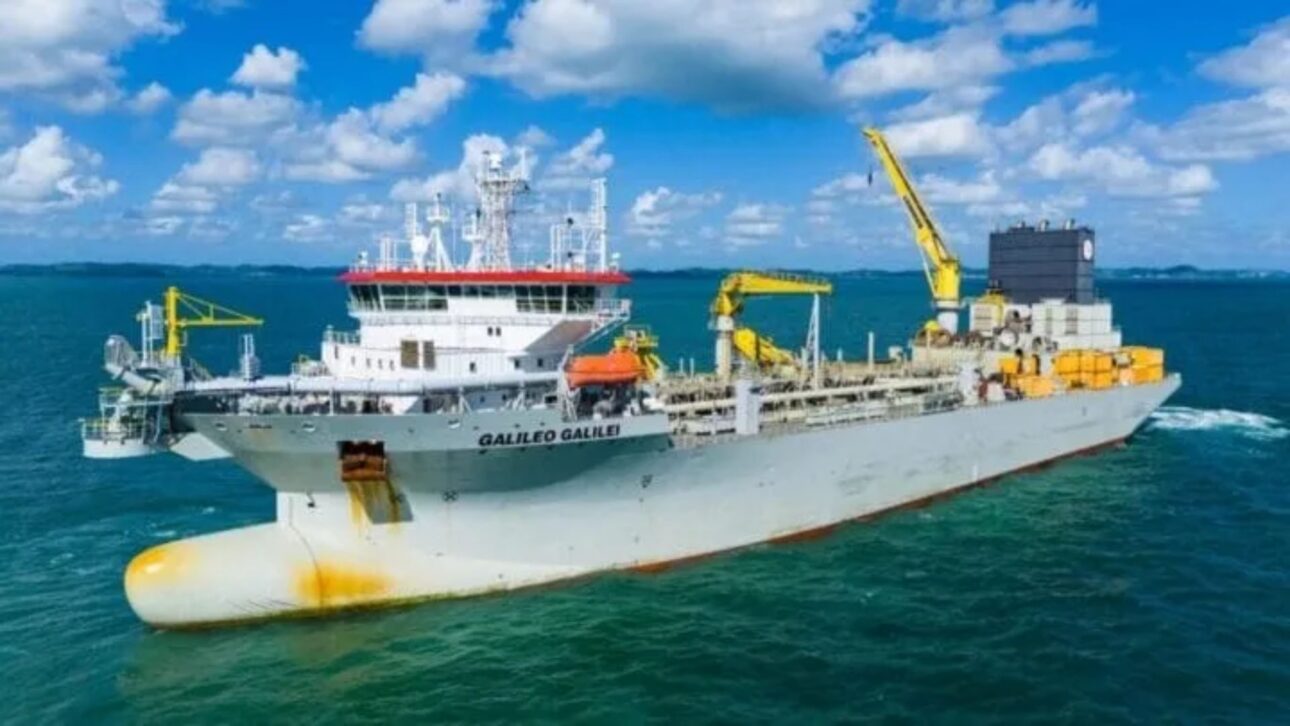
The protagonist of this project is the giant dredger Galileo Galilei, operated by the Belgian company Jan de Nul, considered one of the largest maritime engineering companies in the world. The vessel is expected to arrive in the waters of Santa Catarina later this week to begin the widening of Gravatá Beach.
-
New York clears almost 500,000 m³ of earth, raises a park equivalent to 26 football fields by up to 3 meters, and hides a 2.4 km wall inside to protect 110,000 people from the advancing water.

-
Couple lifts the floorboards in the living room to replace a simple heater and discovers a secret 3-meter abyss hidden for over 100 years beneath their own house.

-
Chinese engineers rotated a 46,000-ton bridge in the air by 52.4 degrees in just 68 minutes, fitting it over one of the country’s busiest railways without interrupting the trains passing right below.
-
The only country that is actually ending homelessness: Finland provides the apartment FIRST, without demanding anything in return.


This is not the first time the ship has appeared here. The same dredger has already worked on the expansion of Central Beach in Balneário Camboriú and the opening of a new navigation route accessing the Port of São Francisco do Sul, making it a familiar presence in major projects on the coast of Santa Catarina.
The schedule is tight. According to the city hall of Navegantes, the dredging operation is scheduled to start between Wednesday, the 15th, and Thursday, the 16th of July 2026, as soon as the vessel is positioned and the support structure is completed. From there, the race to rebuild the sand strip begins.
A 166-meter ship built in China
The vessel’s numbers help to understand why it is called a giant. The giant dredger measures 166 meters in length and 36 meters in width, dimensions that place it among the large naval structures that have passed through the Santa Catarina coast.
The technical specifications reinforce its size. Built in China in 2020 and registered under the flag of Luxembourg, the ship is classified as a Hopper Dredger, a self-propelled suction dredger capable of removing, carrying, and dumping sediments on its own, without relying on other vessels to complete the service.
The cargo capacity is impressive. On each trip, the Galileo Galilei can transport up to 18,000 cubic meters of sand and sediments, equivalent to thousands of cargo trucks. Registered under the IMO number 9872365, it is equipped with modern navigation and environmental monitoring systems and travels the world on coastal engineering and channel maintenance projects.
How a giant suction dredger works
Behind the nickname of giant is an ingenious and relatively simple process to understand. To operate, the dredger’s suction tubes are lowered to the seabed, where the groundwork begins that will give rise to the new beach.
From there, the power of the pumps comes into play. A pumping system removes a mixture of sand and water from the seabed, which is sucked through the tubes and conducted into the vessel, in a continuous flow while the dredger remains in operation.
The destination of this material is a specific compartment. The sand is stored in an internal reservoir called a hopper and, in the widening works, is deposited directly on the beach’s sand strip. It is this cycle of sucking, storing, and dumping that, repeated countless times, reconstructs the shoreline meter by meter.
The mission: widen Gravatá Beach by up to 70 meters
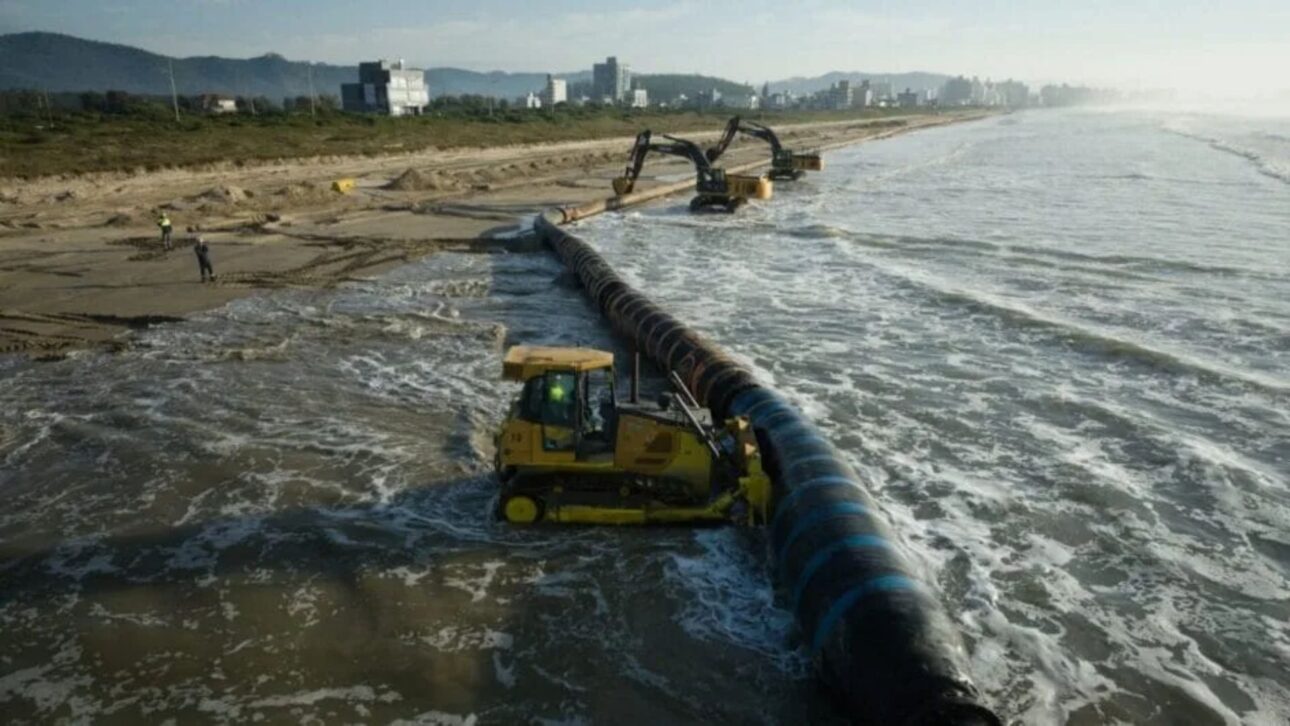
The central objective of the project is to return a strip of sand to Gravatá Beach that the sea has been taking away over the years. The goal is to reach an extension of up to 70 meters in a section where, today, the sand is almost nonexistent in several points.
The intervention is of considerable scale. The dredging will operate along 2.3 kilometers, between the area near the Rio das Pedras and the Gravatá Jetty, covering practically the entire shoreline that needs to be restored in this stage of the project.
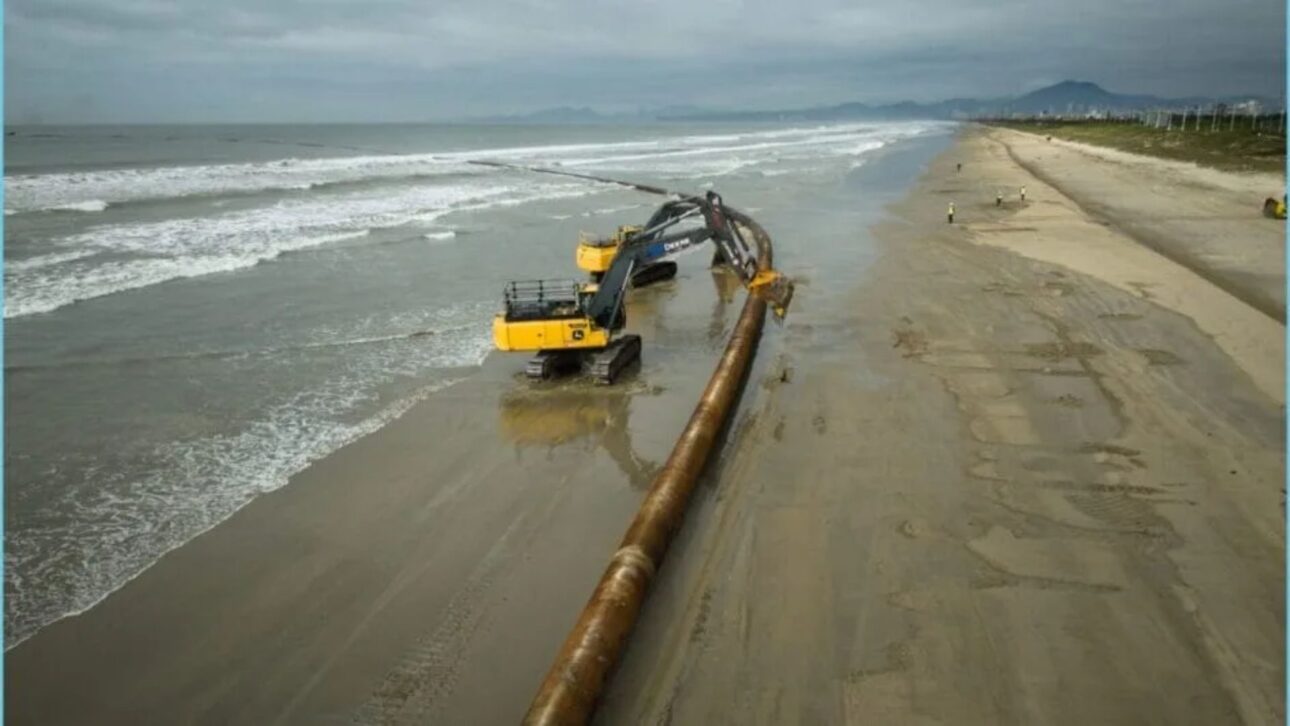
The investment matches the size of the challenge. The project has R$ 31.5 million in public funds and promises to completely transform the local landscape, creating a sand strip wide enough to change the city’s relationship with its main beach.
24 hours a day: the operation that will not stop
When the giant dredger starts working, it will not rest. According to the city hall, the expectation is that the dredging will occur uninterrupted, 24 hours a day, to make the most of each operational window of the vessel.
The accelerated pace has a practical reason. It is estimated that this stage will be completed within 15 days after the start of work, a short deadline for the volume of sand that needs to be moved along the 2.3 kilometers of beach.
Operating without pause requires heavy logistics. Keeping a vessel of this size running day and night involves work shifts, constant monitoring, and meticulous coordination, all to ensure that the sand is removed from the sea and deposited on the shore without interruptions that delay the schedule.
The preparatory phase: 1.5 km of piping in the sea
Before the dredger comes into play, it was necessary to set up the structure that will carry the sand to the beach. On Monday, July 6, 2026, teams began installing about 1.5 kilometers of piping in the sea, a fundamental step for the operation’s functioning.
This piping system plays a decisive role. It is through it that the sand removed from the seabed will be transported to the shore of Gravatá Beach, connecting the vessel’s work to the exact point where the sand strip will be rebuilt.
Without this preparation, nothing would happen. The placement of the piping is what allows the giant dredger to deposit the material in a controlled manner, directing the sand to where it really needs to go, instead of simply returning it to the sea.
Beach closed: what changes for residents and tourists
The good news of the new stretch of sand comes with an important restriction. Throughout the execution of the work, and also for ten days after the completion of the sand placement, Gravatá Beach will be completely closed to the public.
The prohibition is broad and makes no exceptions. Swimming, walking, fishing, and any other type of activity are prohibited on the shore, precisely during the period when heavy machinery will be in full operation along the beach.
The recommendation applies to everyone. The city council’s guidance is that no one enters the area until it is officially released, to avoid accidents in an environment that, during the work, ceases to be a leisure space and becomes an open-air construction site.
Why the closure is a safety issue
The closure is not a bureaucratic exaggeration, but a measure to protect life. According to the Infrastructure Secretary, Roberto Ferreira, the site becomes dangerous precisely because of the machinery in operation. “It’s a construction environment with heavy machinery, meaning it’s not a safe place for people to pass”, he stated.
The risk continues even after the sand is deposited. According to the secretary, a settling period is necessary until the ground becomes firm, and anyone stepping on the newly formed strip may sink and get stuck. “While this happens, the ground is not firm, and the person can get trapped, posing a life risk,” he warned.
Therefore, the reopening will be careful. The reopening of Gravatá Beach, after the completion of all stages, will be the responsibility of the Municipal Fire Department, which will assess when the space is safe to welcome the public again.
A veteran of Santa Catarina’s beaches
The choice of Galileo Galilei is not by chance. The giant dredger is already a well-known figure on the coast of Santa Catarina, having participated in some of the largest coastal engineering works carried out in the state in recent years.
Its resume on the Santa Catarina coast is robust. Besides the widening it will now perform in Navegantes, the vessel has already worked on the enlargement of the Central Beach of Balneário Camboriú, one of the most talked-about interventions of its kind in the country, and on the new navigation route accessing the Port of São Francisco do Sul.
The accumulated experience weighs in favor of the work. Having a vessel already tested in similar projects tends to reduce unforeseen events and provide more predictability to a job that needs to be executed in a short time frame and under continuous operation.
What a widening project solves
Projects like the one at Gravatá Beach are part of a broader strategy of coexisting with the sea. The widening, or nourishment, is a response to coastal erosion, the natural process by which waves and currents consume the strip of sand over time.
Restoring the beach brings benefits beyond the landscape. A wider strip of sand acts as a natural barrier protecting the shoreline, helping to absorb the force of the sea and reduce damage caused by storms and water advances into the city.
There is also the economic and social aspect. Wider beaches benefit tourism, commerce, and leisure for the population, which helps explain why coastal cities have invested in such projects, even when they require temporary closures and million-dollar budgets.
What to expect in the coming weeks
With the pipeline installed and the giant dredger on its way, Gravatá Beach enters the final stretch of a long preparation. The coming days should mark the effective start of dredging, with the vessel continuously depositing sand on the shore.
The recommendation, for now, is patience. While the work progresses and the ground settles, the guidance is to respect the closure and wait for the Fire Department’s approval before returning to the beach, even if the new strip of sand already seems ready for use.
And you, have you ever seen one of these giant dredgers in action?


From a 166-meter ship made in China to a strip of sand up to 70 meters wider, the widening of Gravatá Beach promises to be one of the most impressive projects on the Santa Catarina coast in the coming months.
And you, have you ever seen a giant dredger working up close? Do you think it’s worth closing the beach for weeks to widen the strip of sand? Share your opinion in the comments and tag that friend who loves to follow major engineering projects.