





 Portuguese
  English
  Spanish
  3 min of reading


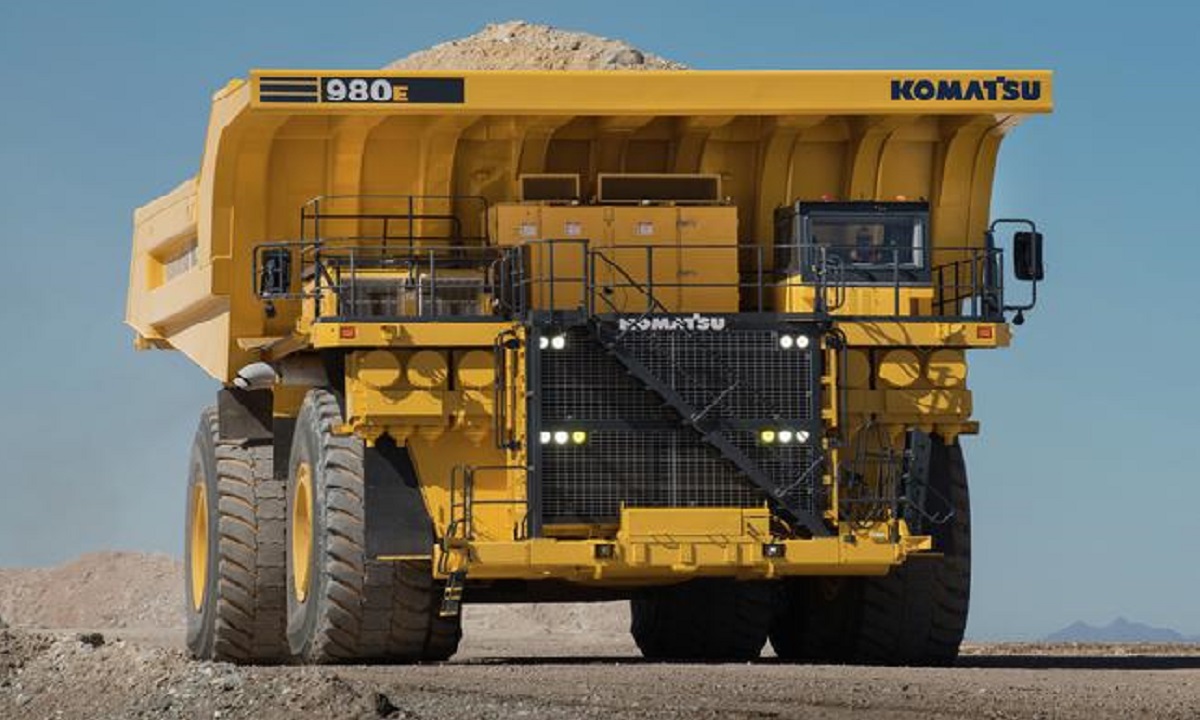
The Komatsu 960E Mining Truck, Which Became Highly Coveted by Mining Companies, Has 3500 Horsepower, 327 Ton Capacity, and Can Be Used in Any Mining Locations
The new Komatsu 960E is one of the largest mining trucks in the world in operation, leaving behind trucks that attract attention for their grandeur, power, and robustness. Unlike those, the new mining truck has a significant presence in the mining sector, allowing no other to take its place.
The mining truck can be used for mining activities on uneven tracks and in hard-to-reach places due to a lack of infrastructure. Also, the mining truck is prohibited from driving on public roads due to its gigantic dimensions, which are abnormal for transportation in urban areas. Because of its heavy weight, the mining truck could damage the asphalt infrastructure within seconds.
More About the New Mining Truck
The new mining truck measures 15.60 meters in length, 7.37 meters in height, and 9.19 meters in width, weighing almost 580 tons. Despite having giant power, the mining truck can reach a maximum speed of 64 km/h, due to its dimensions and weight.
-
The Chinese SUV that promises to travel up to 1,300 km has arrived in Brazil: Geely EX5 EM-i starts from R$ 199,990, does 112 km in electric mode, and will still be produced in Paraná in partnership with Renault.

-
Electric trucks may force companies to put more vehicles on the roads to transport the same load, and the unexpected reason lies in the weight of the batteries.

-
The nuclear submarine that never arrives: The Álvaro Alberto project has accumulated 47 years of development, R$ 40 billion spent since 2008, and may now be delayed until 2037 due to a lack of R$ 1 billion in the Brazilian Navy’s coffers.
-
Residents are trying to prevent electric cars from charging inside buildings due to fear of battery fires, placing condominiums at the center of a dispute between safety, misinformation, and the future of mobility.




Mining and Job Creation: Brazilian Government Opens Process for the Transfer of Three Mining Areas in Four States
The Geological Service of Brazil (SGB-CPRM) has initiated the process for the transfer of three mining areas in Rio Capim (PA), Bom Jardim de Goiás (GO), and Miriri, a region located between Paraíba and Pernambuco. The mineral deposits of Kaolin in Rio Capim, Copper in Bom Jardim de Goiás, and Phosphate in Miriri are already authorized for exploration following the publication of the transfer notice by public agencies.
According to the agency, the main objectives of the mission are to stimulate the growth of the mining industry and encourage investment with a focus on economic development, as well as job creation.
In the process of conducting research and studies on deposits, the federal government hopes to engage private sector participation as part of an effort to incentivize the mining industry. The auction will take place on December 7 in Brasília, starting at 10 a.m. (local time).
Marcio Remédio, Director of Geology and Mineral Resources of the SGB-CPRM, stated that “the notices open potential for investments and job development in these locations.” Recently, he participated in a discussion panel on mining assets that took place at Exposibram 2022 and invited several companies to participate in the auctions.
Get to Know the Three Areas Better
Phosphate in Miriri: The project is for a set of locations in the coastal region of two Brazilian states, Paraíba and Pernambuco, about 45 kilometers (km) north or south of the city of João Pessoa/PB. It extends its jurisdiction over the municipalities of Alhandra and Pedra do Fogo in the state of Paraíba, and Goiana in the state of Pernambuco.
Copper in Bom Jardim: The region is part of a mining asset that spans 1,000 hectares and has in-depth studies of mineralization, as well as resources estimated at 4.5 million tons of ore.
Kaolin in Rio Capim: The notice for the transfer of kaolin ore, which was issued for the municipality of Ipixuna do Pará (PA), was divided into two blocks, which together cover a total area of 10 thousand hectares. It is estimated that the North Block has a total resource volume of 574 million tons of kaolin, while the South Block has 218 million tons of the ore.





Be the first to react!