






 Portuguese
  Spanish


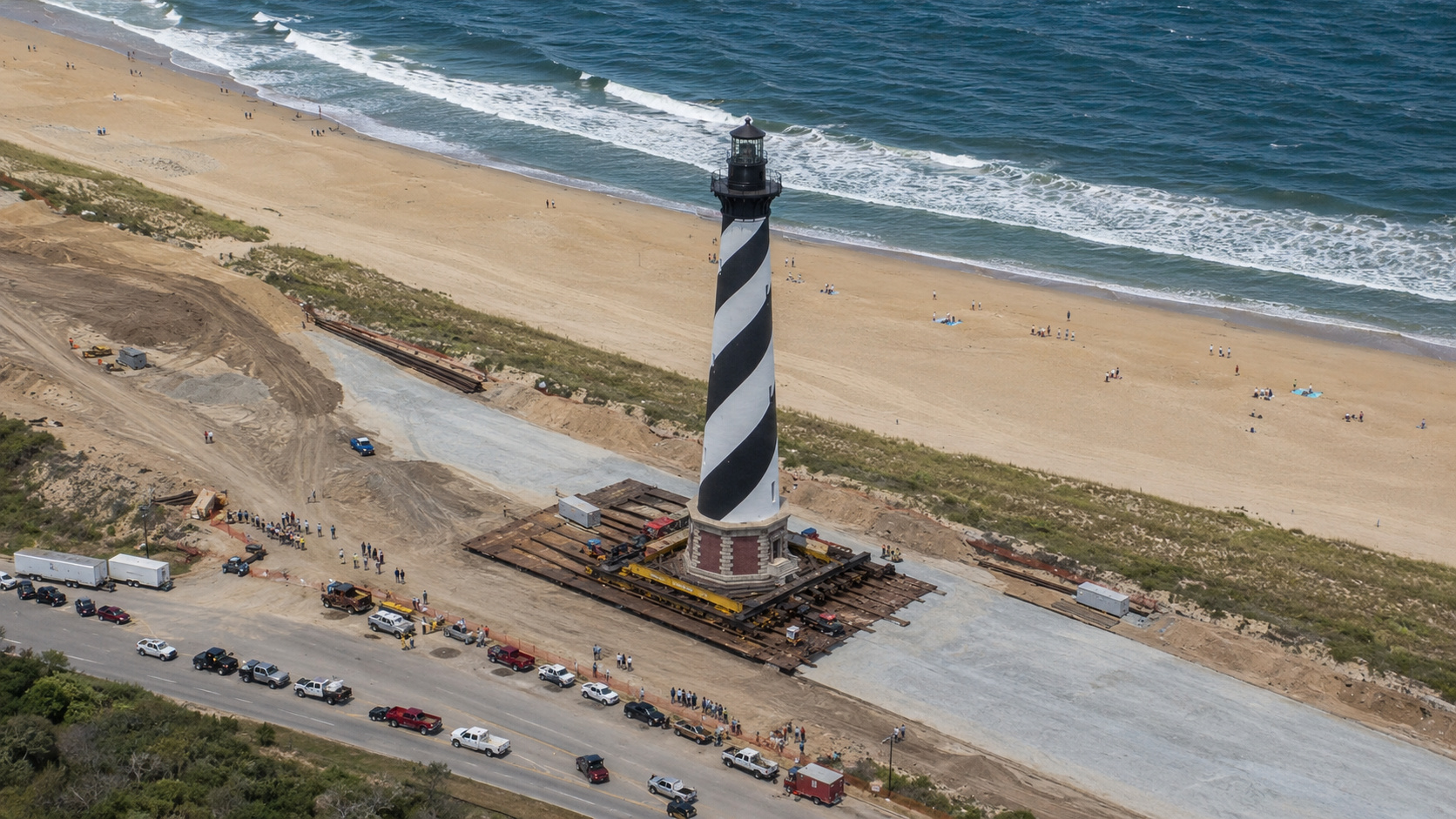

Cape Hatteras Lighthouse was moved 2,900 feet in 1999 to escape coastal erosion, in one of the largest engineering operations in the US.
The Cape Hatteras Lighthouse in North Carolina is one of the most impressive cases of coastal engineering ever recorded in the United States. Instead of just building a seawall, engineers decided to move an entire historic tower away from erosion, preserving the monument and allowing the coastline to continue its natural process of change.
According to the National Park Service, the lighthouse was built in 1870 on Hatteras Island, in the Buxton area, and was originally about 1,500 feet from the ocean, equivalent to approximately 457 meters. However, with the advance of coastal erosion, this distance decreased over the decades to just 120 feet from the water in 1970.
The situation became critical because the lighthouse relied on a sensitive foundation. According to the National Park Service, the original base had yellow pine wood supported in fresh water over compacted sand, with a brick and granite foundation above. If erosion removed the surrounding sand or if saltwater invaded the structure, the wood could rot and compromise the stability of the tower.
-
Daughter left São Paulo to help her father in the garden, learned the trade shortly before losing him, and took over the family’s greenhouses alone, overcoming prejudices until supplying vegetables to 2 major supermarkets and inspiring the creation of a seal to recognize women who sustain businesses in agribusiness.

-
A rural school teacher uses a board with only 2 letters to form dozens of words, turning literacy into a game and making children learn to read with joy, while the simple method wins over educators across Brazil and takes the video to surpass 6.2 million views.
-
A man left a company he managed for 11 years, exchanged the office for a farm that needed renovations, and created a regenerative system that now feeds more than 2,000 people per week, using greenhouses, rotational grazing, and rainwater to produce for longer without destroying the soil.
-
A woman bought a 1912 lighthouse on a remote island in Norway, spent almost two decades restoring the structure, and transformed the Litløy Lighthouse into a refuge open to visitors in the middle of the North Atlantic.


4,830-ton lighthouse was too close to the sea and was at real risk of disappearing
The most striking image in history is of a gigantic lighthouse threatened by the Atlantic. According to an updated article from the National Park Service, the erosion of the coastline led to the decision to move the 4,830-ton brick structure inland, in an operation considered unprecedented in scale to preserve the historic monument.
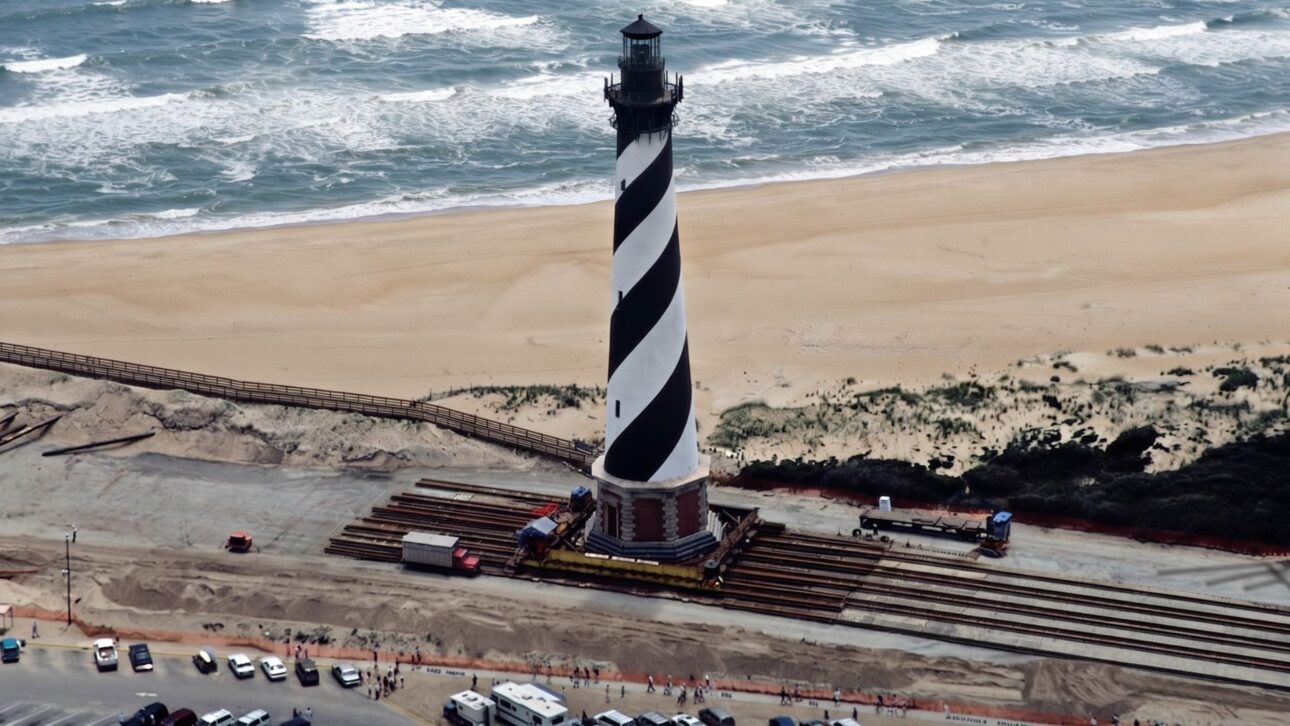
The Cape Hatteras Lighthouse also carries technical and historical importance. According to the National Park Service, it is 193 feet tall, about 59 meters, and remains the tallest brick lighthouse in the United States. The black and white spiral tower served as an essential navigation aid in a dangerous stretch of the Atlantic coast.
The region is known for strong currents, storms, and shifting sandbanks. Therefore, the lighthouse was not just a beautiful construction in a coastal landscape. It was part of a maritime safety infrastructure in an area historically dangerous for vessels.
Before the change, they tried to contain the sea with works, sand, and rigid structures
The decision to move the lighthouse was not immediate. According to the National Park Service, since the 1930s there had been attempts to protect the tower from the advancing sea, including structures perpendicular to the coast, known as groins, as well as artificial beach nourishment and new interventions in the following decades.


In 1936, the Coast Guard abandoned the original lighthouse to the sea and transferred its light to a metal tower in Buxton Woods. Later, with new coastal stabilization attempts in the 1960s and 1970s, the discussion on how to save the structure continued without a simple solution.
The problem was that the barrier island kept moving. The National Park Service itself explains that the Outer Banks have been gradually migrating westward for thousands of years, with storms removing sand from the ocean side and depositing material on the sound side. In other words, the lighthouse was stationary, but the island was not.
Relocation was considered the best solution combining preservation and coastal protection
The relocation of the lighthouse was surrounded by debate. According to the National Park Service, in 1987 the agency sought help from the National Academy of Sciences, which evaluated alternatives to save the Cape Hatteras Lighthouse. The 1988 report recommended relocation as the most economical method to protect the structure.
Even so, the idea faced resistance. Many feared that the brick tower would not survive the transport. The National Park Service reports that the proposal was debated for years until subsequent studies reinforced relocation as the best long-term solution. In 1998, the United States Congress approved funding to execute the project.
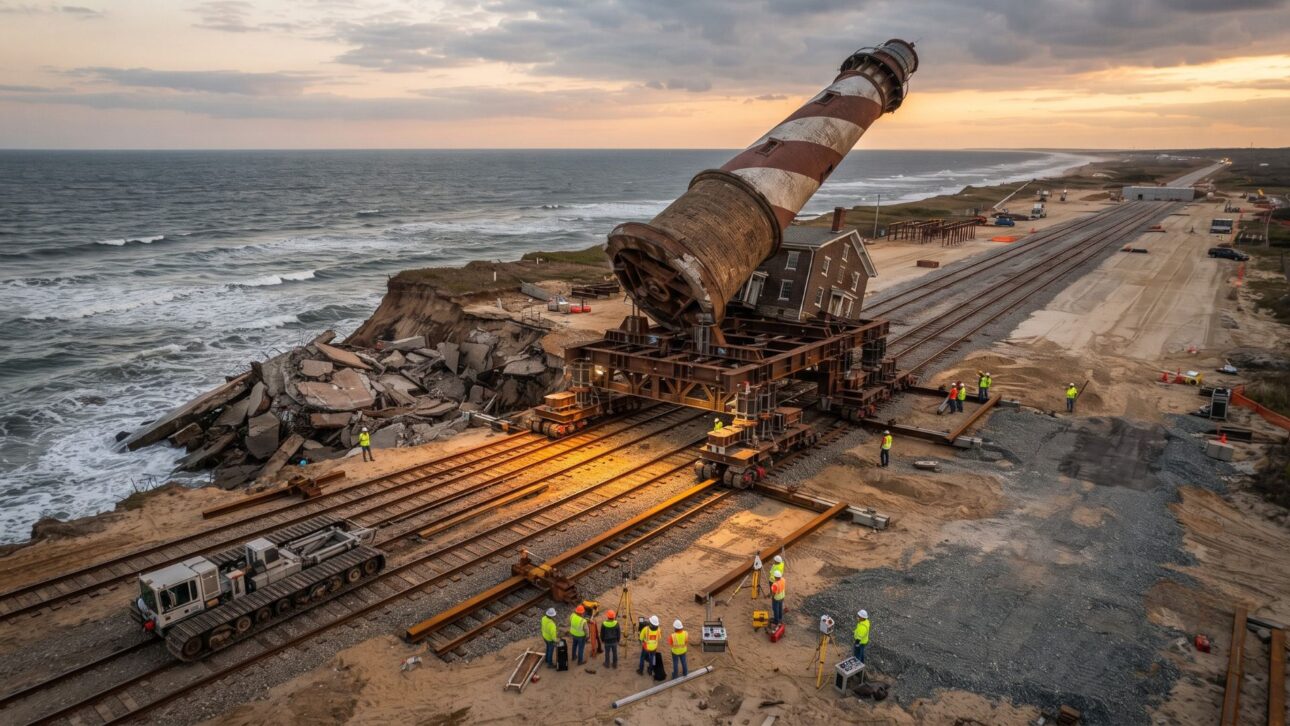
The decision had an important logic: to preserve the heritage without trying to permanently freeze the coastline with a rigid wall. Instead of turning the lighthouse into an island surrounded by protective structures while the beach continued to recede, engineers chose to move the monument to where it would have more time of safety.
Entire tower was lifted, placed on tracks, and moved 5 feet at a time
The operation began to seem impossible when it came time to move the tower. According to the National Park Service, the International Chimney Corp., from Buffalo, New York, was awarded the contract to carry out the move, with assistance from Expert House Movers, from Maryland. The concept involved lifting the 4,830-ton structure, transferring the weight to a transport system, and moving the tower along a prepared route.
The original foundation was temporarily replaced with beams and supports. Then, a steel structure was inserted under the tower, with hydraulic jacks capable of raising the lighthouse about 6 feet, allowing the introduction of rolling beams and rollers.
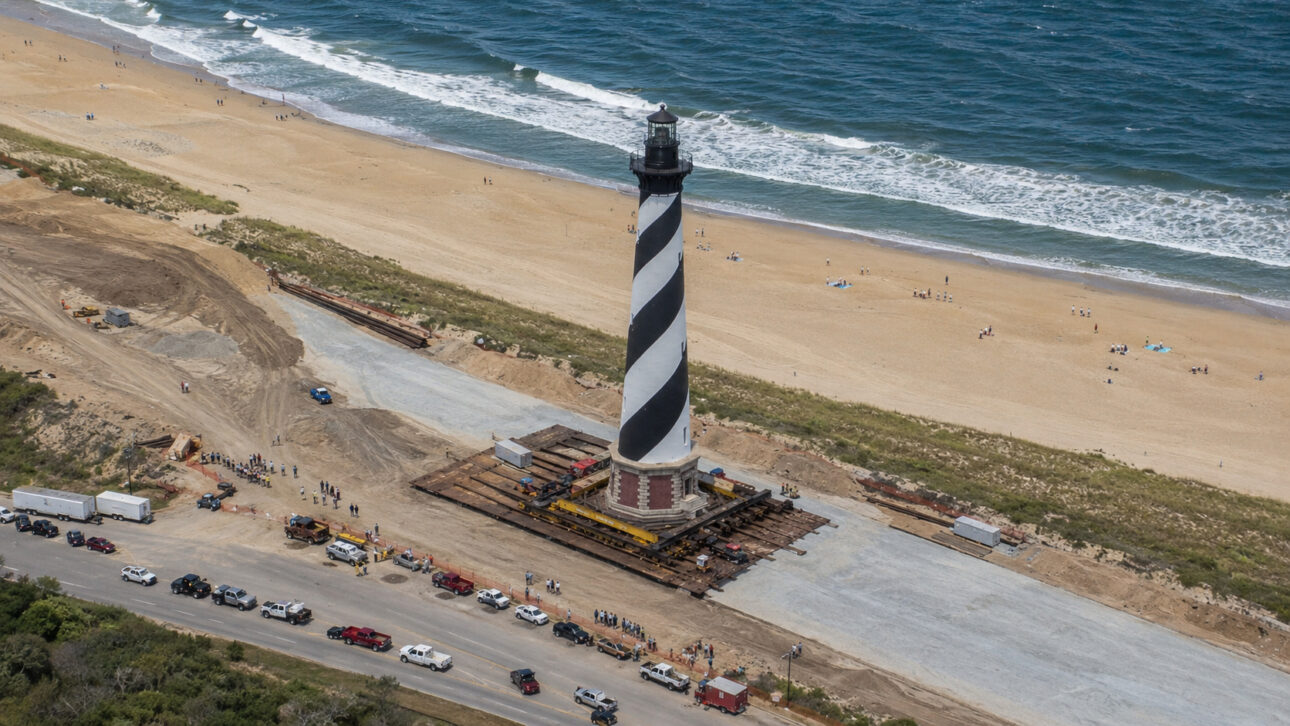
According to the National Park Service, after being lifted, the lighthouse began to move on June 17, 1999, on metal tracks and steel rails. Hydraulic push jacks, attached to the rails, pulled the structure 5 feet at a time. Sixty automatic sensors measured load, tilt, vibration, and diameter of the tower during the move.
Lighthouse traveled 2,900 feet and returned to a safe distance from the ocean
The move took 23 days. According to the National Park Service, the lighthouse reached the new location on July 9, 1999, after traveling 2,900 feet southwest, equivalent to about 884 meters.
The new position left the structure again about 1,500 feet from the ocean, a distance similar to what existed when the lighthouse was built in 1870.

The project did not only move the main tower. According to the National Park Service, the lighthouse station consisted of seven historic structures, and the auxiliary buildings, such as the principal keeper’s house, the double keepers’ house, the oil house, cisterns, and walkways, were also relocated to maintain the original spatial and altimetric relationship.
The new foundation was also prepared to receive the monument. According to the National Park Service, the tower was placed on a base formed by a reinforced concrete slab 60 by 60 feet and 4 feet deep, in addition to layers of brick and rock.
Operation showed that retreating can be smarter than fighting against the sea
The relocation of the Cape Hatteras Lighthouse became a lesson in coastal adaptation. On many beaches, the traditional reaction to the advancing sea is to try to harden the coast with walls, riprap, and barriers. In the case of the lighthouse, the more enduring solution was to accept that the island would continue to change and move the heritage out of the critical zone.
According to the National Park Service, the decision to move the lighthouse was considered a way to preserve historical structures while accommodating the natural processes of the coastline. This combination explains why the case continues to be cited as an example of cultural preservation in environments vulnerable to erosion.
The lighthouse resumed operation on November 13, 1999. The National Park Service states that, in the new location, it should remain protected from the waves for approximately another 100 years, although the very history of the Outer Banks shows that no coastal solution is definitive in the face of constantly moving barrier islands.


