Portuguese
  Spanish


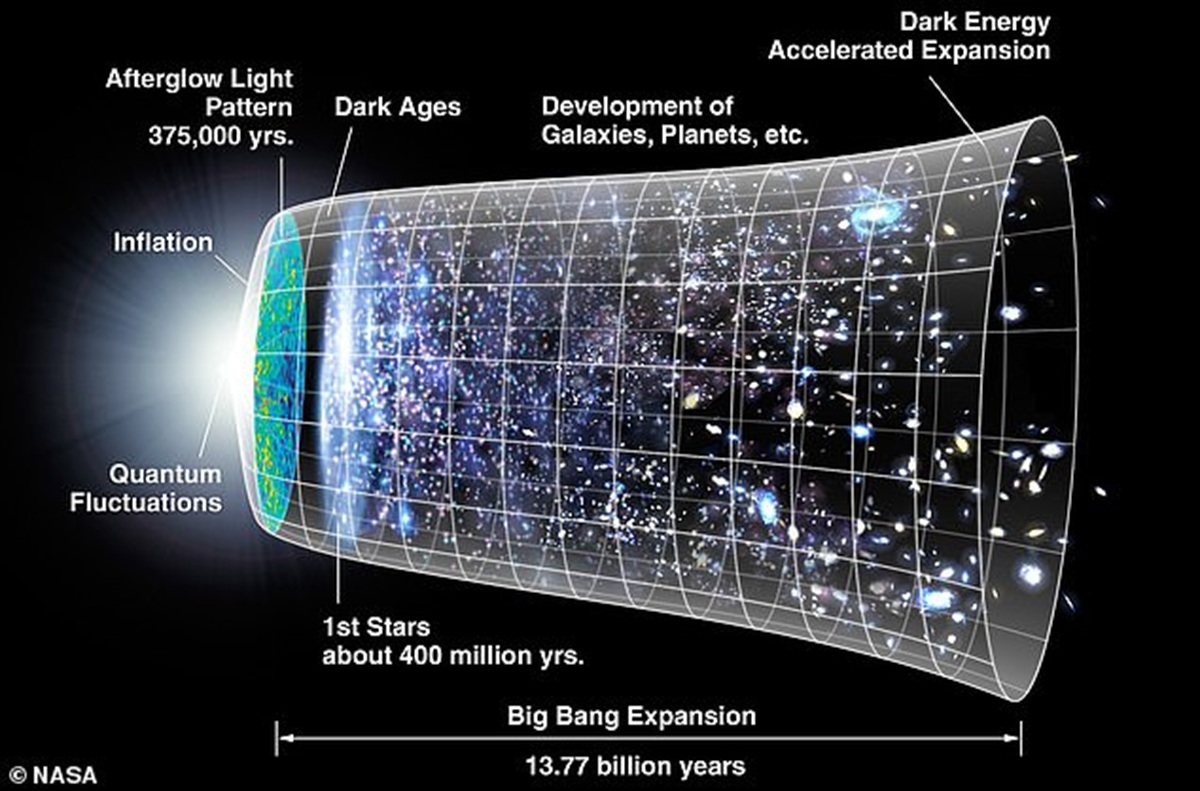

New measurement made by an international team of 40 researchers indicates that the universe is expanding at about 73.5 kilometers per second per megaparsec, above the predictions of current models, reinforcing the Hubble tension and opening space for doubts about dark energy, gravity, and the physics of the cosmos
The universe is expanding at a speed greater than predicted by current models, and new research has raised the level of uncertainty surrounding this difference by presenting one of the most precise measurements ever made about the rate of growth of the cosmos. Instead of resolving the doubt, the study reinforced the so-called Hubble tension and expanded the possibility that there is something fundamental still unexplained in the scientific understanding of the universe.
The international team of astronomers calculated that the rate of expansion of the universe is about 73.5 kilometers per second per megaparsec, a unit of distance equivalent to 3.26 million light-years. This value is higher than estimated by models based on the primitive universe, which indicate an expansion between 67 and 68 kilometers per second per megaparsec.
The difference between these numbers may seem small, but it exceeds what could be attributed to statistical uncertainty. Therefore, this divergence has been treated as a persistent problem in cosmology and has gained strength again with the new analysis published in the journal Astronomy & Astrophysics.
-
High School Teen Develops AI to Detect Autism and ADHD Signs from Retinal Patterns with 89% Accuracy

-
Abandoned Building in Brazil to Become Biotechnology Unit with $10 Million Investment, Bridging Science, Industry, and Public Health

-
Netherlands Builds Giant 240-Meter Inflatable Barrier That Rises to Protect Cities from Storm Surges

-
Brazilian Submarine Robot “FlatFish” Operates Independently at 3,000 Meters Depth to Inspect Seafloor Pipelines Without Support Vessels



How the new measurement of the universe was made
To arrive at the result, the researchers combined different measurement techniques of the universe’s expansion in a model called the Local Distance Ladder. The proposal was to bring together distinct methods into a single framework to test whether the discrepancy remained even under a broader and more rigorous check.
The analysis included observations of red giant stars with known brightness, exploding stars, and different types of galaxies. The combination of these elements allowed the team to obtain a measurement described as having extremely high precision for the rate of expansion of the universe.
The result remained around 73.5 kilometers per second per megaparsec even when individual techniques were removed from the analysis. This weakened the hypothesis that the difference could be explained by an isolated failure in any of the methods used in the local measurements.
The authors stated that the work effectively rules out explanations for the Hubble tension based on a single overlooked error in local distance measurements. For the group, the growing body of evidence strengthens the possibility that the discrepancy is real.
Hubble tension challenges current models
Traditionally, scientists measure the expansion of the cosmos in two main ways. One observes nearby stars and galaxies to check the speed at which they are moving away from Earth, while the other uses data from the early universe to estimate what the current rate of expansion should be.
In theory, both paths should lead to compatible results. In practice, however, measurements of the nearby universe continue to indicate a faster expansion than predicted by models anchored in the initial conditions of the cosmos.
This divergence is known as the Hubble tension and has repeatedly appeared in various studies. The new research not only maintained this difference but also consolidated it with a level of precision that has increased scientists’ perplexity.
In the article, the researchers classified the result as a significant shift in perspective. They also pointed out that the findings reinforce the hypothesis of new physics or a deeper reevaluation of the conditions of the early universe.
The implications are relevant because they suggest that standard models of cosmology may be incomplete. Since these models depend on measurements from the early universe, the persistence of the tension raises the possibility that some essential component is still not being fully considered.
What may be missing in the understanding of the cosmos
Among the possibilities cited by the researchers are effects of dark energy that have not yet been fully incorporated, the existence of new particles, or changes in the way gravity acts on a cosmic scale. In this scenario, the Hubble tension would cease to be seen as a technical observational problem and would be treated as a signal of limitation in the current model of the universe.
The authors stated that the discrepancy may not be the result of measurement error, but rather evidence that the current cosmological model lacks a fundamental component. This assessment increases the weight of the study and places the universe at the center of a discussion about possible revisions in known physics.
The team responsible for the research gathered 40 scientists, including members from NSF NOIRLab and the Space Telescope Science Institute. With next-generation observatories expected to provide even more precise measurements, the hope is to discover whether the difference will be resolved or if it will continue to point to new physics.
While this answer does not arrive, other scenarios for the future of the universe are also under debate. Among them is the hypothesis of the Big Crunch, which considers the possibility that the cosmos, at some point, will stop expanding and begin to collapse in on itself.
In this theory, the dark energy that currently pushes celestial bodies apart could be overcome by gravity, initiating a contraction movement.
Stars and galaxies would collide and merge, temperatures would rise to thousands of degrees Celsius, hydrogen atoms would be shattered into free protons and electrons, and the universe would ultimately be reduced to a single immense ball of fire, with the destruction of all matter, life, time, and space.