Portuguese
  Spanish



With a launch scheduled for the second half of 2026, China accelerates Chang’e 7, takes its equipment to the Wenchang space center, and bets on the Moon’s south pole to search for water, study the soil, and pave the way for a more stable lunar occupation
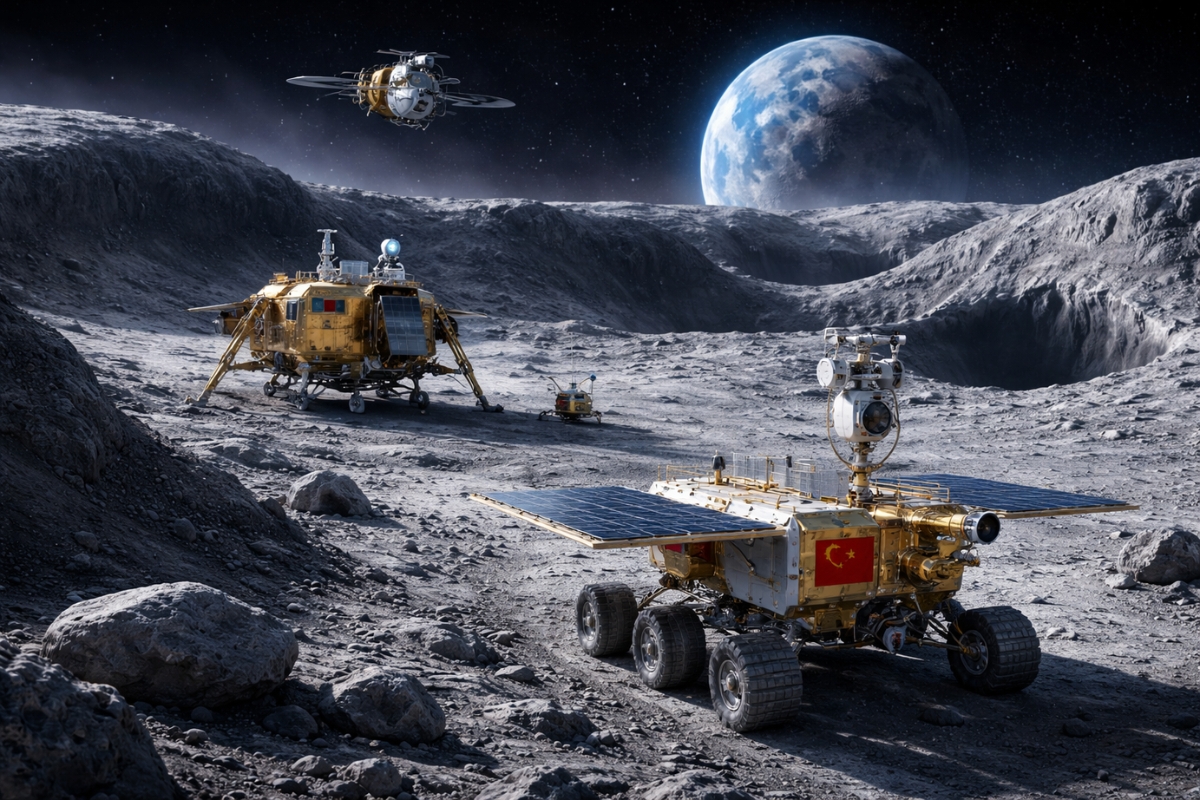
China has accelerated preparations for Chang’e 7 and placed the Moon’s south pole at the center of its new space stage. The mission targets an area considered crucial for finding water ice and paving the way for more advanced operations.
With a launch scheduled for the second half of 2026, the operation includes an orbiter, landing module, exploration vehicle, and mobile equipment to study the soil, environment, and lunar structure. The advancement increases the pressure for human presence beyond Earth.
Wenchang enters the decisive phase for the launch in 2026
After the arrival of the probe at Wenchang, the mission components were taken to the launch complex. Now, the stage is for testing and verifications before sending it into space.
-
China Develops Custom 140-Ton Electric Mining Truck with 770 kWh Swappable Battery, Deploys 290 Units in Xinjiang’s Largest Zinc Mine

-
Meta to Launch Arena, a New Prediction App Targeting 3.56 Billion Users, Competing with Polymarket and Kalshi

-
Scientist Challenges Famous Human Evolution Theory, Argues Homo Sapiens Evolved Gradually Over Thousands of Years
-
15-Year-Old American Builds Ocean Generator with PVC Pipe and 3D-Printed Propeller for $12, Wins National Prize, Presents at White House, and Makes Forbes 30 Under 30 List




This movement places the mission in a more sensitive phase, as every technical adjustment now counts towards the schedule. The focus is to ensure that all systems work together seamlessly at the time of landing and exploration.

Moon’s south pole becomes the most valuable target of the operation
The choice of the Moon’s south pole was not made by chance. The region concentrates craters that remain in shadow and, therefore, arouses interest due to the chance of preserving ice reserves.
Finding water at this point could change the logic of future missions. Besides its scientific value, the resource is seen as an important piece to sustain human presence and expand exploration capabilities.
Search for ice and launch preparation gain new weight
According to China Manned Space Agency, the crewed space agency of the Chinese government, preparations for the mission have already begun, and the operation has been designed to investigate the lunar environment, locate water, and deepen the study of the region.
In practice, this positions Chang’e 7 as one of the most important missions of the new Chinese phase. The project combines orbital observation, controlled descent, and surface movement to increase the volume of data about the area.


Soil, magnetic field, and lunar interior come into focus
The mission will not only look for the presence of water. The plan includes analysis of the soil composition, study of the magnetic field, and observation of the internal structure of the Moon.
These measurements help to better understand how the region behaves and what limits it imposes for future missions. The more detailed this map is, the greater the ability to plan human presence with less risk.
Chang’e 8 in 2029 expands the plan for using discovered resources
After Chang’e 7, the next planned step is Chang’e 8, scheduled for 2029. The idea is to assess how the identified resources can be utilized in subsequent missions.
This step brings Chinese exploration closer to a broader goal, which is to move from the reconnaissance phase to operations that make practical use of what is found. This leap could shorten the path to a more constant human presence on the Moon.
Lunar race before 2030 gains new pressure
The Chinese goal of reaching the Moon before 2030 adds a new dimension to this mission. The country views lunar exploration as part of a larger competition for technology, strategic presence, and prominence in space.
In recent years, China has made significant advancements with Chang’e 4, the Tianwen 1 mission, and the construction of the Tiangong station. Now, the focus on the south pole reinforces the competition for the most coveted area of the satellite.
If the mission confirms water and expands knowledge about the terrain, China will be closer to transforming the region into an operational base for the next decade. This aligns research, infrastructure, and continuous presence in a single movement.
More than just a launch, Chang’e 7 repositions the lunar south pole at the center of the space competition and pushes the rivalry into a decisive territory. This advancement changes the global strategic landscape.