





 Portuguese
  English
  Spanish
  5 min of reading
  0 comments


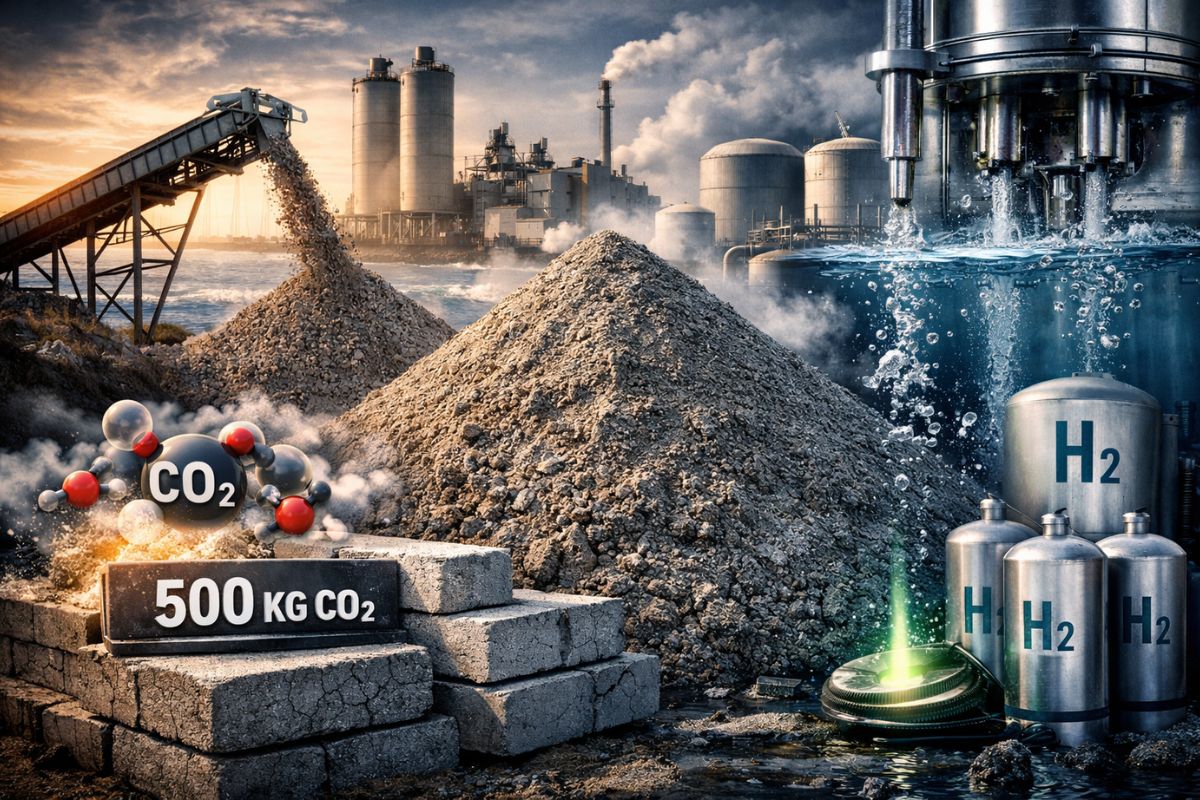
Researchers From Northwestern University Done on March 19, 2025, Accelerated a Phenomenon Seen in Shells and Reefs: With Electric Current and Enriched Seawater, They Generate Solid Minerals That Replace Sand or Gravel in Concrete and Store Up to 500 Kg of CO2 Per Ton, While Coproducing Hydrogen in Modular Reactors Designed for Coastal Use.
The Promise of “Cleaner Concrete” Often Faces the Same Obstacle: The Sector Depends on Processes That Release a Lot of CO2, and the Volume Produced Is Gigantic. When Such a Common Material Accounts for Almost 8% of Global Emissions, Any Alternative Needs to Be Born with Scale in Mind, Not Just Good Laboratory Results.
It Is at This Point That the Proposal From Northwestern University Enters: Instead of Just Trying to Reduce Harm, Scientists Show a Way to Transform CO2 into Part of the Construction Input Itself. The Idea Is to Turn Captured Carbon into Useful Solid Material, Capable of Replacing Sand and Gravel and Still Making Space for Hydrogen Produced in the Same Process.
Why Concrete Became a Climate Problem

Concrete Is the Most Widely Used Material in the World, and Precisely Because of That, Its Climate Footprint Is Heavy. Part of the Impact Comes from the Production Chain and the Massive Consumption of Inputs, and the Result Appears in a Hard-to-Ignore Number: Almost 8% of Global Emissions Are Associated with Concrete.
-
Tiny robots inspired by ants can build and demolish structures on their own in a Harvard experiment.

-
Mansion basement becomes archaeological site: engravings possibly made by enslaved people are found in a property over 260 years old in Ouro Preto

-
A 13-meter marine predator, larger than two articulated buses, spent decades in Texas museum collections right under the noses of paleontologists: now named Tylosaurus rex, it had serrated teeth capable of crushing skulls and dominated the oceans of North America 80 million years ago.

-
Australia transforms remnants of plastic bags, glass bottles, and printer cartridges into new roads; each kilometer of Reconophalt uses 200,000 bags, 63,000 bottles, toner from 4,500 cartridges, and 50 tons of repurposed pavement.


In This Scenario, It Is Not Enough to “Offset” CO2 Later. Northwestern’s Proposal Changes the Point of Attack: If Carbon Can Be Incorporated into Stable Minerals Before Even Reaching the Construction Site, Concrete Stops Being Just a Source of CO2 and Has the Chance to Carry a Fraction of That Carbon in Solid Form.
What Northwestern University Really Created

The Core of the Innovation Is a Set of CO2-Based Solid Materials Designed to Enter Construction as Aggregates, That Is, as Substitutes for Sand and/or Gravel in Concrete.
Instead of Capturing Carbon and Storing It Somewhere, the Process Gives Carbon a “Second Life” in the Form of Mineral Granules.
These Solids Can Also Serve Other Applications in the Built Environment, Such as Cement, Plaster, and Paint.
The Logic Is the Same: If the Resulting Material Has Composition and Behavior Compatible with Industrial Uses, It Is Not Restricted to a “Niche” Solution; It Becomes Part of an Existing Chain.
Seawater and Electricity: The Inspiration That Came from Shells and Reefs
The Process Is Inspired by a Natural Mechanism: The Formation of Shells and Coral Reefs. By Applying Electric Current to Seawater Enriched with CO2, Researchers Induce Reactions That Lead to the Formation of Solid Minerals, Highlighting Calcium Carbonate, Very Close to Limestone.
It Is a Way to Accelerate Something That Geology Would Take Millennia to Do.
The Central Chemical Explanation Involves the Mineralization of CO2. In Seawater, Ions Such as Calcium and Magnesium React with Dissolved CO2 under the Effect of Electric Current, Resulting in Stable Minerals.
The Key Point Is Stability: When CO2 Becomes a Solid Mineral, the Risk of “Returning to the Air” Due to Leakage Ceases to Be the Main Problem.
Adjusting Texture and Density: Why This Decides If It Becomes “Real Sand”
For an Aggregate to Replace Sand or Gravel, It Is Not Enough to “Exist.” It Needs to Have Physical Characteristics Compatible with What Concrete Requires.
This Is Why the Team Describes the Possibility of Adjusting Texture and Density by Changing the Intensity of the Electric Current or the Flow of Injected CO2. This Is Not a Detail: It Is the Type of Adjustment That Brings the Material Closer to a Controllable Industrial Behavior.
This Control Also Helps Explain Why Synthetic Minerals Are Seen as Strong Candidates for Concrete. According to Publications in Advanced Sustainable Systems, the Materials Can Store Up to Half Their Own Weight in CO2, and the Team Estimates That One Ton of the Material Would Store More Than 500 Kg of CO2.
In Other Words, the Aggregate Is Not Just “Neutral”; It Can Act as a Carbon Reservoir Within a Product That Is Already Widely Used.
When Carbon Becomes Product: What Changes in Relation to “Traditional” Storage
Many Capture Strategies Depend on Storing CO2 in Geological Reservoirs, with All the Discussion about Monitoring and Risk of Leakages over Time.
Here, the Approach Is Different: Captured Carbon Transforms into a Solid That Becomes Part of a Construction Material. CO2 Ceases to Be a Waste and Becomes a Component of a Useful Input.
There Is Also an Important Difference Regarding the Traditional Carbonation of Concrete. This Carbonation Captures Only a Fraction of the CO2 Associated with Manufacturing, Typically Ranging from 5% to 10%, While the Proposed Method Seeks to “Lock” CO2 Before the Material Enters the Usage Cycle.
Instead of Relying on Limited Capture Over Time, Capture Already Begins Embedded in the Aggregate.
Scale and Industrial Integration: Sand, Coast, Cemex, and Hydrogen
The Proposal Directly Addresses Two Bottlenecks of the Sector: Emissions and Sand Extraction. The Global Demand for Sand Pressures Marine and River Ecosystems, So Replacing Part of This Input with Minerals Made from CO2 Tackles a Parallel Problem. It Is a Climate Solution That Also Affects the Aggregate Mining Map.
To Move from Concept to Industrial Routine, the Team Worked in Partnership with Cemex and Advocates for Modular Reactors That Could Be Installed Near Coastal Cement Plants. In This Arrangement, Seawater Stops Being Just “Scenery” and Becomes Operational Raw Material.
And There Is a Relevant Co-Product: The Process Generates Hydrogen, Described as Valuable Clean Energy. The Practical Question Becomes Where This Hydrogen Fits into Local Logistics and Demand, Without Turning the Innovation into an Abstract Promise.
What Northwestern University Brings to the Table Is a Change of Logic: Using Electricity and Seawater to Convert CO2 into Stable Minerals That Enter Concrete as Substitutes for Sand and Gravel, with the Potential to Store More Than 500 Kg of CO2 per Ton of Material and Still Coproduce Hydrogen.
In a Sector Linked to Almost 8% of Global Emissions, the Strength of the Idea Lies in Tackling the Problem at the Heart of the Input.
Considering Real Life, Do You Think It’s More Feasible to See This Technology Arise in Coastal Regions Near Cement Plants, or Would It Only Make Sense in Specific Industrial Hubs?
If Concrete Started to Carry “Locked” CO2 in the Form of Mineral, Would That Change Your Perception of Works, Cities, and Infrastructure, or Would the Main Barrier Still Be Cost and Adoption by the Industry?


-

-

2 people reacted to this.