





Building a 100 m² house seems like a simple calculation, but the standard of finishing can take the budget from R$ 220 thousand to more than R$ 750 thousand. Foundation, land, materials, frames, electrical, and decisions made during execution explain why the square footage can mislead families before the construction.
A 100 m² house may seem easy to calculate: just multiply the size by the cost per square meter. But in practice, the same square footage can result in an economical, intermediate, or high-standard construction, with differences exceeding half a million reais.
What changes the calculation is not just the size of the construction. Foundation, land, labor, region, project, materials, and standard of finishing are included in the budget. The plan can remain the same, but the choices made before and during the construction completely change the final value.
How much can it cost to build a 100 m² house
As a national reference, SINAPI indicated in April 2026 an average construction cost of R$ 1,946.09 per square meter, including materials and labor. In a simple calculation, this would already place a 100 m² house near R$ 195 thousand.
-
Giant 3,600-ton Crane Breaks Two World Records by Installing World’s Largest Single-Piece Forged and Welded Hydrogenation Reactor, Weighing 3,037 Tons, in Chinese Petrochemical Plant in Just Six Days

-
$80 Million Bridge in Brazil Cuts Travel Time from 30 Minutes to 1 Minute, but Audit Reveals Major Flaws
-
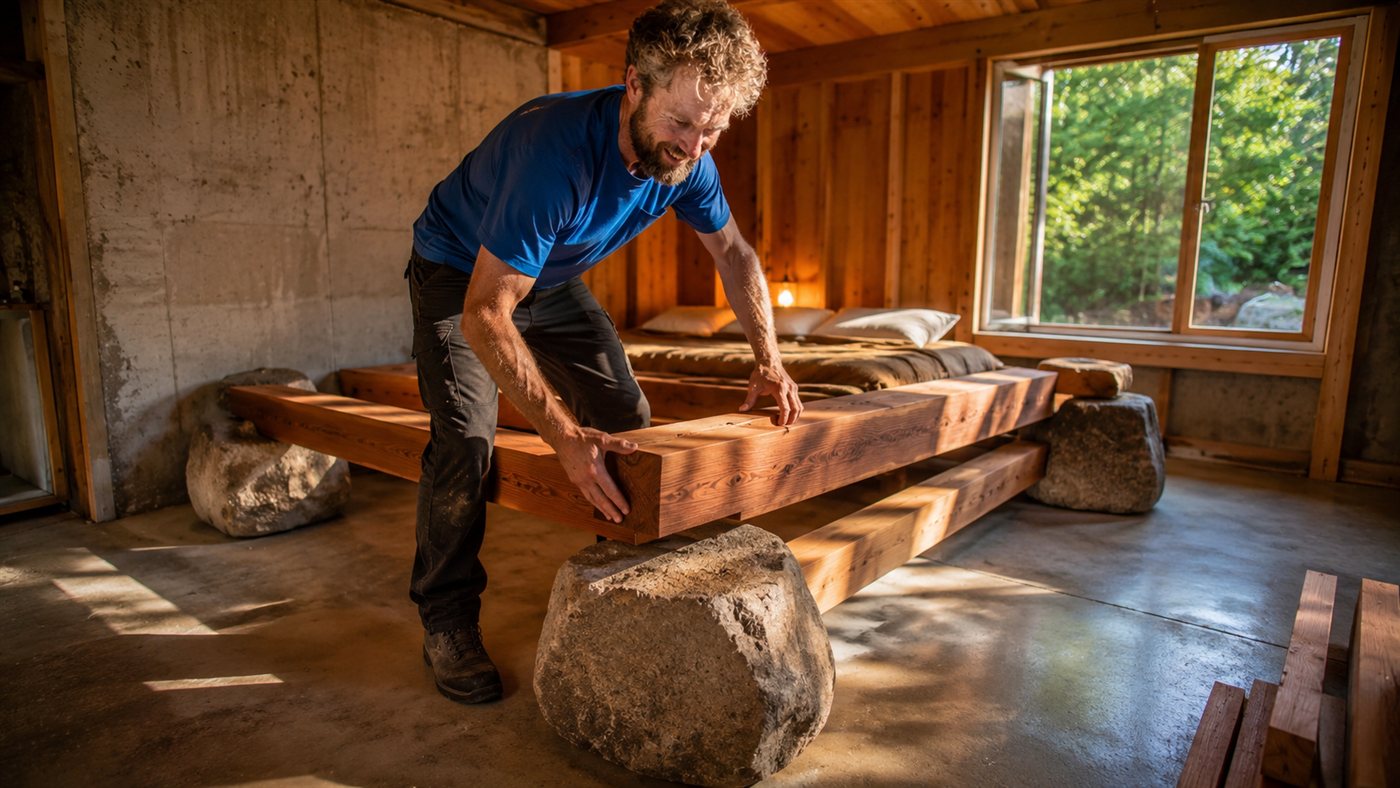
Man Builds Stone Bed with Granite Rocks and Hand-Sawn Cedar Beams, Home Extension Garners Over 437,000 Views on Bonus Bolts Channel

-
Brazilian Researcher Develops Color-Changing Roof Tile to Reduce Air Conditioning Use by Up to 15%



But a real construction usually goes beyond this number. Projects, fees, losses, management, land, foundation, customizations, and finishes can raise the budget. That is why the average cost serves as a starting point, not as a fixed price.
In practice, a basic standard house can range between R$ 220 thousand and R$ 280 thousand, considering a range of R$ 2,200 to R$ 2,800 per square meter. Meanwhile, an intermediate construction can vary from R$ 300 thousand to R$ 420 thousand.
In the high standard, the same area can jump to R$ 500 thousand to R$ 750 thousand or more, with values starting from R$ 5,000 to R$ 7,500 per square meter. The difference lies in choices that seem small when viewed separately but weigh heavily when added up.
The standard of finishing changes the entire calculation
The standard of finishing is one of the main factors responsible for the price difference. A basic house prioritizes functionality, simple materials, and economical solutions. Meanwhile, a high-standard house usually includes more sophisticated aesthetics, superior materials, and more detailed execution.
This appears in floors, ceramics, metals, countertops, doors, windows, facade, lighting, and roofing. Each material change may seem small, but the set pushes the project into another cost range.
A simple porcelain tile has a different impact than a premium coating. A standard window costs less than a custom-made frame. A common countertop does not weigh as much as a higher-value stone or a custom design.
The issue is that many of these decisions are made gradually. When the owner realizes, the house that started with a basic budget has already gained items of intermediate or high standard, without the square footage having changed.
Invisible items also increase construction costs

Not all expenses appear in the decoration or final finish. An important part of the budget is hidden in stages that the resident hardly sees after the work is completed.
Foundation, plumbing installations, electrical points, preparation for air conditioning, planned lighting, gutters, roofing, and structure can significantly change the cost. The house becomes more expensive even before receiving flooring, paint, or furniture.
The land also weighs in. A lot with a slope, poor soil, or the need for containment may require a more expensive foundation. On the other hand, a flat and well-prepared lot tends to simplify stages and reduce risks.
Therefore, comparing only the final price of two projects can be misleading. One proposal may include items that another left out, creating an apparent difference that disappears when everything is accounted for.
Cheap budget may hide important stages
Before signing a contract, it is ideal to check if all budgets are considering the same items. A cheaper proposal may not include project management, complementary projects, certain finishes, or specialized labor.
It is also important to check if the budget considers the type of foundation, the number of electrical and plumbing points, the roofing model, the solution for gutters, and possible adjustments. Without this comparison, the cheap option can turn into an addition in the middle of the project.
Another point is the brand and line of materials. Two budgets may mention “floor,” “door,” or “window,” but work with completely different standards of quality, durability, and price.
This care avoids a common trap: choosing the lower proposal and later discovering that essential items were not included. In a 100 m² house, small absences can turn into large expenses.
Decisions in the middle of the construction tend to be more expensive
The best way to control the cost is to define the standard before starting. When important choices are left for later, the tendency is to decide in a hurry, accept more expensive substitutions, and approve additions that were not planned.
This happens a lot with coatings, lighting, metals, doors, countertops, and facades. The more decisions are left open, the greater the risk of the house exceeding the initial budget.
Defining the standard does not mean choosing everything at once with absolute rigidity, but establishing limits. Knowing whether the construction will be basic, intermediate, or high-end helps filter materials and avoid comparisons outside the financial reality.
The most important question is not just “how much does it cost to build 100 m²?”. The real question is: what house fits within those 100 m² and within the available budget?
The square footage measures the space, but the standard reveals the cost
A 100 m² house can have the same size on paper and completely different costs in practice. What changes the final value is the combination of land, foundation, labor, project, materials, and finish standard.
The numbers show this difference clearly: from R$ 220,000 in a basic standard to more than R$ 750,000 in a high standard, the variation can surprise those who only look at the built area.
In the end, the square footage helps imagine the size of the construction, but it does not define the price alone. The chosen standard is what reveals the real size of the bill.
And you, do you think building a 100 m² house is still worth it given this cost variation, or has the finish standard made the construction too unpredictable for most families? Share your opinion.
With information from O Antagonista.


