






 Portuguese
  Spanish


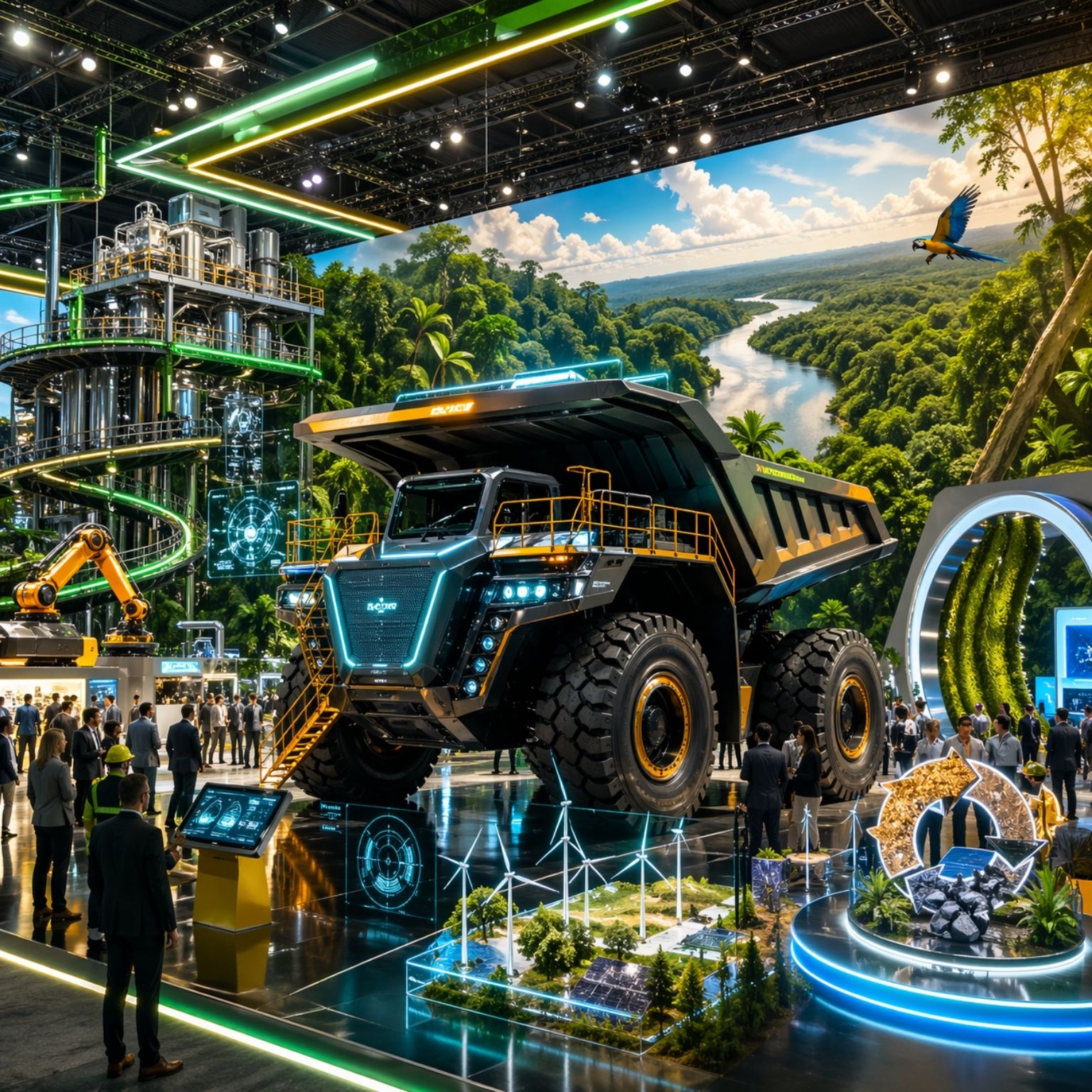

At the world’s largest industrial fair, Vale places the future with AI at the center of its stand and connects mining, energy transition, innovation, and environmental protection in the Amazon
The mining company Vale participated in Hannover Messe, in Germany, considered the world’s largest industrial fair, to present what it calls the “mining of the future,” with less environmental impact and more technology. The exhibited proposal includes the use of future with AI in process stages, in addition to autonomous equipment, production circularity, and an immersive experience that takes visitors to “enter” the Amazon rainforest, where the company maintains one of its main iron ore operations.
Vale’s presence at the event also had a political and symbolic component. According to the presented report, President Lula visited the company’s stand at the inauguration of Hannover Messe. In an exclusive interview with correspondent Américo Martins, Vale’s technical vice-president, Rafael Bitar, stated that the company wanted to show the strategic relevance of mining to the world, especially in the context of the energy transition, as minerals are the basis for technologies linked to a cleaner energy matrix.
What Vale calls the future with AI in mining
For Vale, the “mining of the future” is not limited to the mine. Rafael Bitar describes the concept as an integrated vision, connecting mining, sustainability, shared value, workforce, and intelligent operations. The central message is that there is no technology without mining, and that the demand for metals tends to grow in the coming years.
-
Digital Transformation Essential in Energy, Oil, and Gas Industries, But IT Infrastructure Often Overlooked

-
Brazilian Students Repurpose Clay Tea Cups to Create Cooler That Lowers Room Temperature by Up to 10°C Without Air Conditioning or Fans
-
353-Year-Old Mystery Deepens as Archaeologist Arrested with Teeth and Bone Fragment Possibly Linked to d’Artagnan, the Real Musketeer Behind Alexandre Dumas’ Inspiration

-
16-Year-Old Invents CoolTowel, a Fitness Towel That Stays Cold for Up to 2 Hours, Wins Global Alibaba Competition with Over 15,000 Participants, Earning $1 Million



In practice, the company tries to reposition mining as an essential base industry for technological and energy chains. Within this discourse, Vale says that the future with AI is not a distant promise: it is something that is already being executed in the present, with planned expansion.
How the future with AI already appears in operations, with autonomous trucks and optimization
Among the examples cited, Vale states that it already uses autonomous trucks, without operators, in some mines and intends to expand this model. The company also says it uses artificial intelligence in different areas of the process to increase optimization, reduce fuel consumption, and decrease emissions.
The logic presented is direct: automation and the future with AI serve as tools for operational efficiency and environmental goals, with practical impact on costs and emissions throughout the operation.
The numbers that explain the bet on circularity
One of the most striking data points highlighted by Rafael Bitar was what he called the “world’s largest circular mining program.” According to him, Vale produced 26.5 million tons last year from mining waste and tailings.
Another number cited in the interview reinforces the magnitude of the change: about 7% of 2025’s production would have come from waste and tailings. Circularity appears as a pillar of the company’s future with AI, both for efficiency in utilization and for the effect of reducing the need for new fronts from existing material.
Amazon at the center of the stand: immersion, historical operation, and protected area
Vale brought an immersive experience linked to the Amazon to the fair, presented as part of the effort to connect mining with environmental protection. Rafael Bitar stated that the company has been operating in the region for over 40 years and described the operation as an example of responsible mining.
The main data point cited was the case of Carajás: according to him, Vale, together with ICMBio, protects an area of native forest of over 800,000 hectares, using only 3% of that area for mining. He also said that the company progressively closes used areas, with recovery over time.
Decarbonization and fuels: from diesel to ethanol and the increase in biodiesel
Speaking of investments, Rafael Bitar pointed to decarbonization as a central theme for the next cycle. He stated that Vale has been investing to reduce its own emissions and also to help reduce emissions from clients, such as steel producers in the case of iron ore.
Among the examples, he cited tests of new fuels in trucks and locomotives. The company is reportedly studying a new bifuel engine for off-road trucks, with the possibility of using ethanol, in addition to evaluating an increase in the proportion of biodiesel in the blend for its equipment.
Next steps: iron ore, nickel, and the goal to double copper production


In addition to technology and sustainability, Vale presented growth ambitions. Rafael Bitar stated that the company intends to continue expanding its iron ore business and, at the same time, increase copper production, with the goal of doubling this volume.
The executive cited current production in the range of 300,000 to 380,000 tons of copper per year, with the objective of exceeding 700,000 tons in the coming years, up to the next decade. He also mentioned that Vale produces nickel, has a nickel mine in Brazil, and wants to gain competitiveness in this segment, with investments projected for the coming years and decades in the country.
Why this draws attention: technology, geopolitics, and the dispute over the “image” of mining
Rafael Bitar acknowledged that accidents have marked the image of mining as a “rupture image” and affirmed that the company is trying to reposition the sector based on safety, responsibility, and sustainability. In the presented view, being at Hannover Messe serves to show that mining, energy transition, and technology are connected, and that Brazil plays a strategic role in this scenario.
The bet is that showcases like this, with a **future with AI**, automation, circularity, and an environmental protection narrative, will help change how mining is perceived by society, without losing focus on the growing demand for metals.
And you: does Vale’s presence with this “future with AI,” circularity, and Amazon package at Hannover Messe change how you view mining, or does distrust still weigh more?


