






 Portuguese
  Spanish


Egypt rushes to produce wheat in the desert, reduce dependence on Russia and Ukraine, and protect the subsidized bread that sustains 70 million people
According to World Grain, Egypt maintains one of the world’s oldest, most sensitive, and politically explosive relationships with a staple food: subsidized bread. The Baladi program has existed for over half a century and distributes bread at nearly zero cost to about 70 million Egyptians, making wheat supply a matter of national stability. To keep this system running, the country imported 12.7 million tons of wheat in 2025-2026, preserving its position as the largest wheat importer in the world.
In the past five years, Russia and Ukraine together supplied 44.7 million tons to Egypt, with 35.8 million from Russia and 8.9 million from Ukraine. The war that began in 2022 and the closure of export corridors in the Black Sea triggered the biggest Egyptian wheat supply crisis in decades, with prices rising 60% in three months. Since then, the government has been executing a more aggressive program to expand domestic wheat production, reduce external dependence, and expand the irrigated agricultural frontier in the desert.
Egypt’s subsidized bread is a political red line since the 1977 uprisings
According to World Grain, understanding why Egypt is trying to plant wheat in the desert requires understanding the political weight of bread in the country. In 1977, President Anwar Sadat attempted to reduce subsidies as part of an agreement with the International Monetary Fund, but the decision triggered the so-called Bread Uprisings, with 79 dead, hundreds injured, and government retreat in just 48 hours.
-
After Two Years of Water Scarcity, Brazilian Farmer Finds Well on Her Land, Boosting Mango and Passion Fruit Production in Central Brazil

-
Cashew Becomes Billion-Dollar ‘Superfood’ in Ivory Coast: 1.6 Million Hectares of Monoculture Encroach on Forests as Families Trade Food for Nuts

-
In Rural Brazil, José Sirval Operates a Water-Powered Mill Grinding 125 Kilograms of Corn Daily Using His Great-Grandfather’s Century-Old Monjolo
-
From Market Stall to Agribusiness: Patagonian Fruit Grower Owns 550 Hectares and Processes 18 Million Kilos of Pears and Apples Annually, Exporting Directly to Brazil


Since then, the price of bread has been treated as a red line in Egyptian policy. In 2024, the government raised the price of subsidized bread for the first time in 36 years, from one Egyptian pound to two pounds per package of five units. The issue was significant enough to appear in international agricultural market reports, reinforcing how Baladi bread remains at the center of the country’s social stability.


The system is managed by the General Authority for Supply Commodities, the GASC, which purchases wheat abroad through tenders and distributes the grain to mills that produce flour for state bakeries. Between 2017 and 2021, the government spent an average of US$ 3.8 billion per year on wheat imports, showing the extent of the dependency.
Egypt attempts to grow wheat in the desert with efficient irrigation and expansion of agricultural area
According to World Grain, Egypt has 1 million km² of territory, but less than 4% is arable land, concentrated in the narrow strip along the Nile and the delta. The rest is desert, which has historically limited any more ambitious projects for grain self-sufficiency.
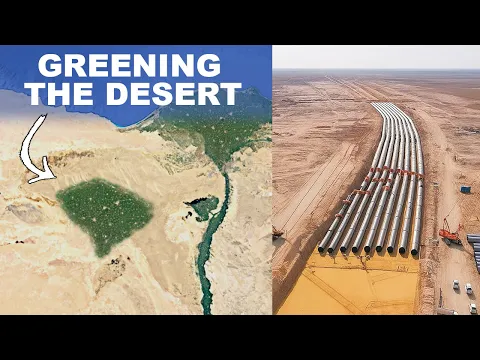
The current government strategy has two pillars. The first is intensification, with increased productivity per hectare in traditional areas through high-yield seeds and more efficient irrigation.
The second is extensification, with the opening of new agricultural areas in the desert using modern systems, especially Mechanized Raised-Bed Irrigation, or MRBI, a technology adapted for arid areas that reduces water consumption compared to flood irrigation.
According to ICARDA, MRBI improves water use efficiency and increases productivity with fewer inputs. This technical advancement has become a central piece of Egypt’s plan to produce more wheat in a territory where water limitation has always been the main obstacle.
Egypt’s wheat production could reach 9.8 million tons with 1.5 million hectares planted
According to World Grain, the Egyptian government has set a target to reach 11.5 million tons of wheat, still below the current annual imports, but much above the recent historical base. For the 2026 harvest, the projection is 9.8 million tons, which would represent the country’s second-highest historical record.
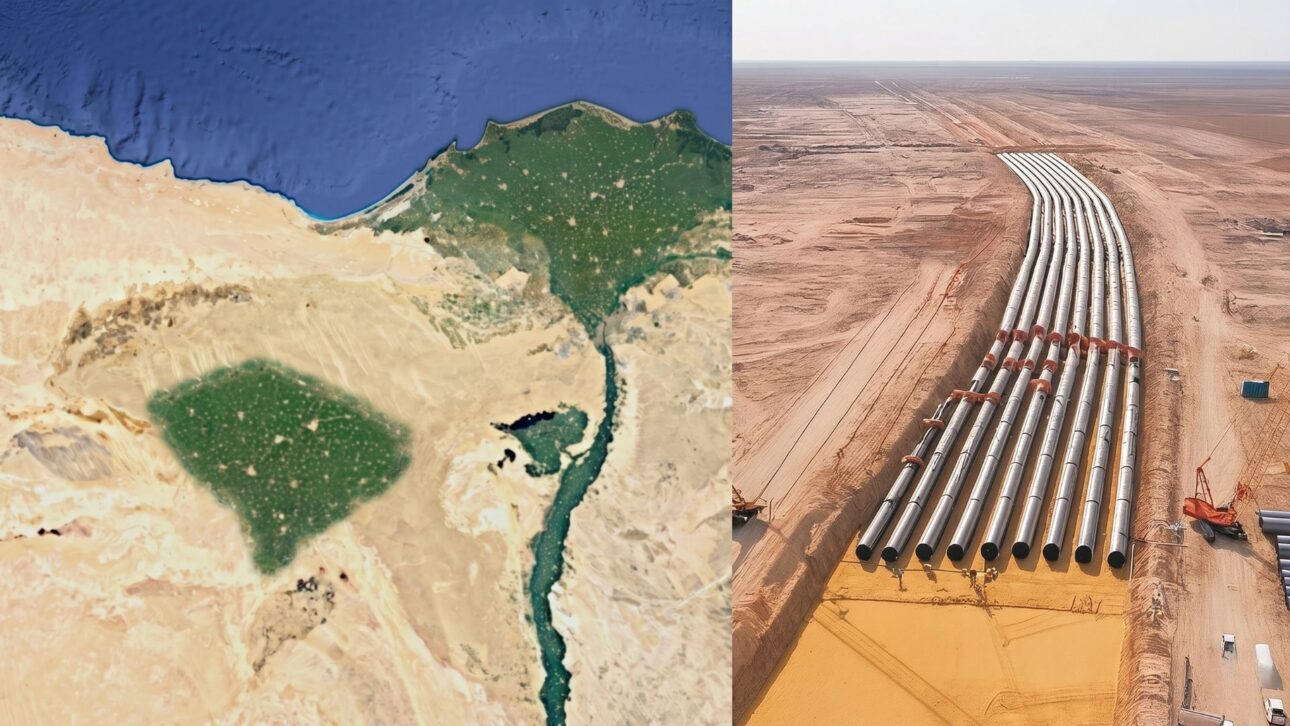
This progress was accompanied by an expansion of 170 thousand hectares compared to the previous year, raising the total planted area to 1.5 million hectares. This data is relevant because it shows that the Egyptian strategy has moved beyond mere rhetoric and has begun to produce visible results on a national scale.
The harvest begins in April in Upper Egypt and continues until July in the recently developed areas. In a country that has always been seen as structurally dependent on imports, increasing domestic production at a relevant pace changes not only the agricultural equation but also the logic of food security.
Russia dominates Egypt’s wheat, while Brazil barely enters this market
According to World Grain, the Egyptian wheat market operates, in practice, as a market strongly dominated by Russia. Alone, it delivered 35.8 million tons to Egypt in the last five years, more than all other suppliers combined.
Russia’s advantage is structural: geographical proximity, lower freight, competitive prices, and bilateral agreements with state support.
Brazil hardly participates in this specific wheat market. According to the publication, Brazilian wheat does not meet the protein standards required by Egyptian flour, and the freight between Brazilian ports and Alexandria is much more expensive than the route from the Black Sea.
Therefore, Brazil’s space in Egypt appears more in other products, such as corn, soybean derivatives, vegetable protein, chicken, and DDGS.
This detail matters because the Egyptian advance in wheat production does not mean complete agricultural isolation. The country will continue to import various items, and the reorganization of these purchases may affect competition among exporters in various segments, including those in which Brazil already competes in the market.
Crisis in the Gulf exposed banking fragility in wheat and food imports
According to World Grain, the Black Sea crisis in 2022 was not the only recent shock. In 2026, the conflict in the Gulf also affected the financial system used in agricultural commodity operations. Banks in Dubai reduced or suspended services, causing delays in processing payments for Egyptian imports.

The USDA recorded in March 2026 that some Egyptian mills could not pay for ships already docked at the port of Alexandria due to failures in the banking clearing system.
The country then experienced a critical paradox: the wheat was physically at the port, the mills needed the flour, the subsidized bread needed to be produced, but the payments could not be completed.
In response, Egypt created a new state import entity, announced in a letter to the Russian Ministry of Agriculture in December 2025, to take a more central role in food purchases and reduce dependency on the private banking system. This shows that the Egyptian concern is not only agricultural but also financial and logistical.
Guaranteed price to the farmer became the engine of wheat expansion in Egypt
According to World Grain, the expansion of 170 thousand hectares in a single year did not happen by chance. The government raised the guaranteed purchase price of wheat paid to the farmer, creating a direct incentive to expand the planted area.
In November 2023, the price was set at US$ 219.75 for every 150 kilograms, provided that the producer sold at least 60% of the harvest to the government. The combination of a minimum price above the market, access to high-yield seeds, and subsidized irrigation created the economic foundation that stimulated expansion.
If Egypt maintains this pace for a few more years, the projection presented by the publication indicates that the planted area could reach 2.35 million hectares, with potential production between 15 and 16 million tons at the current yield. In this scenario, wheat self-sufficiency would no longer seem unlikely and would become a calculable goal.
Wheat self-sufficiency in Egypt could reorganize the global grain market
According to World Grain, a less wheat-dependent Egypt would change the global balance of agricultural trade. The country is currently the world’s largest importer, and any significant reduction in its purchases would have a direct impact on suppliers like Russia, Ukraine, and European countries.
At the same time, an Egypt that spends less foreign currency on wheat can redirect resources to other purchases, which may maintain or even increase its demand for corn, animal protein, soybean derivatives, and other food inputs.
For Brazil, the most relevant effect might not be in wheat, but in the redistribution of Egypt’s appetite for other agricultural products and the commercial reaction of global competitors displaced from this market.
The central point is that Egypt is not just trying to harvest more wheat. It is trying to reduce a historical vulnerability that mixes food security, political stability, Black Sea geopolitics, and currency pressure.
If the plan works, the world’s largest wheat importer could become one of the most important cases of agricultural reconfiguration on the African continent.


