






 Portuguese
  Spanish


Galaxy J1453g, observed with support from the Telescopio Nazionale Galileo, reveals unusual internal structure and may help astronomers revise models on the formation of giant galaxies
The galaxy J1453g, observed with support from the Telescopio Nazionale Galileo, in La Palma, caught the attention of astronomers for presenting an internal structure considered unusual for a massive elliptical system. The investigation used gravitational lensing, spectrographic data, and information from the Gaia satellite to analyze a distant formation that may require a revision of models on the evolution of giant galaxies.
Galaxy J1453g focuses on the most important point of the discovery
The discovery focuses on the galaxy J1453g, described as a massive elliptical system with unexpected internal characteristics for its age.
The most relevant data is the contrast between what traditional models predict and what was observed in the recent mapping.
-
Digital Transformation Essential in Energy, Oil, and Gas Industries, But IT Infrastructure Often Overlooked

-
Brazilian Students Repurpose Clay Tea Cups to Create Cooler That Lowers Room Temperature by Up to 10°C Without Air Conditioning or Fans
-
353-Year-Old Mystery Deepens as Archaeologist Arrested with Teeth and Bone Fragment Possibly Linked to d’Artagnan, the Real Musketeer Behind Alexandre Dumas’ Inspiration

-
16-Year-Old Invents CoolTowel, a Fitness Towel That Stays Cold for Up to 2 Hours, Wins Global Alibaba Competition with Over 15,000 Participants, Earning $1 Million




According to the cited theories, ancient elliptical galaxies should present a core with more homogeneous evolution.
However, J1453g revealed a stellar configuration compared to the structure of the Milky Way, making the system an object of interest for new studies.
This difference suggests that the processes of merging and accumulation of matter may have occurred more slowly and gradually than predicted.
The central point of the research, therefore, is not just in the obtained image, but in the possibility of revising how giant galaxies grow over time.
Telescopio Nazionale Galileo helped measure the distant system
The observation was made from the Roque de los Muchachos, in La Palma, with the participation of high-precision optical instruments.
Among them, the Telescopio Nazionale Galileo stands out as an important piece for providing spectrographic data on the analyzed system.
These data allowed the study of photons that traveled for billions of years before reaching the mirrors of terrestrial telescopes. For this, astronomers needed to filter atmospheric interferences and isolate the characteristic brightness of the observed formation.
The atmospheric stability of La Palma, the use of modern spectrographs, and the collaboration between European institutions were pointed out as factors that helped make the analysis feasible.
The combination of these elements allowed the observation of details that would be difficult to separate in common deep space images.
Gravitational lens acted as a natural magnification
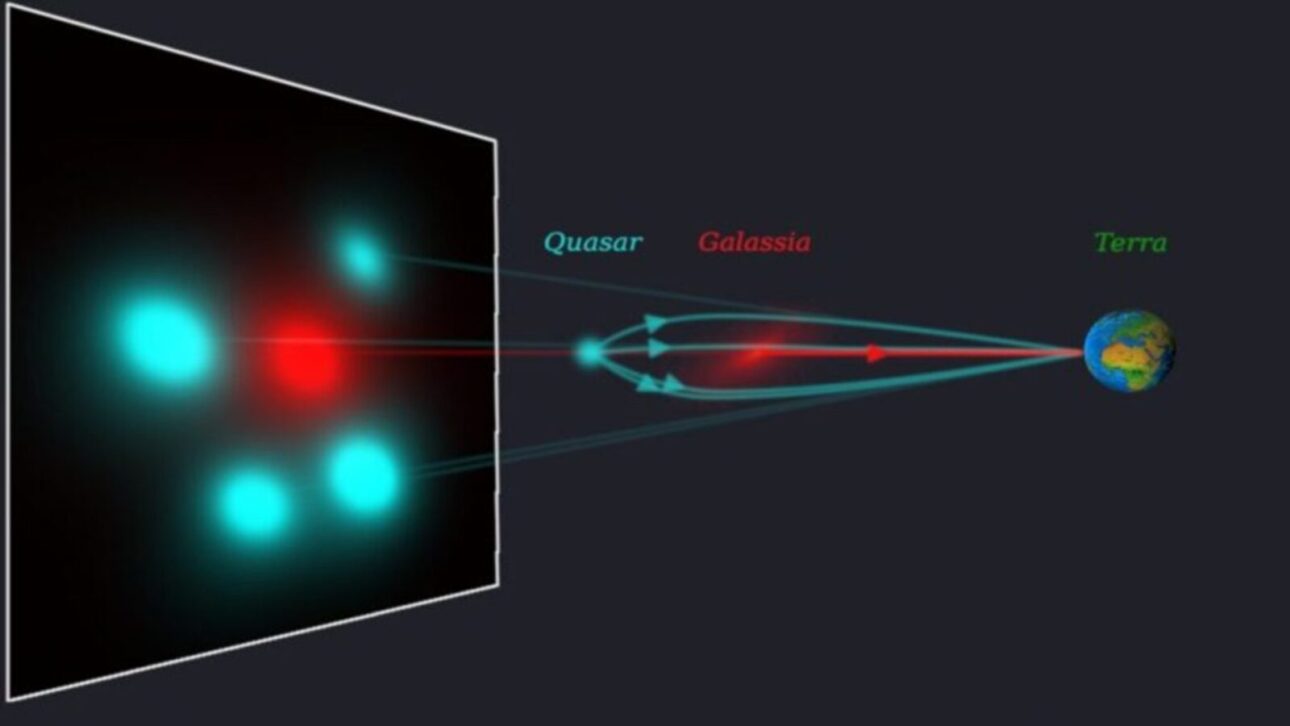
The investigation also relied on a gravitational lens, a phenomenon that occurs when a massive object is aligned between the Earth and a distant light source. In this situation, gravity curves space and magnifies the image that reaches the observatories.
In the analyzed case, the alignment generated an Einstein Cross, splitting the radiation of a quasar into four bright points.
This configuration allowed researchers to study the system with greater precision and measure its mass with highlighted resolution in the base material.
The gravitational lens played a practical role in the research because it acted as a kind of natural instrument.
Without this effect, the observation of the distant structure would be more limited, especially in a system with information so dependent on alignment, brightness, and visual separation.
Gaia expanded the use of spatial data in research
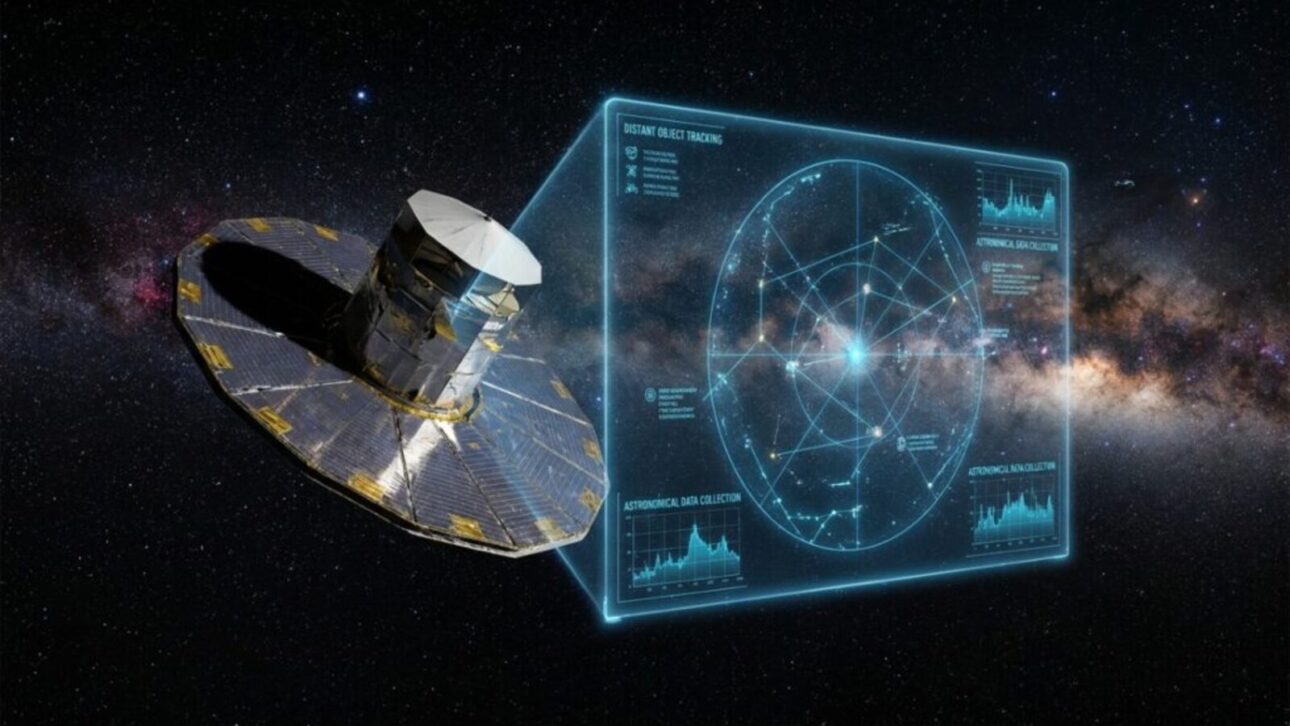
Another relevant point was the use of the Gaia satellite, originally designed to map local stars in Earth’s neighborhood.
In the investigation, astronomers applied its spatial resolution to track distant objects and identify rare optical alignments.
The integration between Gaia data and terrestrial spectrographs helped reduce visual noise and improve the final mapping.
The base material highlights that this strategy shows how existing equipment can be used in scientific fronts beyond their initial objectives.
With the results, the astronomical community is expected to intensify searches for other similar gravitational lenses.
The indicated expectation is that new observations will help compare distant systems and update numerical simulations used to explain the formation of massive galaxies.
This article was prepared based on information from the base material provided by the user, with data, numbers, and statements preserved as per the consulted material.


