





 Portuguese
  English
  Spanish
  5 min of reading
  1 comment


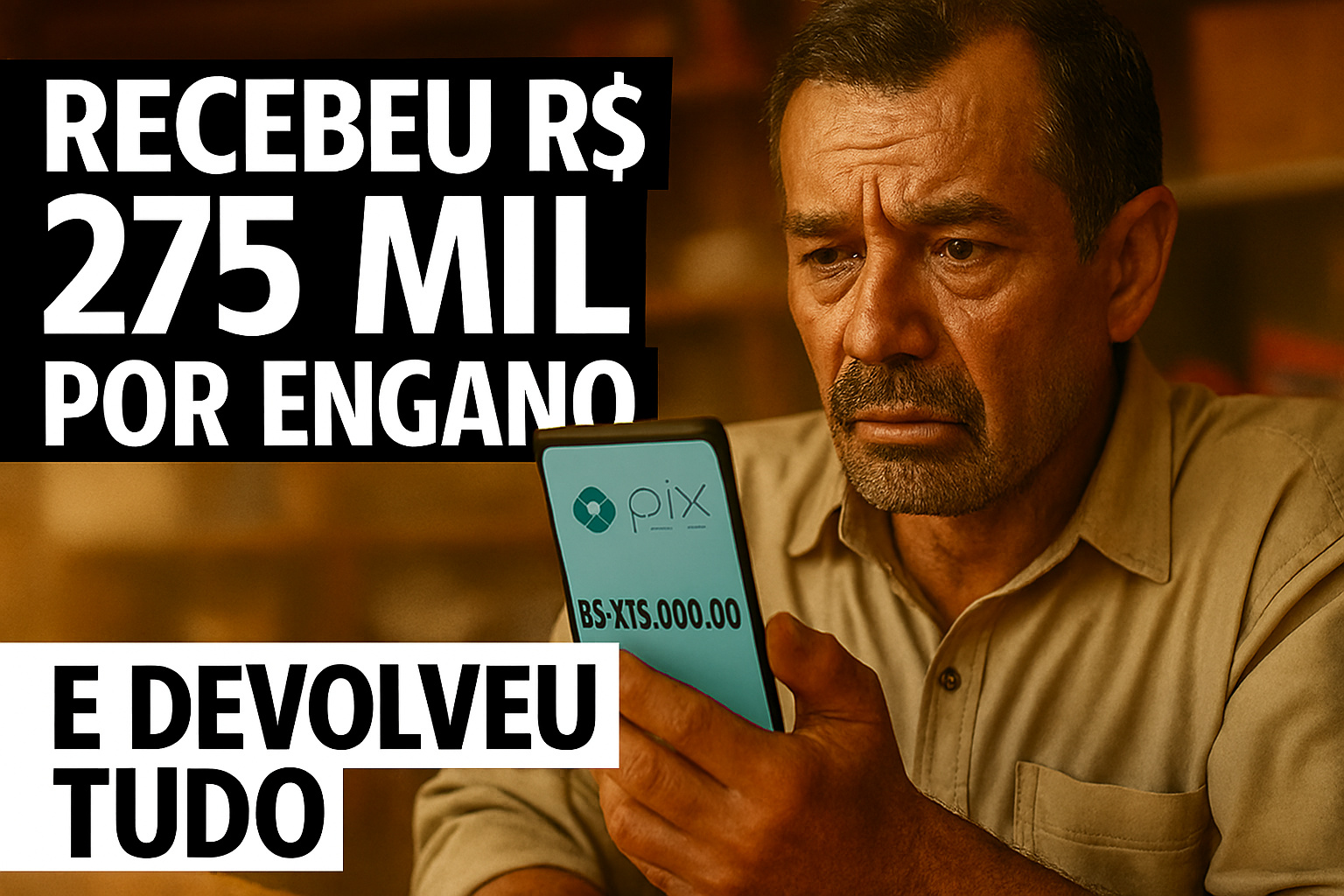


Salesperson Who Earns Minimum Wage Receives Pix Transfer of R$ 275 Thousand by Mistake, Thinks It’s an April Fool’s Joke and Returns the Money, Becoming an Example of Honesty. The Incident Occurred in 2022
What would you do if R$ 275 thousand suddenly appeared in your bank account? For salesperson Daniel Franco de Oliveira, 35, the answer came even before any doubt: “I would return it.” And that’s exactly what he did. On April 1, 2022— a date known as “April Fool’s Day,” Daniel received an unexpected Pix transfer of R$ 275,307.01 and, for a few seconds, thought it was a joke. But the money was real, the result of a banking error, and the worker’s attitude turned a simple mistaken transaction into one of the most inspiring stories in the country.
Daniel works at a veterinary products company and lives on a minimum wage. That Friday, when checking his statement via the app, he was shocked: the balance was hundreds of thousands of reais above normal.
“I thought it was some kind of scam because it didn’t make sense. Then I thought it was an April Fool’s joke,” he told G1. He also mentioned that he considered restarting his phone, believing it to be an app error.
-
22 life-sized concrete cars were sunk in the waters off Miami Beach to create an underwater traffic jam that will host 2,200 corals and could become the first major artificial marine life corridor in the region.

-
A devastating cyclone removed about 6.4 million tons of sand from a city in Australia, exposed hidden walls, and forced an offensive of over R$ 100 million to rebuild destroyed beaches in a recovery that could take up to 3 years.

-
Half of Brazil is under maximum alert due to intense storms, with rainfall of up to 50 mm per day, winds of 60 km/h, and extreme heat nearing 38°C, which could affect millions in the coming days.

-
At 78 years old, Arnold Schwarzenegger surprises the world by revealing a powerful diet with bananas, lentils, and protein that reduces 80% of meat and promises extreme longevity.

Minutes later, the salesperson realized that the amount had been sent via Pix by a company with which he had never made any transactions. His first reaction was to trace the origin of the transfer and understand what had happened. “I couldn’t imagine using money that wasn’t mine. I kept thinking about who might be desperate looking for this amount,” Daniel said.
The Day a Banking Error Became an Example of Character
As soon as he confirmed that the amount was legitimate and had been deposited by mistake, Daniel contacted his bank manager to inform what had happened.
The responsible department confirmed the error and engaged the bank’s legal team to process the refund. Even without any immediate obligation to return the amount — since the transaction had been completed, the salesperson insisted that the money be returned as soon as possible.
In an interview, he explained that he acted on principles, not out of fear. “I couldn’t sleep knowing I had something that wasn’t mine. Imagine someone who depends on that money to pay employees, debts, rent. It would be unfair,” he declared.
Daniel’s gesture went viral on social media after the report was published. Internet users highlighted that the worker’s honesty “is worth more than R$ 275 thousand.” In an era marked by digital scams, fraud, and mistaken transfers that end up in long legal disputes, the simple and immediate attitude of the salesperson became a symbol of character and humanity.
A Contrast with Most Cases of Pix Errors
While good-faith cases like Daniel’s are rare, Brazilian courts have been overwhelmed with actions involving undue transfers.
In 2024 and 2025, courts across the country judged hundreds of cases where the recipient of a mistaken Pix spent the amount or refused to return it, claiming “bank error” or “gift from a stranger.” In many of these cases, judges have imposed fines for illicit enrichment, with penalties that include interest, correction, and even moral damages.
The most recent case of national repercussion involved a construction company that mistakenly transferred R$ 48 thousand to a woman who used the amount to renovate her house and ended up being sued.
In another ruling, a worker received R$ 10 thousand improperly, blocked the sender, and claimed to be unemployed; the court ordered him to return the full amount and pay a fine.
Daniel, on the other hand, took the opposite path. His choice reinforces a message that is uncommon in times of instant gratification and greed: the value of honesty is still invaluable.
“I Can’t Imagine Using Money That Isn’t Mine”
The phrase spoken by Daniel encapsulated the spirit of his gesture and was echoed in newspapers across the country. Even with a modest income and living simply, he returned the money without hesitation. According to reports, the bank confirmed that the refund was completed on the same day.
The company responsible for the mistaken transfer even contacted the salesperson to thank him personally.
The case went viral precisely because it contrasts with the reality of most stories involving undue transfers. Instead of taking advantage of the situation, the worker chose to act on what he believed was right — without expecting reward or recognition. “I would do it again, with any amount. Just because someone made a mistake doesn’t mean I can take advantage of it,” he stated.
A Story That Became an Example
Daniel’s gesture was praised by economists and legal experts, who highlighted the importance of individual actions in times of ethical crisis.
Financial law specialist André Fernandes explained that, although the return of mistakenly received amounts is a legal obligation, “the speed and good faith of the recipient determine the tone of the situation.” According to him, the salesperson’s conduct was “rare and admirable,” as it prevented the case from turning into a legal dispute.
The story of the salesperson shows that, even in the face of unexpected temptations, there are still those who choose the path of integrity. The return of the R$ 275 thousand not only avoided legal troubles, but also transformed him into an example of character. “It’s not about being a nice guy. It’s just about doing what’s right,” he said.
In times when headlines are dominated by cases of misappropriation, scams, and dishonesty, the gesture of an ordinary worker stands out precisely for its simplicity. Daniel Franco de Oliveira showed that sometimes the greatest gain is in keeping a clear conscience — and that honesty can still go viral.








Faria o mesmo. A situação está difícil, mas o correto é devolver.