Portuguese
  Spanish


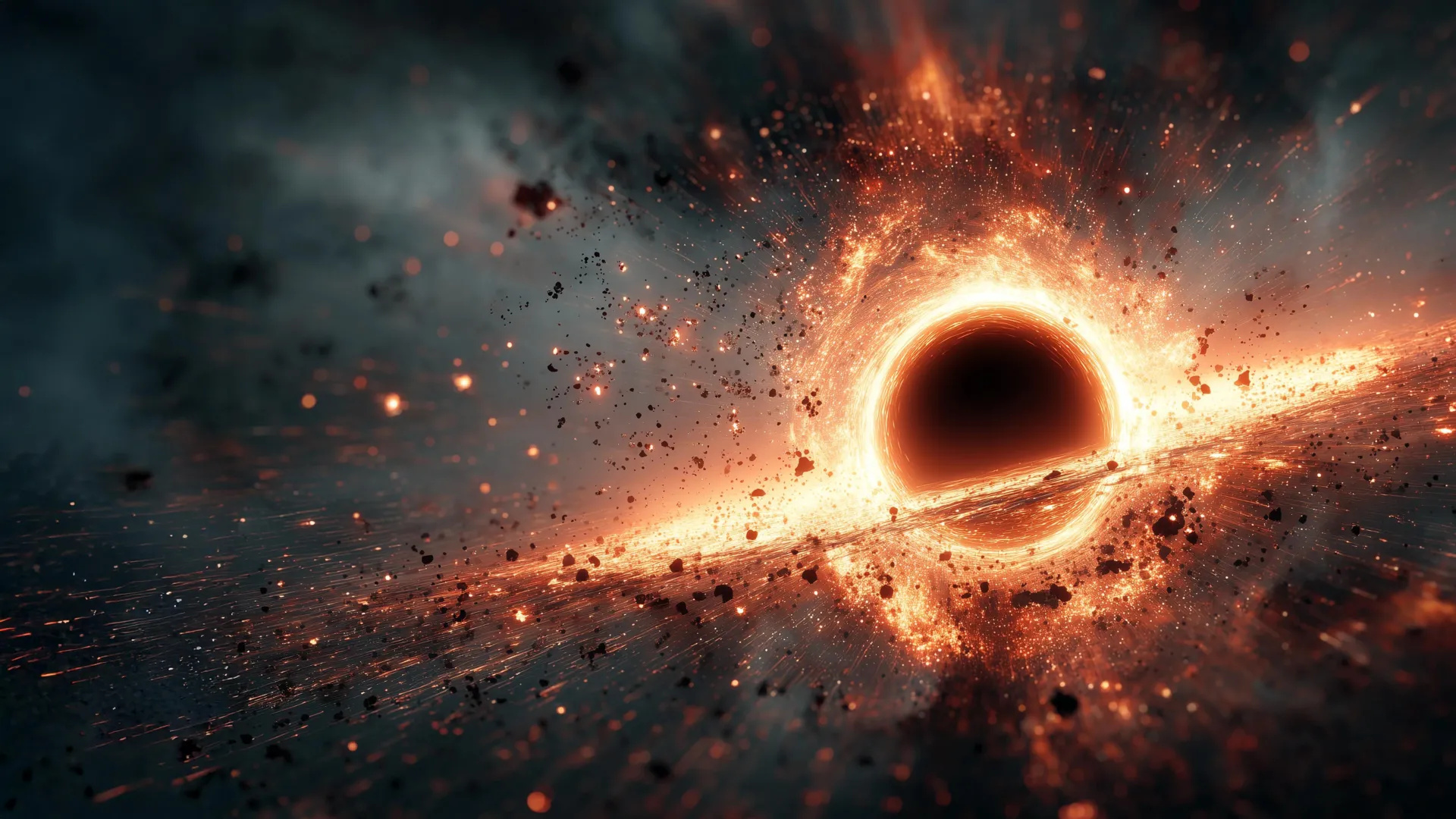

The rebirth of an inactive galactic nucleus reveals how extreme energy outbursts can regulate stellar growth in distant clusters.
An astronomical phenomenon of catastrophic proportions has been observed in a distant galaxy, where a black hole awakens after 100 million years of absolute inactivity.
The object, located at the center of a star cluster, came back to life by consuming a massive gas cloud that approached its event horizon. The reactivation generated an energy release so intense that scientists described the event as a cosmic volcanic eruption, capable of shaping the evolution of the entire surrounding galaxy.
The awakening after 100 million years and the dynamics of the eruption
The reactivation process began subtly but quickly escalated into a colossal emission of radiation and subatomic particles. When the black hole awakens after 100 million years, it disrupts the balance of its immediate environment, launching jets of plasma that extend thousands of light-years into intergalactic space. These jets act as thermal pistons, heating the surrounding cold gas and preventing the formation of new stars in the central region of the galaxy.
-
Eufy Unveils Omni S2: Advanced Robot Vacuum with 30,000 Pa Suction, Self-Cleaning Mop, AI Obstacle Avoidance, 12-in-1 Station, and Built-In Fragrance Dispenser

-
Swiss Glaciers Lose 10% of Volume in Two Years as Europe’s Largest “Water Tower” Dries Up; Scientists Use “Smart Stones” in the Alps to Gauge Remaining Water Supply for 170 Million People
-
Australia plans massive artificial reef project to protect Gold Coast and save storm-battered beaches from erosion

-
Humanoid Robots Begin Replacing Workers in Repetitive Roles as Companies Accelerate Industrial Automation




Space observatories detected the sudden brightness in multiple wavelengths, from X-rays to high-frequency radio waves. This clear signal that the black hole awakens after 100 million years offers a rare opportunity to study the life cycle of these cosmic giants.
The eruption not only illuminates the galactic center but also reveals the structure of materials that have been quietly accumulated during the object’s long dormancy period.
Impacts of the eruption on the galactic environment
The analogy with a volcano is used by the scientific community due to the way the black hole expels matter accumulated under extreme pressure. At the moment the black hole awakens after 100 million years, centrifugal force and intense magnetic fields redirect some of the captured matter before it crosses the point of no return.
This cosmic “breath” creates gigantic cavities in the hot gas of the cluster, visible in high-resolution images captured by state-of-the-art telescopes.
The consequences of this eruption may last millions of years, permanently altering the density and temperature of the interstellar medium. The fact that the black hole awakens after 100 million years demonstrates that these objects are not just sinks of matter, but active regulators of galactic health. The energy released is so vast that it could power the luminosity of billions of stars simultaneously, creating a visual spectacle that crosses the vacuum of space to terrestrial sensors.
Perspectives for Extragalactic Astronomy
The study of this sudden awakening allows theorists to refine models regarding the periodicity of active galactic nucleus activity.
Now that the black hole awakens after 100 million years, researchers are monitoring the stability of the jets to predict how long the eruptive phase should persist. The analysis of light spectra reveals the chemical composition of the “meal” that triggered the awakening, providing clues about the origin of the gas cloud that fed the giant.
This event reinforces the idea that the universe is a dynamic environment, where even the most stable objects can undergo violent transformations. Whenever a black hole awakens after 100 million years, science gains a new laboratory to test the laws of general relativity under extreme conditions.
The cosmic volcanic eruption continues to be monitored by a global network of telescopes, promising more data on the interaction between extreme gravity and visible matter.
Click here to access the study.