






 Portuguese
  Spanish
  5 min of reading
  0 comments


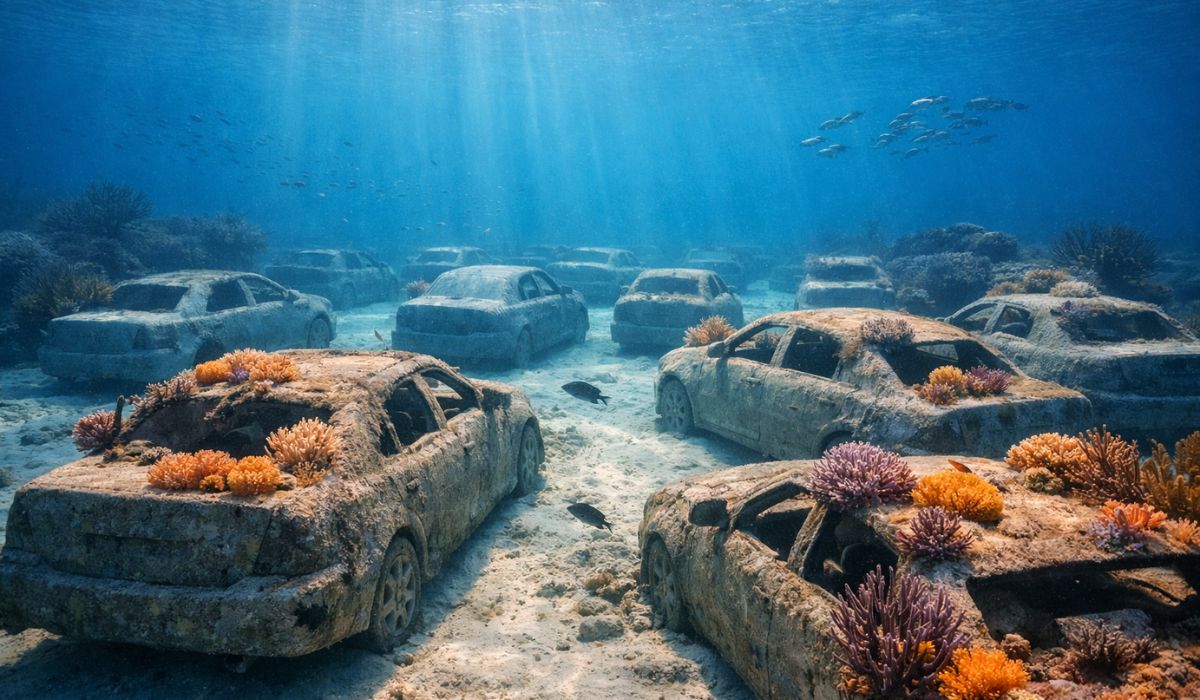
A submerged installation transforms concrete cars into bases for corals and marine life, while Miami Beach invests in public art, environmental restoration, and sea visitation in a project that advances in phases along the coast.
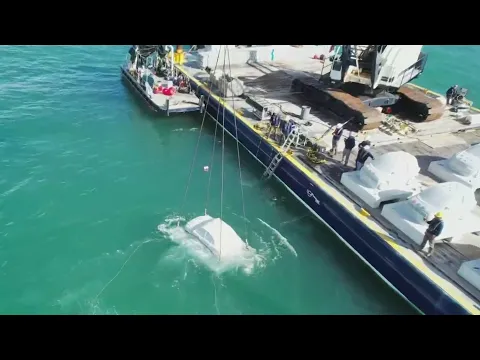
Twenty-two life-sized cars, molded in marine-grade concrete, have been submerged in the waters of Miami Beach to create the first installation of REEFLINE, an underwater corridor focused on public art and environmental restoration.
The structure, called Concrete Coral, was installed in the sea off South Beach and is set to receive 2,200 native corals cultivated in a Miami laboratory, according to the organization responsible for the project.
The installation is located in a stretch in front of 4th and 5th Streets, about 6 meters deep and approximately 240 meters from the beach.
-
Federal Police involved in the case to identify the person responsible for hacking the Civil Defense system, which sent ten false alerts, frightened residents of different capitals, and turned messages about real risks into notifications with “misanthropy” and even alien attacks.

-
Extreme drought causes ghost village to reappear at the bottom of the reservoir that supplies Athens, revealing houses, a school, and ruins swallowed since the 1980s as the lake shrinks and exposes the water crisis threatening the capital of Greece.

-
An entire village lay asleep at the bottom of a lake for 3,000 years: divers suction sediments in Italy and reveal more than 600 wooden stakes, bronze tools, and traces of a Bronze Age settlement hidden underwater.
-
They call it the “Shopee house” and even cardboard, but the R$ 20,000 house is a certified Wood Frame from Alea, financed by Minha Casa Minha Vida: understand if it’s worth more than masonry.


According to the Miami Beach city hall and REEFLINE, the proposal is for the set to function as a submerged sculpture, marine habitat, and part of a visitation route for activities such as diving and snorkeling, depending on sea conditions and area usage rules.
Artificial reef in Miami Beach opens first phase of REEFLINE
The work marks the beginning of the first stage of a broader plan conceived by Ximena Caminos, founder of REEFLINE, with a masterplan by architect Shohei Shigematsu from the OMA office.
For this opening, Argentine artist Leandro Erlich created a set that reproduces the image of a traffic jam on the seabed.
Commenting on the installation to the Associated Press, Caminos stated that the project brings together art and science in a pioneering intervention.

The statement was made during the start of the structure’s deployment, presented by the group as the first phase of a corridor that could advance along the coast of Miami Beach.
The artistic reading of the work was also mentioned by Colin Foord, scientific director of REEFLINE.
According to him, the goal is to plant soft corals on the cars to form an area capable of attracting fish and other marine organisms.
In the same interview, Foord stated that the image of a submerged traffic jam helps to communicate the proposal of the installation.
Native corals will be planted on concrete cars in the sea
The 2,200 corals planned for the first phase will be transferred from the Miami Native Coral Lab, maintained by REEFLINE.
According to the organization, the laboratory works with native species and colonies considered resilient, including urban specimens that have survived recent bleaching and disease events.
The organization reports that these corals will be fixed to the sculptures using technology developed for this type of transplantation.
The group’s expectation is that, over time, the structures will provide shelter for different species and gain biological complexity as the corals develop.

This work is being carried out in a context of strong pressure on Florida’s reefs.
In official statements, NOAA reported that the marine heatwave recorded in 2023 in the state was unprecedented in duration, intensity, and timing on the annual calendar.
As of April 2024, the agency confirmed the fourth global coral bleaching event ever documented, also impacting areas of Florida.
Project tests marine restoration and underwater infrastructure
In addition to the artistic installation, REEFLINE presents the corridor as a testing space for coral transplantation techniques and for hybrid models of underwater infrastructure.
In its institutional materials, the organization states that the goal is to complement existing coastal ecosystems and create new surfaces for marine colonization in a shoreline altered by beach nourishment projects and other urban processes.
The organization also reports that the sculptures were produced with neutral pH concrete and low-impact materials designed for marine use.
According to REEFLINE, the biological occupation of the structures tends to begin shortly after installation, while the development of the corals occurs over the following months and years.
Foord stated to the Associated Press that the formation of this environment could accelerate the creation of a reef ecosystem and enhance local biodiversity.
However, he presented the assessment as the project’s expectation, not as a proven result of the first phase.
REEFLINE funding and expansion plan in Miami
The implementation of the first phase received partial support from a $5 million bonus approved by voters in Miami Beach, as part of the municipal Arts and Culture program.
At the same time, REEFLINE is running a campaign to raise $40 million with the goal of expanding the underwater corridor along approximately 11 kilometers of coastline, in up to 11 phases.
In an official statement, the Miami Beach city hall associates the initiative with the preservation of the coastal strip and the encouragement of activities related to ecotourism.
During the public presentation of the project, Mayor Steven Meiner stated that healthy reefs function as part of the city’s natural infrastructure and mentioned the potential for job creation linked to guided tours, diving, snorkeling, kayaking, and paddleboarding.
REEFLINE also maintains educational programs focused on marine conservation.
According to the organization, the actions include activities with schools in Miami-Dade, volunteer participation in coral planting alongside scientists, and a floating learning center about the marine environment.

Next installations of the underwater corridor have been announced
The next phases already have installations and authors announced by the organization.
Among the planned works are The Miami Reef Star, created by Carlos Betancourt and Alberto Latorre, and Heart of Okeanos, by Petroc Sesti.
According to the schedule presented by REEFLINE, these structures are part of the continuity of the underwater corridor planned for the coming years.
With the first phase installed, the evolution of the project will be monitored by indicators related to coral development, the occupation of the structures by marine fauna, and the progress of the next announced phases.



Be the first to react!