Portuguese
 Spanish


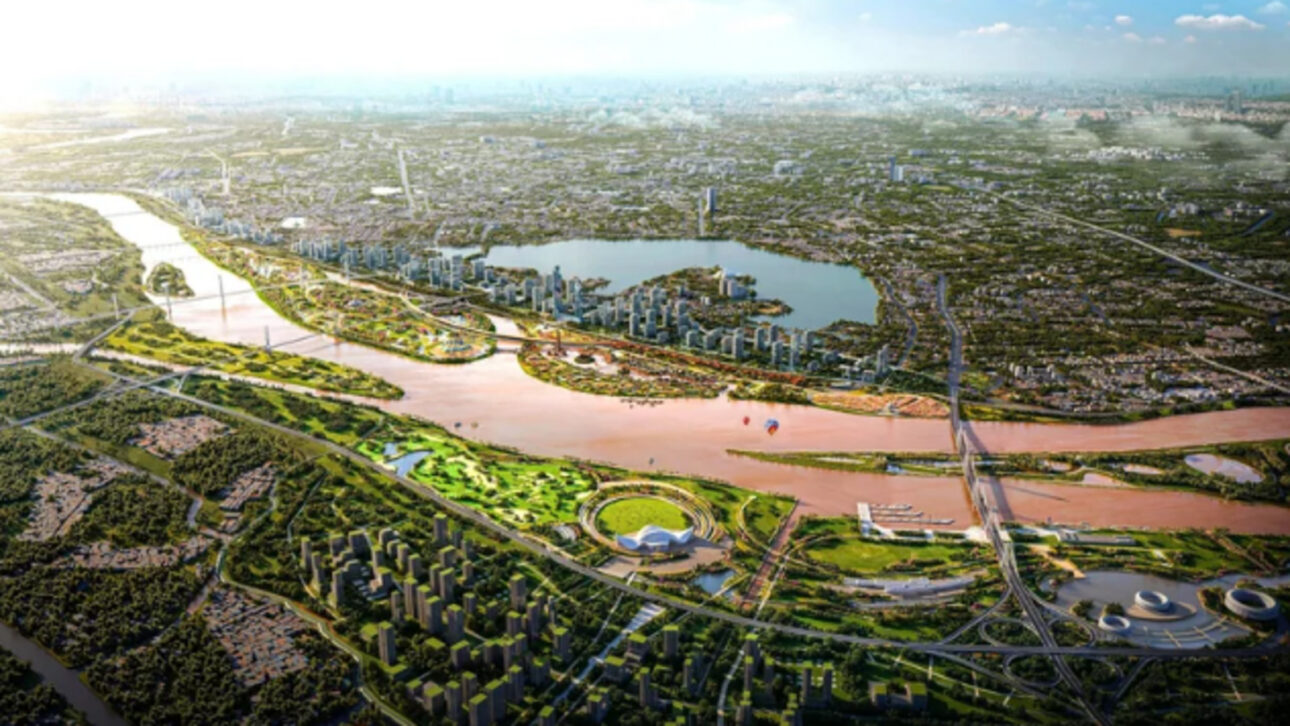
With a planned investment of $28.56 billion, the Vietnam megaproject will span 11,400 hectares in Hanoi and bring together major construction groups, as Dai Quang Minh expands its work in highways, bridges and planned communities
Vietnam is preparing one of Hanoi’s largest urban investments: a $28.56 billion megaproject spanning approximately 11,400 hectares. The Red River Panoramic Boulevard project brings together major business groups and is part of Dai Quang Minh’s expansion. The company also invests in bridges, highways and new neighborhoods across the country.
The project, known as Red River Panoramic Boulevard, covers areas in 16 communes and wards in the Vietnamese capital. Its preliminary investment exceeds $28 billion and includes an extensive urban development and infrastructure effort.
A consortium of three companies will carry out the project: Dai Quang Minh Real Estate Investment, Truong Hai Group Corporation (Thaco) and Hoa Phat Group.
-
Kenya builds new 880-meter-long bridge 100 meters above the Nithi River to replace dangerous crossing that has killed more than 60 people since 2018

-
Dubai Crown Prince Sheikh Hamdan says 14,000 workers have put 33 million hours into the Dh20.5 billion Metro Blue Line, now nearly 30% complete, as Dubai revealed new trains for up to 1,246 passengers.

-
Keolis Côte d’Ivoire chief Paulin Murhula has started preparing the crews for Abidjan’s first metro, a 37.4 km line with 18 stations designed for up to 540,000 passengers a day from January 2029.
-
Prime Minister Narendra Modi walked across Nitish Setu after opening the 9.76-km, six-lane bridge over the Ganges, built for about ₹4,280 crore to give north and south Bihar a new road link and take traffic off two older bridges.


The consortium was established by a decision issued by the Hanoi People’s Committee on June 3, 2026.
Dai Quang Minh serves as the consortium’s representative and lead company, with a reported minimum stake of approximately 30%.
The project is part of the company’s expansion strategy. Dai Quang Minh has moved beyond concentrating its activities in Ho Chi Minh City to take part in developments across different regions of Vietnam.


Red River Panoramic Boulevard project will span 11,400 hectares across 16 areas of Hanoi, Vietnam
The project’s vast footprint is one of the defining features of Red River Panoramic Boulevard.
Its 11,400 hectares equal approximately 114 square kilometers, illustrating the scale of the planned urban development.
With a preliminary investment of $28.56 billion, the project ranks among Hanoi’s largest infrastructure and urban development projects by financial value.
Dai Quang Minh is also involved in other developments in the capital.
Alongside Thaco, Hoa Phat and Song Hong Future Group, the company is part of a consortium responsible for mixed-use urban development and resettlement projects in the Linh Nam ward.
These initiatives expand the companies’ presence across different areas of urban development, including infrastructure and residential districts.
Another investment announced by Dai Quang Minh is in Tay Ho Tay, an urban area of the capital.
There, the company plans to build a commercial, services and shopping complex on a 23,901-square-meter site.
The estimated budget for the commercial development is $188.48 million.
The companies behind the projects are also linked through corporate ownership stakes.
Founded in November 2025, Song Hong Future Group began operations with approximately $58.14 million in charter capital.
In the initial shareholding structure, Tran Dang Khoa, chairman of Dai Quang Minh, held a 40% stake in the company. He also serves as chairman of Song Hong Future Group.
Construction company expands operations with $294 million canal and city planned for 27,500 residents
Dai Quang Minh is not concentrating its investments solely in Hanoi.
In Da Nang, the company was named in November 2026 as an investor in the Cua Lo canal construction project, with a budget of approximately $294.17 million.
The project was approved by the Da Nang People’s Committee under a public-private partnership (PPP) model.
The planned contract is a build-transfer, or BT, arrangement. Under this model, the contract calls for the project to be built and then transferred to the government.
Dai Quang Minh was responsible for preparing the feasibility study, a document that assesses the conditions required to carry out the project.
Under the approved plan, financing may involve a land bank of more than 1,334 hectares in the Tam Hoa-Tam Tien area.
Also in Da Nang, another project is expanding the company’s real estate business.
In July 2026, Dai Quang Minh was selected as the investor for a new urban area in Chu Lai.
The megaproject will cover more than 188 hectares, involve an investment of over $730.74 million and be designed to accommodate approximately 27,500 residents.
The area is divided into six sectors and is expected to offer more than 7,800 apartments.
In addition to these projects, the company has submitted proposals to build a bridge between the port areas of Tam Hiep and Tam Hoa.
It has also proposed a road linking Viet Han Industrial Park to Vo Chi Cong Road.
In Dong Nai province, the company is involved in transportation infrastructure initiatives, including the Dau Giay-Tan Phu Expressway.
Another project involves a road connection between Ma Da Bridge and the Ba Hao intersection.
Company began with major projects in Ho Chi Minh City and now plans to launch 42 projects
Founded in March 2011, Dai Quang Minh got its start in Thu Thiem New Urban Area in Ho Chi Minh City.
Among its best-known projects is Sala, an urban development that helped establish the company’s real estate business.
The company also took part in building four main roads in Thu Thiem and Thu Thiem 2 Bridge, now called Ba Son Bridge.
Its track record also includes Mai Chi Tho Boulevard and roads near the area’s central lake.
As operations expanded, the company began preparing additional public-space projects.
The proposals include a central square, a 27-hectare riverside park and a 150-hectare ecological park in southern Thu Thiem.
The company’s 2026 financial plan reflects this expansion of activities.
Dai Quang Minh set a target of starting construction on 42 projects and completing 12 others during the year.
Planned disbursements exceed US$813.91 million.
The company projected revenue of approximately US$465.09 million for 2026.
For 2027, the company expects revenue to reach US$1.43 billion, more than three times the amount projected for 2026.
These figures are company projections and do not represent financial results already achieved.
Profit surges 8.5-fold as Dai Quang Minh’s debt reaches US$2 billion
The expansion of the company’s portfolio coincided with significant changes in Dai Quang Minh’s finances.
According to its financial report for the first half of 2026, consolidated pretax profit reached approximately US$58.67 million.
That was 8.5 times higher than in the same period of 2025.
Net profit reached US$40.46 million, 6.4 times the year-earlier level.
Profitability also improved.
Return on assets, a measure of profit relative to the resources controlled by the company, rose from 0.29% to 1.06%.
Return on equity increased from 0.73% to 2.21%.
As of June 30, 2026, the company had approximately US$1.83 billion in equity, up 111% from a year earlier.
Of that amount, about US$1.47 billion was paid-in capital, including charter capital and share premium.
However, the financial gains also came with an increase in liabilities.
Total liabilities reached nearly US$2 billion at the end of the first half, up 48.8% from June 2025.
Bank loans totaled approximately US$763.43 million.
Other financial obligations exceeded US$1.18 billion, split between short- and long-term commitments.
The company also reported US$58.14 million in outstanding privately placed corporate bonds.
The proceeds from the bond issue were allocated to two specific projects.
Half, or approximately US$29.07 million, went to the Thadico-Binh Duong Specialized Mechanical Engineering Industrial Park.
The other half was allocated to a planned commercial and services complex in Tay Ho Tay, Hanoi.
The company’s ownership structure has also changed in recent years.
Information released in early 2025 showed that Thaco controlled 77.5% of Dai Quang Minh, while Tran Ba Duong and his family held the remaining 22.5%.
In late 2025, Tran Dang Khoa returned as the company’s chairman, nearly a decade after leaving the position.
His return was documented in the investment proposal for the Red River Panoramic Boulevard, submitted to Hanoi authorities in early December that year.
The move came as Dai Quang Minh prepared a new investment phase centered on urban projects, transportation infrastructure and industrial developments in different parts of Vietnam.
Article prepared based on information published by Theinvestor.