Portuguese
  Spanish


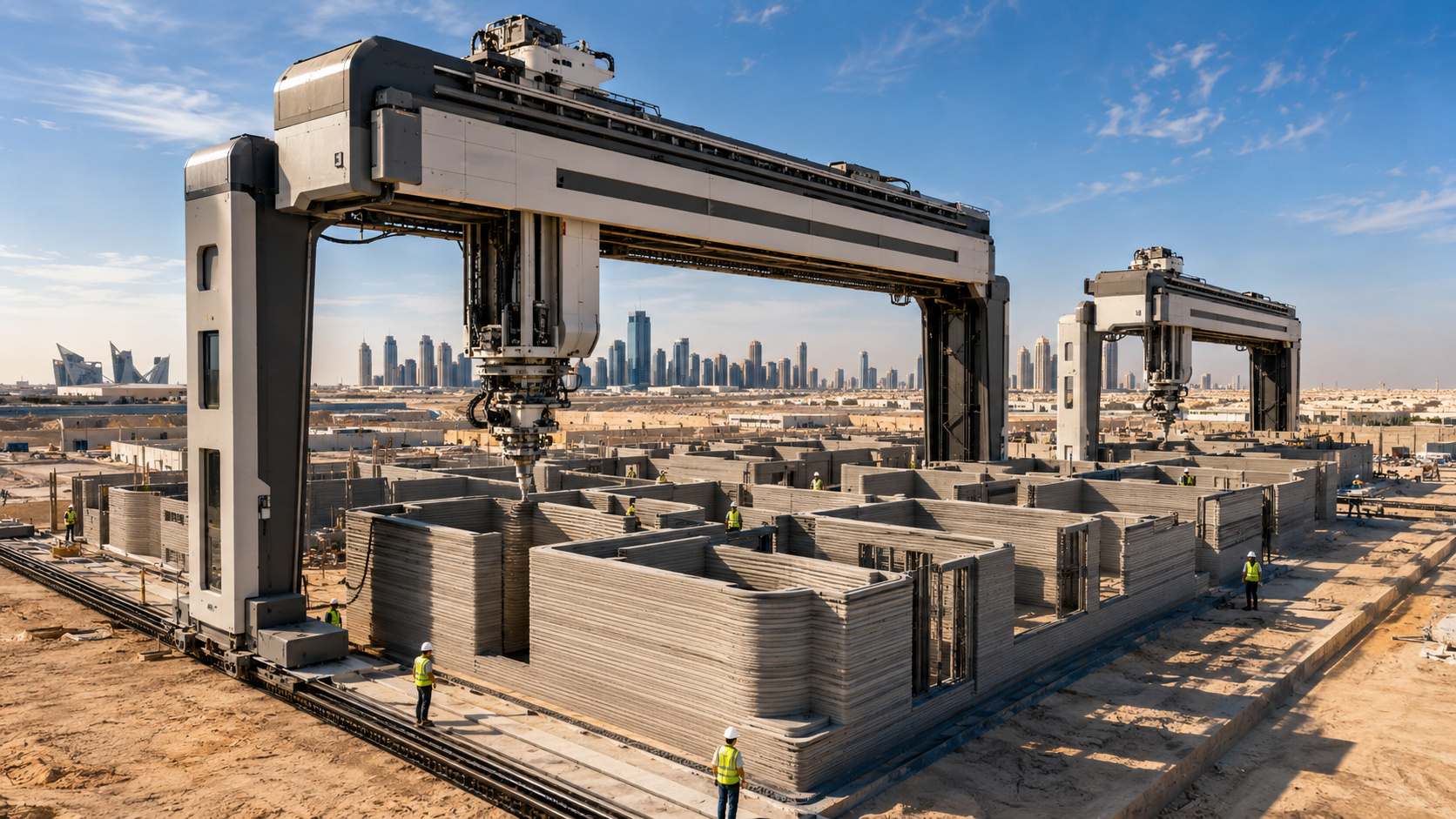


Automated construction in Qatar places giant 3D printers at the center of the worksite and brings concrete schools to a scale that once seemed distant from the routine of traditional construction sites
In Qatar, two 50-meter 3D printers will erect entire schools in concrete and take automated construction to a new level of scale.
The information was published by All3DP, a site about 3D printing and additive manufacturing. The technology uses giant machines to deposit layers of concrete, in a process that replaces part of the manual masonry with controlled printing.
The impact is in the size of the bet. 3D printing in civil construction stops appearing only in small houses and starts targeting school buildings, with greater demands for structure, finishing, and daily use.
-
Father and Son Build 97 cm Thick Circular Stone House in Brazil, Inspired by Scottish Architecture, Creating a New Agrotourism Hub

-
Sweden Removes 200-Ton Concrete Gallery to Restore Pjältån River’s Natural Flow in Europe’s Largest Aquatic Restoration Project

-
Key Infrastructure Projects for Brazil’s Next President: Expanding Railways to Cut Transport Costs, Reduce Truck Traffic, Create Jobs, and Boost Industries Nationwide

-
While China Builds Undersea Rail and Mexico Connects Two Oceans, Brazil Struggles with Grain Transport Due to Lack of Railways


Giant 50-meter machines take on a central role in the construction site
The printers used in Qatar are customized BODXL models, prepared to work in unusual dimensions within civil construction.
Each machine is 50 meters long, 30 meters wide, and 15 meters high. In practice, they function as large gantries, tall structures that move over the construction area.


Instead of raising walls only with traditional masonry teams, the system deposits concrete in layers, following a design planned before execution.
This logic changes the common image of the construction site. The machine ceases to be a support equipment and takes on the center of the worksite, almost as if it were the construction site itself in motion.
3D printed schools show a change of scale in civil construction
The main difference of the project is in the scale. 3D construction in concrete has already appeared in smaller experiments, but entire schools represent a greater challenge.
A school needs to serve people every day. Therefore, it’s not enough to just print walls. The building also needs finishing, electrical installations, internal circulation, and safety validation.
This point makes the project more relevant to the sector. It tests if 3D printing can move from a technological showcase to real-use construction projects.
There is also a strong visual effect. Seeing a 50-meter machine molding concrete in layers helps the public understand how automation can transform old construction stages.
All3DP details the BODXL printers and the advancement of layered concrete
All3DP, a site about 3D printing and additive manufacturing, detailed the use of customized BODXL printers in the school projects in Qatar.
The basis of the technology is simple to understand. The concrete comes out of the machine in layers, one on top of the other, until it forms parts of the structure planned in the project.
This process allows for creating different shapes from the more common straight walls. 3D printing can facilitate curves and freer designs because the machine follows a digital model.
Even so, the construction doesn’t become completely automatic. After printing, important stages still come in, such as finishing, installations, and technical checks.

Automated construction promises speed, fewer forms, and less waste
Automated construction attracts attention because it can reduce manual stages and simplify parts of the process. In a traditional construction, many walls require forms, markings, and repeated work.
With 3D printing, the concrete is applied at the right point and in planned layers. This can reduce waste and lessen the need for forms in some parts of the construction.
Another gain is in design freedom. The machine can follow paths defined in the digital project, which allows for less common formats.
Even so, the technology needs to prove performance outside the lab. A school requires strength, safety, good finishing, and proper functioning in daily use.
Standards, finishing, and installations continue to be challenges for printed schools
The advancement of 3D printed schools does not eliminate important questions. The structure needs to be validated and the building must comply with technical regulations before being used.
There are also challenges in finishing. A concrete printed wall may require subsequent treatment to receive paint, coating, or visual adjustments.
Electrical installations represent another sensitive point. Wires, light points, sockets, and other systems need to be integrated into the project without compromising the structure.
Therefore, 3D printing appears as a powerful part of the construction, but not as a complete replacement for all the professionals involved.
Qatar transforms the printed school into a showcase of the future for the sector
The project in Qatar shows how the giant 3D printer can cease to be a curiosity and become a real test for larger constructions.
The dimensions of the machines reinforce this change. At 50 meters long, they do not look like common construction equipment. They resemble a factory set up on the site itself.
The result can influence new discussions about labor, speed, waste, and automation. The construction industry observes this type of experience because it challenges processes used for decades.
There is still no guarantee that printed schools will become the standard. The project, however, shows that the technology is already being tested on a much more ambitious scale.
The two giant 3D printers in Qatar pose a practical question to the construction industry: to what extent can a machine take over tasks previously performed by entire teams?
If a school can be safely printed in concrete with good finishing, do you believe this technology should become the standard in construction or remain a showcase for a few countries?