






 Portuguese
  Spanish


During the construction of the Huajiang Grand Canyon Bridge, in Guizhou province, workers discovered a massive aquifer that was continuously pouring water and threatened to compromise the project. According to ndmais, instead of simply draining it, engineers installed reservoirs in the mountains and pipelines on the bridge deck that, when full, release the water into an artificial waterfall of 625 meters in height and 300 meters in width over the deepest canyon in China.
The highest bridge in the world hides within its structure an engineering solution that turned a problem into a spectacle. During the construction of the Huajiang Grand Canyon Bridge, in Guizhou province, southwest China, workers found a massive aquifer that fed a continuous flow of underground water. The excess moisture threatened the progress of the work and the integrity of the equipment at the bottom of the canyon, locally known as the “Earth’s fissure” due to its depth of 625 meters. The solution found by Chinese engineers was not only efficient, it was cinematic.
Instead of wasting the massive aquifer’s water with conventional drainage, the project integrated strategically positioned reservoirs in the mountains surrounding the bridge. The system directs the excess flow through pipelines installed directly on the deck of the structure itself. When the reservoirs reach their limit, the water is released all at once, creating an artificial waterfall of 625 meters in height and approximately 300 meters in width that spreads through the deep valley like a liquid curtain visible from kilometers away. TIME magazine included the site in the list of the most incredible places in the world in 2026.
The bridge that is 625 meters above the river

The Huajiang Grand Canyon Bridge was inaugurated on September 28, 2025, and connects the Liuzhi district to Anlong county, crossing the Beipan River in one of the most mountainous and isolated regions of China. The structure has a total length of 2,890 meters, a main span of 1,400 meters, and weighs 22,000 tons, positioned 625 meters above the riverbed, equivalent to more than two Eiffel Towers stacked.
-
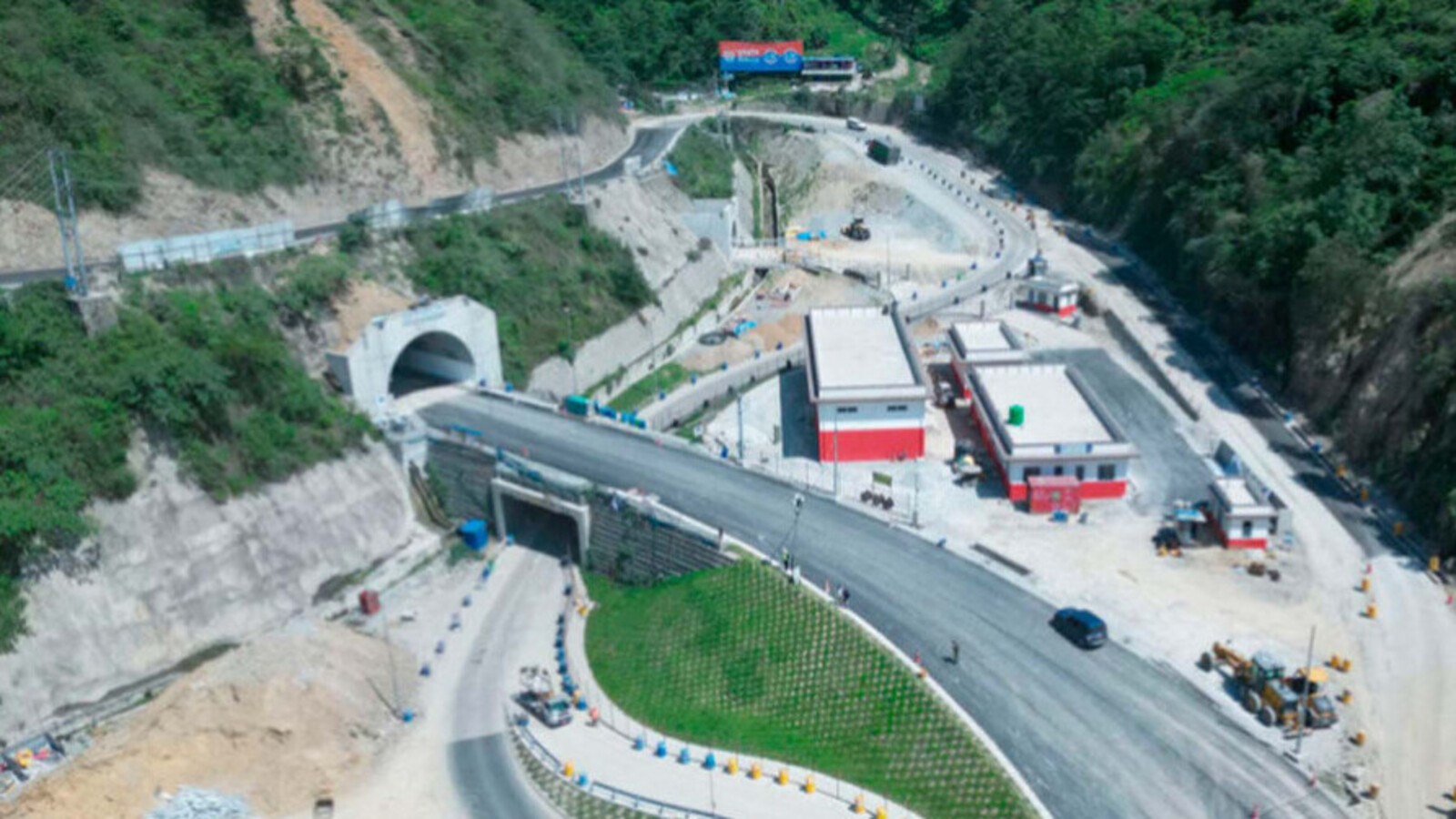
After 79 Months and $145 Million Investment, Nepal Set to Open First 2.7 km Road Tunnel to Ease Traffic in Kathmandu Valley

-
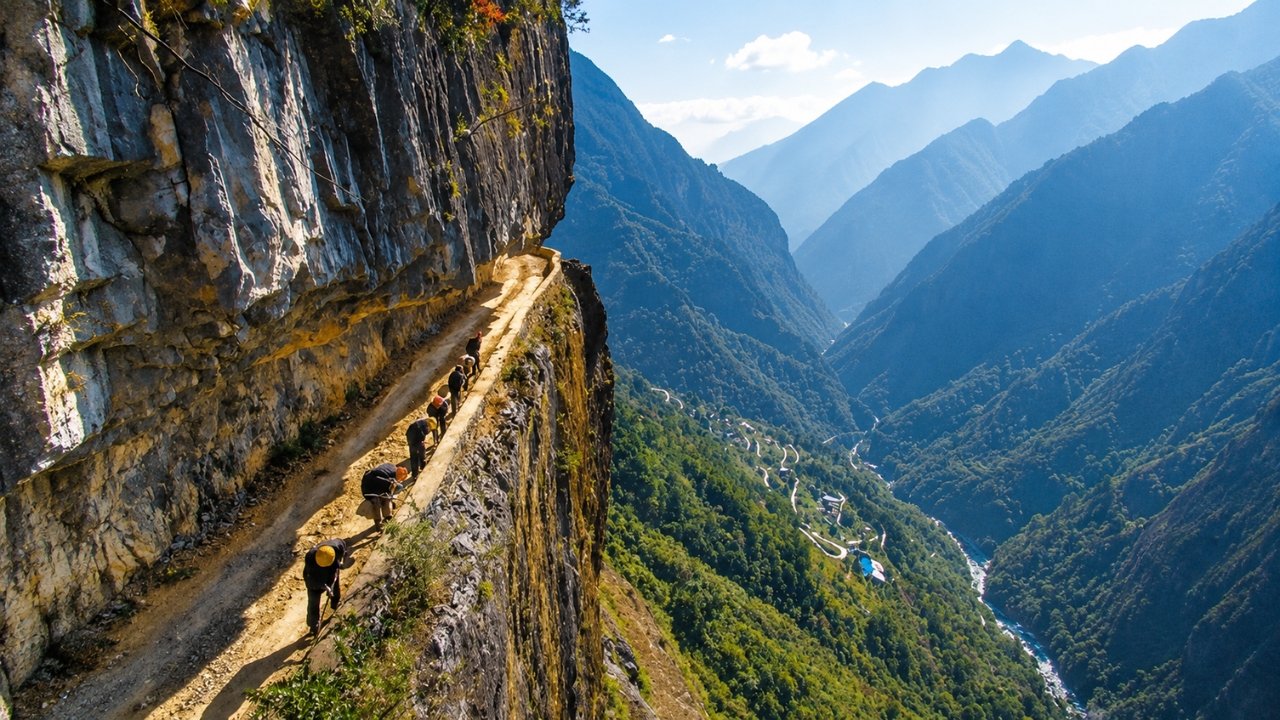
In China, 23 Families Spent Over 4 Years Carving a 1.2 km Road Through a Cliff to Overcome Isolation and Transform a Remote Village

-
Giant 3,600-ton Crane Breaks Two World Records by Installing World’s Largest Single-Piece Forged and Welded Hydrogenation Reactor, Weighing 3,037 Tons, in Chinese Petrochemical Plant in Just Six Days

-
$80 Million Bridge in Brazil Cuts Travel Time from 30 Minutes to 1 Minute, but Audit Reveals Major Flaws


The construction took three years and eight months, facing challenges such as steep slopes, complex geological conditions, and severe wind gusts that required wind tunnel testing and the installation of fiber optic sensors along the entire route. The project used a lighter arch design that reduced the predicted weight by 30%, allowing the bridge to support vehicle traffic without compromising structural safety.
How the immense aquifer turned into a waterfall

The discovery of the immense aquifer happened during excavations on the canyon slopes. The underground water flowed continuously, flooding work areas and compromising the schedule. Engineers realized that simply pumping the water out would be expensive, inefficient, and waste an abundant natural resource.
The solution was to build accumulation reservoirs in the mountains adjacent to the bridge and connect them to the deck through pipelines. When the volume of water captured from the immense aquifer reaches the maximum capacity of the reservoirs, the system releases the excess in a controlled drop that spans the entire height of the bridge. The flow is intermittent and depends on the rainfall regime: during wet periods, the waterfall operates at full force; during severe droughts, the mechanism is temporarily halted and only reactivated when the natural flow of the aquifer is restored.
The crossing that reduced two hours to two minutes
In addition to the waterfall, the bridge had a direct impact on the lives of local residents. Before the inauguration, crossing the canyon required winding around mountains on winding roads for approximately two hours. With the bridge, the same journey takes less than two minutes, connecting communities that lived isolated by the rugged terrain and opening access to commerce, health, and education.
Guizhou is one of the provinces with the lowest GDP per capita in China, and a large part of the population lives in agricultural areas with limited infrastructure. The Huajiang Bridge is part of a new highway planned to integrate tourist sections and boost the region’s economic development. The expectation is that the combination of road infrastructure with the tourist attraction of the waterfall and canyon will generate jobs and revenue for communities that previously relied solely on subsistence farming.
Tourism that arises from an engineering problem


The waterfall fed by the immense aquifer was not planned as a tourist attraction, but it quickly became one. The bridge features a high-speed glass panoramic elevator that takes visitors to a café located 800 meters above the Beipan River. For the more adventurous, there is bungee jumping and a glass walkway 580 meters high, with a panoramic view of the canyon and the waterfall itself.
Recognition by TIME magazine as one of the most incredible places in the world in 2026 consolidated the status of the Huajiang Bridge as an international tourist destination. What began as a headache for engineers who encountered the immense aquifer during excavations turned into a postcard that attracts visitors from all over the world and demonstrates how Chinese engineering turns obstacles into opportunities.
Have you ever heard of a bridge that has a 625-meter artificial waterfall? What impresses you the most: the height, the aquifer that feeds the waterfall, or the fact that it all started as a drainage problem? Tell us in the comments.





Incredible that the Chinese engineers working on the bridge can turn a huge problem into something spectacular!
Fantastic 😍