Portuguese
  Spanish


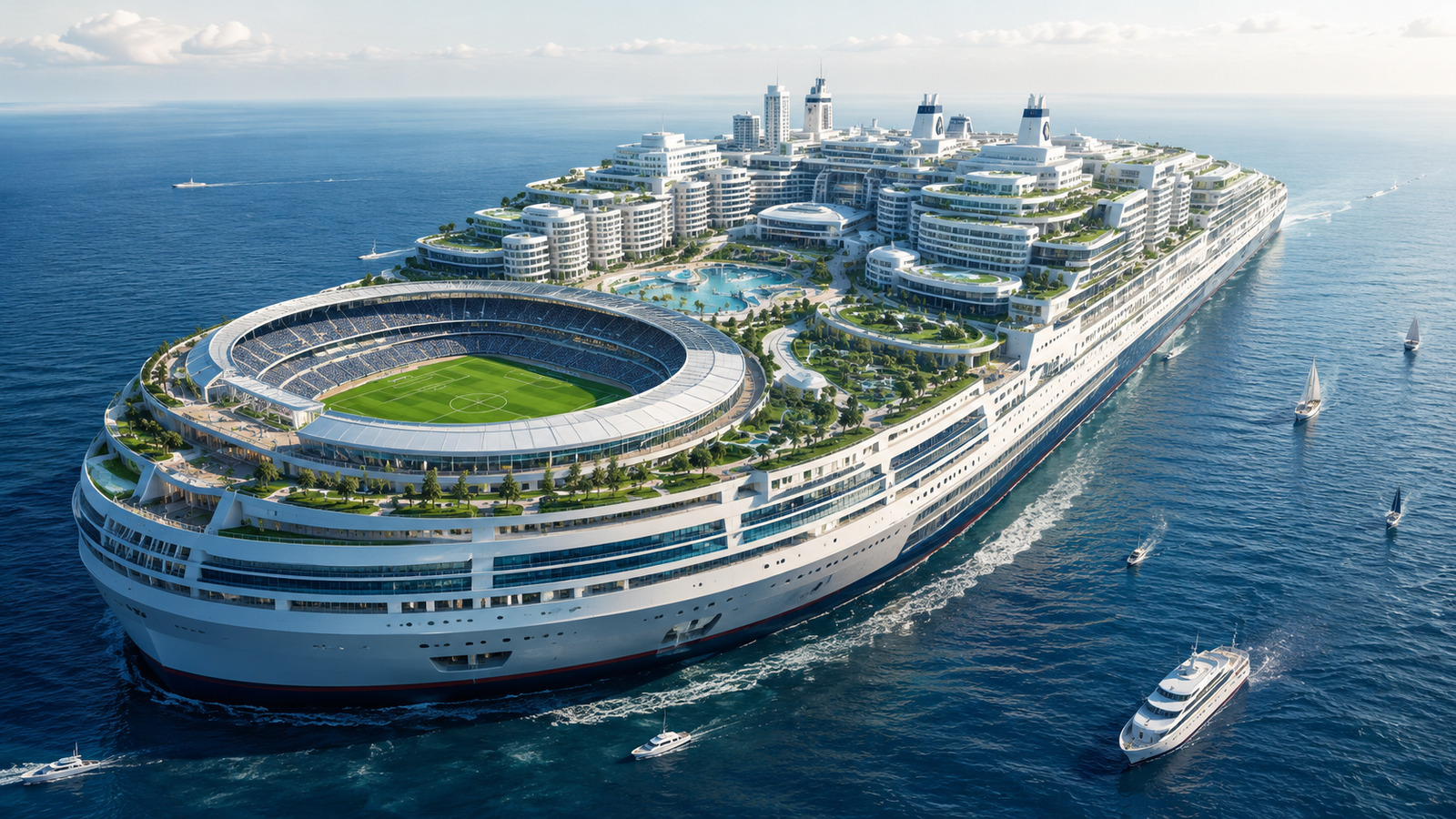

Designed since the 1990s, the Freedom Ship envisions a 1.6-kilometer structure with capacity for over 80,000 people, offering housing, hospital, schools, commerce, leisure, and permanent services at sea
A floating city Freedom Ship with capacity for over 80,000 people was conceived to function as a permanent community at sea, bringing together housing, schools, hospital, hotels, commercial areas, parks, and even a football stadium. Although the concept has existed since the 1990s and has gained prominence again in recent years, the project still depends on funding, engineering solutions, and approvals to come to fruition.


How the floating city was planned
The Freedom Ship was envisioned to be much more than a ship. The proposal envisions a structure about 1.6 kilometers long, over 220 meters wide, and dozens of habitable levels.
Given the planned dimensions, the vessel would have characteristics similar to those of a small city. It is estimated that the complex could accommodate permanent residents, workers, and visitors, forming a population of over 80,000 people.
-
Mbappé makes a decision and refuses to advertise bets: “they have destroyed many people,” says the French star, who witnessed gambling addiction devastate families and entire neighborhoods where he grew up, becoming a global example of responsibility.

-
At 17 years old, he received an order for 2,000 Easter eggs without having a factory, worked up to 18 hours a day to deliver everything, turned artisanal chocolate into a national empire, and today Cacau Show has more than 4,000 stores in Brazil.

-
Couple creates handmade glasses using bottle caps and acetate scraps, creating exclusive models with the brand Save Me.

-
The illiterate peasant who “predicted” the pandemic, television, and the two world wars in the 19th century: the prophecies of Mitar Tarabich haunt the internet with a final warning about a Third War that would make the whole world sleep.




The goal is to offer a complete routine at sea, bringing together housing, education, health, leisure, commerce, and work in a single space, without relying on a fixed port to function as an urban center.

Structure includes essential services and leisure areas
The project includes residences, schools, medical centers, hotels, restaurants, offices, shops, parks, and recreational spaces. Among the planned facilities is also a football stadium.
The main difference compared to large cruises lies in the intended use. While tourist ships receive passengers for limited periods, the Freedom Ship was designed for people who would live, study, and work permanently in the structure.
The idea aims to replicate the functioning of a conventional city, offering essential services for the residents’ daily lives during navigation.
Technical challenges still prevent construction
Turning this concept into reality requires overcoming large-scale challenges. A structure of this size would need to ensure stability, energy generation, supply, potable water, waste treatment, security, and medical care for tens of thousands of people.
Another obstacle is the size of the vessel. According to the proposal, the Freedom Ship would have difficulties docking at conventional ports. Therefore, transportation between the floating city and the coast would be carried out by smaller vessels.
In addition to operational issues, the project also faces financial limitations. Without sufficient resources for its execution and without definitive construction stages, the initiative remains just a concept.
Project continues without a forecast to come off the drawing board
The concept of the Freedom Ship emerged in the 1990s and has regained interest in recent years due to the proposal of creating a new form of permanent living on the ocean.
Despite the buzz, there is still no defined date for the start of construction or for the structure’s entry into operation.
If realized, the project could become one of the largest mobile structures ever planned, bringing together complete urban functions on a single platform capable of navigating the world.
This article was prepared based on information from the material provided about the Freedom Ship project, with data, numbers, and statements preserved as per the consulted content.