Portuguese
  Spanish


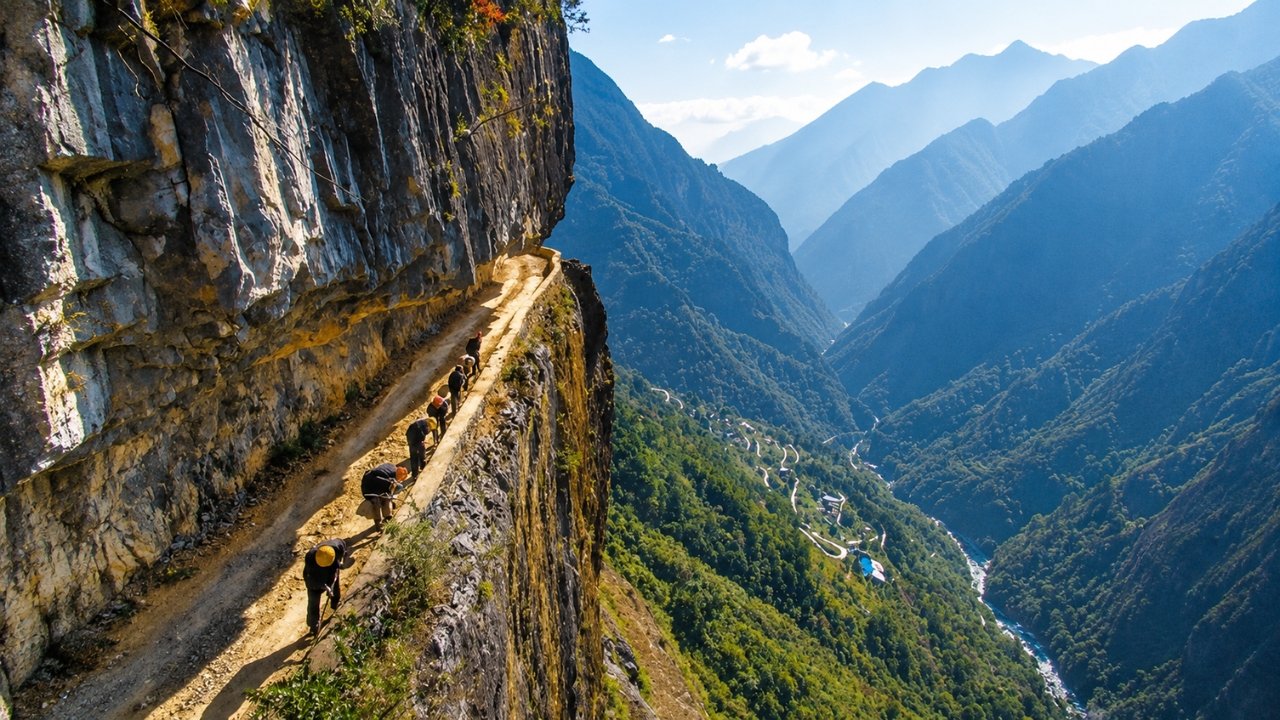

The story of Lanying Road shows how a community isolated by the mountain changed its own routine by creating a connection to the outside world, after years of relying on dangerous paths to bring food, agricultural products, and basic goods.
In a mountainous region of China, 23 families lived isolated by a cliff, narrow trails, and a path so difficult that leaving the village could turn into a whole day’s journey. To bring food, sell agricultural products, or fetch basic items, residents had to face narrow passages alongside the precipice.
It was in this scenario that they made an extreme decision: to carve a 1.2 km road directly into the rock, using hammers, chisels, baskets, ropes, and their own bodies as labor.
The work began in September 2001 and took 4 years and 3 months to complete. According to China Daily, one of the main English-language newspapers in China, the road was opened by 23 families from a small community linked to the village of Lanying, in Chongqing, where just over 80 residents lived.
-
Giant 3,600-ton Crane Breaks Two World Records by Installing World’s Largest Single-Piece Forged and Welded Hydrogenation Reactor, Weighing 3,037 Tons, in Chinese Petrochemical Plant in Just Six Days

-
$80 Million Bridge in Brazil Cuts Travel Time from 30 Minutes to 1 Minute, but Audit Reveals Major Flaws
-
Man Builds Stone Bed with Granite Rocks and Hand-Sawn Cedar Beams, Home Extension Garners Over 437,000 Views on Bonus Bolts Channel

-
Brazilian Researcher Develops Color-Changing Roof Tile to Reduce Air Conditioning Use by Up to 15%



Before the road, each exit was a dangerous crossing
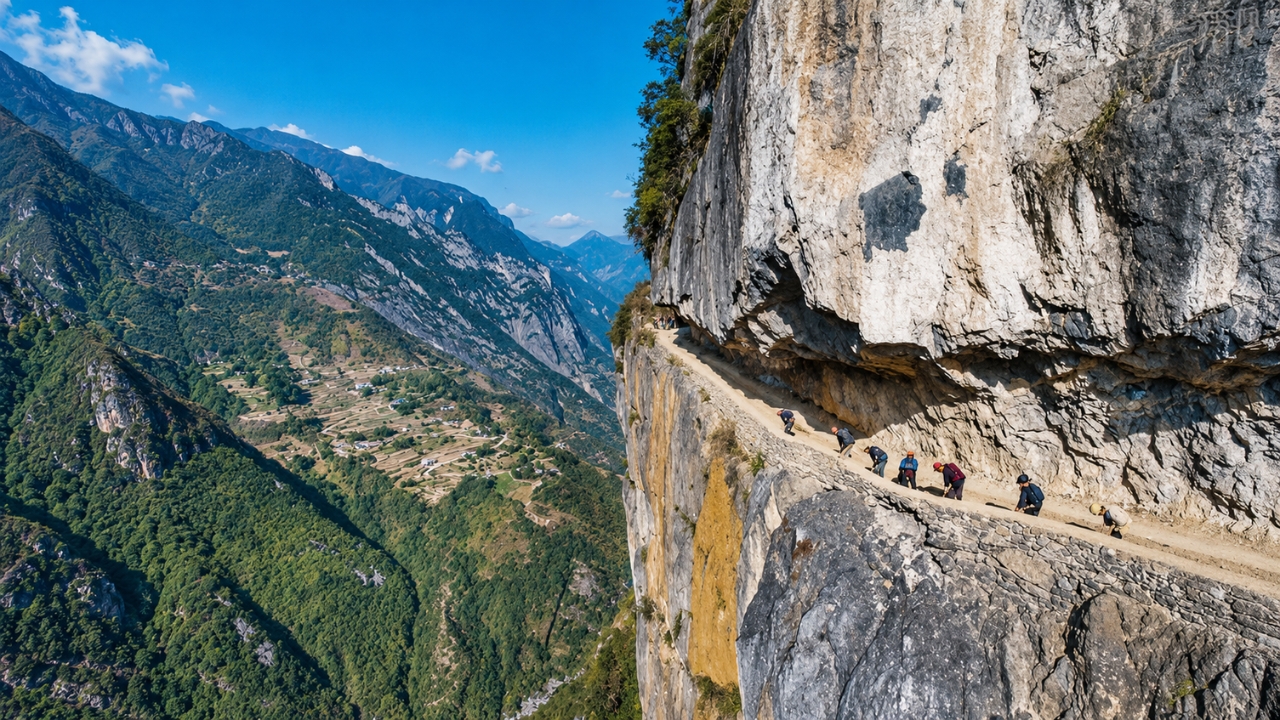
The routine in the village was limited by the mountain. To reach the outside world, residents depended on narrow paths locally known as “maomao roads.” In some sections, these passages were less than 40 cm wide.
It was along these paths that families carried potatoes, corn, and other agricultural products. It was also along this same path that they brought rice, flour, fertilizers, and basic goods into the community.
The problem was not just the distance. The journey required balance, physical strength, and patience. Chinese sources cited in the investigation indicate that reaching a road could take a whole day. On longer old routes, the journey could take up to 2 days per trip.
For those who lived there, the mountain was not a beautiful scenery. It was a daily barrier. Each load on their backs showed how much isolation influenced trade, transport, and the very permanence of families in the place.
The solution was to divide the cliff among the families
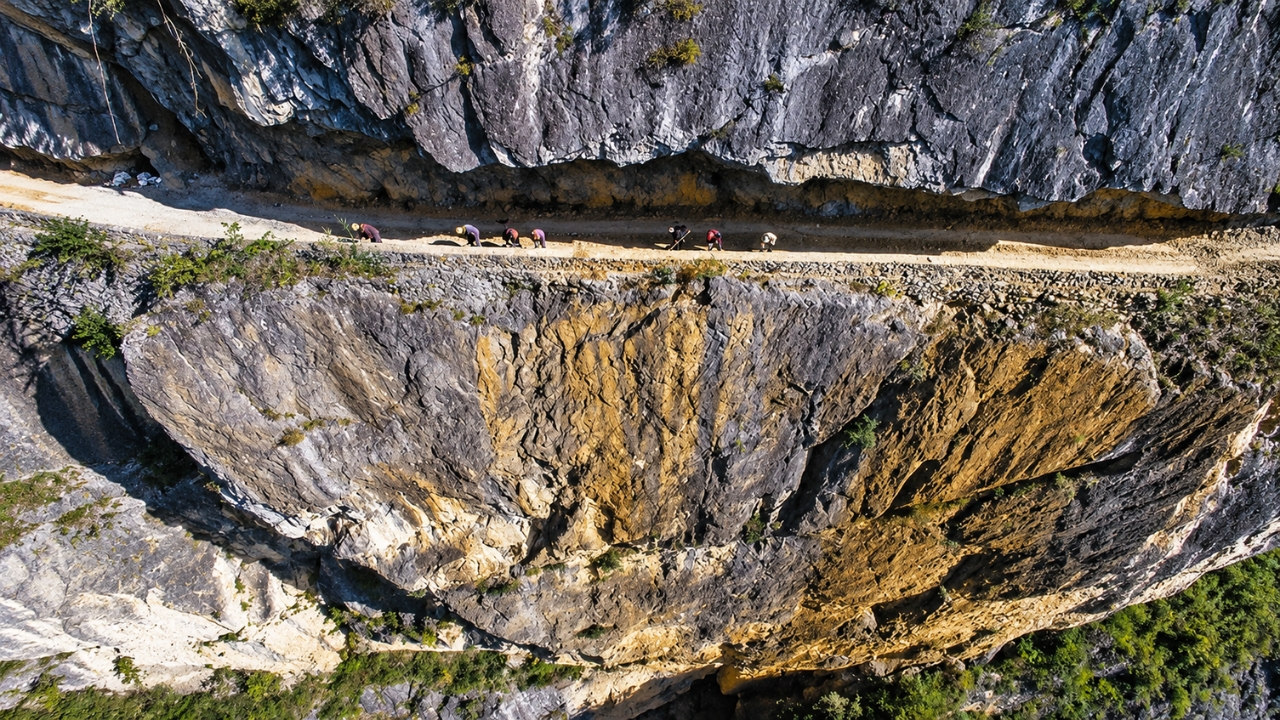
Without heavy machinery at the beginning, the residents divided the future road into 23 sections, one for each family. The idea seemed simple on paper, but the work took place on a stone wall, facing a void of more than 1,500 meters.
Men descended tied by ropes, drilled the rock with steel bars, hammered, made space for explosives, and removed stones in baskets. Day after day, the mountain began to take the shape of a road.
The image is powerful because it does not show a large modern construction, full of machines and engineers. It shows ordinary families making a way in a place where the geography itself seemed to say that no one should pass.
The road was born, but it left marks
At the end of 2005, after 4 years and 3 months of work, the 1.2 km road was completed. But the initial result was still rough. On dry days, the path raised dust. On rainy days, it turned to mud.
Even so, for the residents, it changed everything. The road replaced narrow trails with a real connection to the surrounding region.
The People’s Daily, one of the most well-known newspapers in China, reports that the construction also had serious risks. One of the residents, Xiang Jiagen, lost his right eye after a delayed explosion during the work. The investigation also cites 8 major landslides during the construction period.


The path opened in the rock became an attraction
Years later, between 2017 and January 2018, the road received reinforcement and paving with support from the local government. The passage ceased to be just an improvised path on the cliff and began to allow safer circulation.
With the improved access, the village also entered a new phase. According to iChongqing, a local news portal, the region received tourist infrastructure, including an observation platform, trails, restrooms, and lighting.
The road that was created to bring families out of isolation began to attract visitors, photographers, and drivers interested in the impressive image of the path carved into the mountain.