






 Portuguese
  Spanish


Scientists warn that the World Cup may have slower matches, impacting players’ pace, decisions on the field, and the intensity expected by fans during the tournament, which will be held in 16 stadiums in Canada, Mexico, and the United States.
Analyses by Climate Central and World Weather Attribution indicate that heat may alter performance, safety, and planning for the 2026 World Cup, with 93% of the games at risk of temperatures above 28°C and additional concern in outdoor stadiums.
Heat above 28°C may affect 93% of the 104 games of the 2026 World Cup, increasing risks to athletes’ performance, fan safety, and match pace in Canada, Mexico, and the United States.
World Cup will face climate challenge in 16 stadiums
The analysis was released by Climate Central, a charitable organization that created an interactive tool to estimate how each team may be affected by heat during the tournament. The survey uses historical data to calculate the probability of daily temperatures exceeding 28°C.
-
Wyoming Couple Grows Tropical Fruits Year-Round in -40°C Using Geothermal Greenhouse, Demonstrating Earth’s Heat Can Produce Oranges and Lemons in Snow Without Traditional Heating

-
Ship Returns from Brazilian Coast with Thirty Newly Discovered Life Forms
-
Nigerian Professor Invents Electricity-Free Refrigerator Using Clay Pots and Wet Sand, Extending Shelf Life of Vegetables to 27 Days; 7,000 Units Distributed in Energy-Deprived Villages

-
Flower Farms Supplying London and Amsterdam Face Backlash for Environmental Impact on African Lake, Threatening Jobs for 50,000 Workers



This limit is associated with a decline in players’ physical performance. Previous research indicates that above this mark, athletes may reduce sprint frequency, cover less total distance, and require more recovery time during matches.
The 2026 World Cup will be held in 16 stadiums across Canada, Mexico, and the United States. The schedule will feature 104 games, a number used as a basis in analyses of heat exposure during June and July.
The warning is relevant because soccer relies on bursts, intensity, quick decision-making, and sudden changes in play. In hotter conditions, match speed, tactical choices, and playing style may be affected.
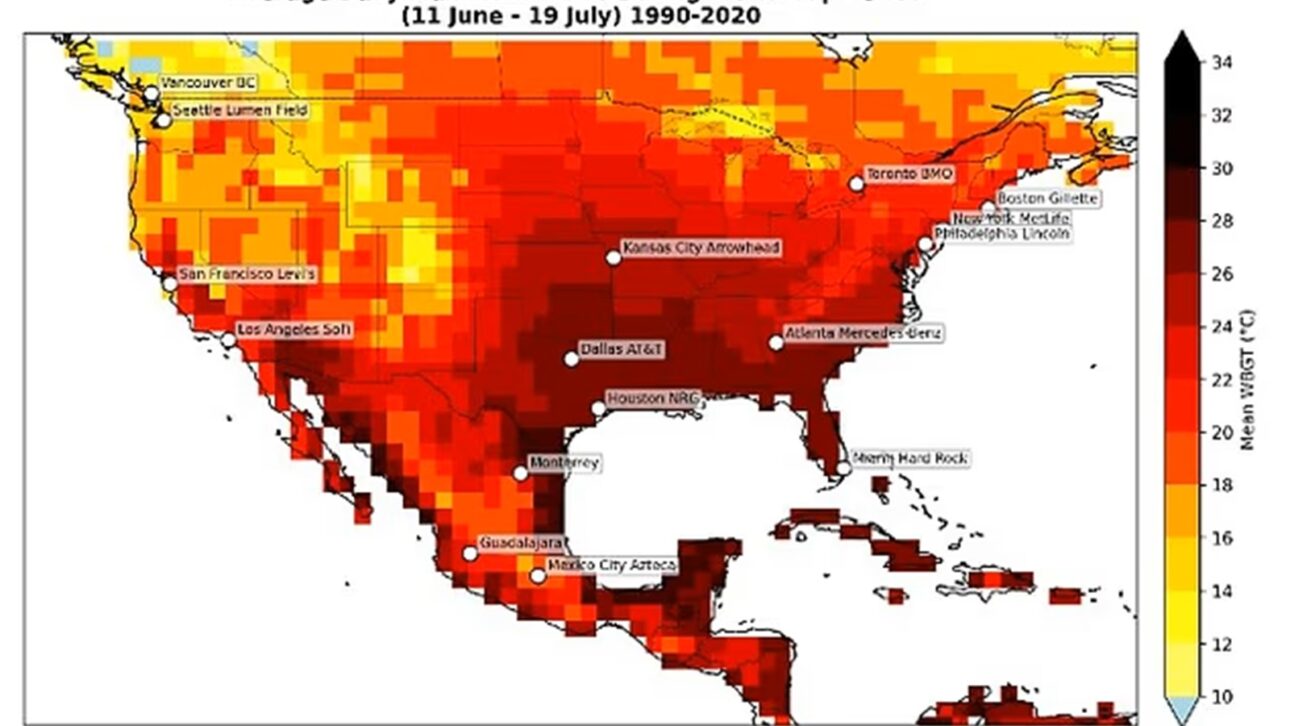
Climate change increases the chance of debilitating heat
Scientists from Climate Central estimate that warming caused by climate change increases the chances of debilitating heatwaves during the tournament by about 8%. The entity states that the consequences may appear in real-time in sports.
The analysis indicates that climate change increases the likelihood of heat impairing performance in all matches. The most notable case mentioned involves the June 26th game in Mexico between Uruguay and Spain.
Another recent assessment by Climate Central points out that extremely hot days in June and July are increasing in all 2026 World Cup stadiums, except for two. The combination of heat and humidity raises concerns.
The risk is not limited to players. Fans and staff will also be exposed, especially since most stadiums are outdoors. Only three arenas have full air conditioning: Atlanta, Dallas, and Houston.
England appears among teams with high risk
England’s first match, against Croatia, has a 95% chance of having temperatures capable of impairing performance. In the same group, the English team has a medium risk of 49% in the initial phase games.
The second match, against Ghana, presents a milder scenario, with a 16% probability of heat detrimental to performance. The third game, against Panama, has a 36% chance of being affected by high temperatures.
Climate Central also calculates that if England reaches the final, it will have four matches with more than a 50% probability of being impacted by heat. This data shows how the problem can follow teams throughout the tournament.
Scotland is also in a situation of concern. The match against Brazil, scheduled for June 24th in Miami, is among the games cited in analyses about intense heat conditions for British fans.
Studies point to matches in unsafe conditions
An independent group of researchers, linked to World Weather Attribution, modeled the climate conditions during each of the 104 matches. The results indicate that a quarter of the games could occur in conditions considered unsafe.
The same study points out that five matches would have such intense heat that experts would recommend a complete postponement. Among the locations cited as concerning are Miami, Kansas City, New York, and Philadelphia, where many games will occur without full air conditioning.
Dr. Joyce Kimutai, from Imperial College London and one of the study’s authors, stated that the context in which the tournament is played has fundamentally changed in just 32 years. The statement reinforces the climatic dimension of the problem.
Organizers are already adopting measures to reduce risks. Among them are more night games in hotter cities and mandatory hydration breaks in all matches, a measure aimed at protecting athletes in heat conditions.
Matches can also be postponed when the wet-bulb globe temperature, known by the acronym WBGT, reaches 32°C. This measurement combines heat and humidity to assess the risk of heat stress.
Even with adaptations, researchers warn that there is a real risk of games in unsafe conditions for players and fans. The issue is significant because it involves sports performance, public health, and the organization of a global event, also during the northern hemisphere summer.
In practice, the World Cup may reveal a new challenge for football: competing in increasingly hot environments, with a direct impact on those who play, watch, and work in the stadiums.
What do you think about this warning regarding the heat at the 2026 World Cup?




WELCOME TO THE GREAT ILLUMINATI.🔺 Greetings to you. Are you ready to join the illuminati for wealth, fame, power, protection, wisdom and all your desires? Apply for Illuminati Membership Today and Enjoy the Benefits. Join us today and start getting $800,000 ($800,000) as your first membership benefit. Plus more awaits you. If you are interested or want to know more about the organization please answer YES Note!!! Distance is not a barrier to join the Illuminati and there is no human blood sacrifice. WhatsApp number +675 8169 4374 🔺🔺🔺