Portuguese
  Spanish


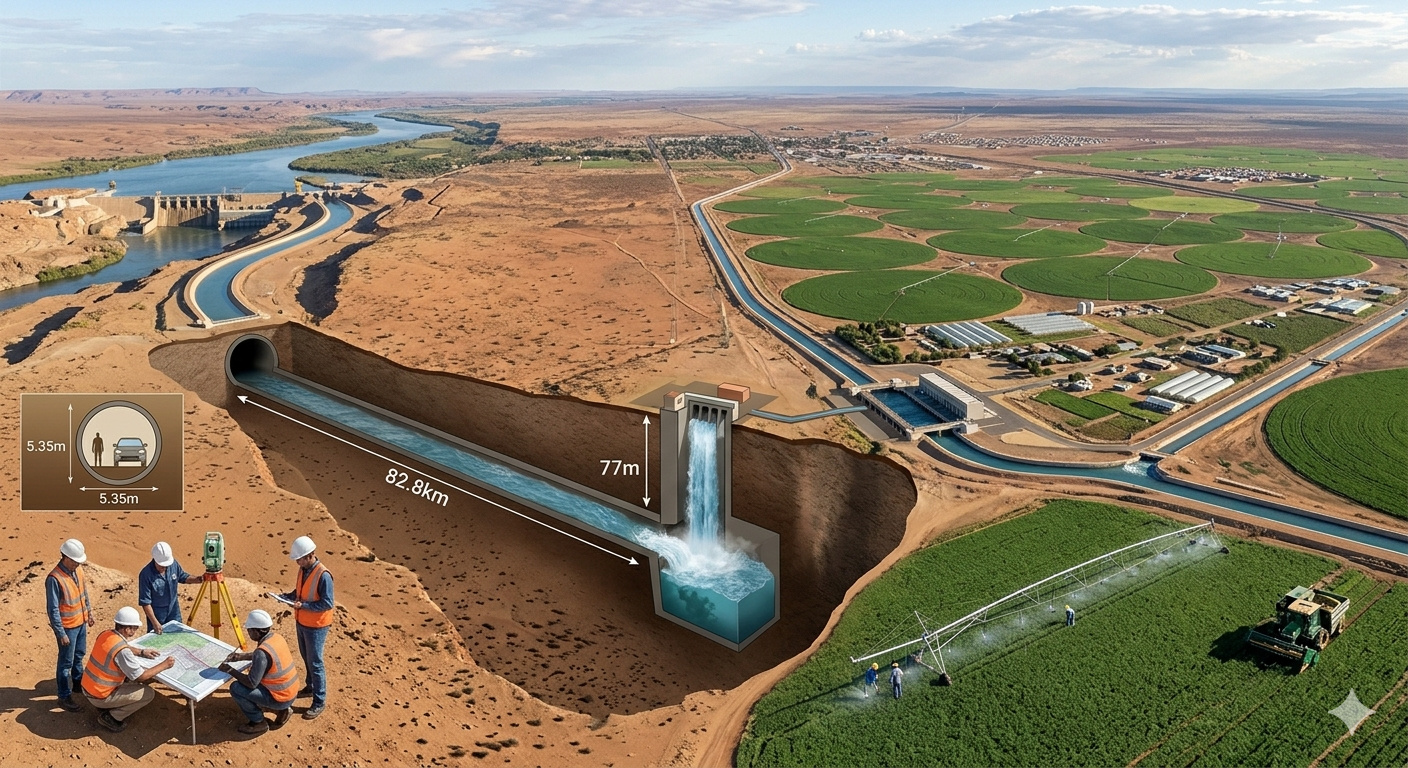

With monumental underground engineering, the Orange River water project supplies the Karoo, enables intensive agriculture, boosts local economies, and redefines sustainable water use in arid South African regions.
Few people imagine that beneath the dry soil of South Africa’s interior lies one of the largest water transfer tunnels on the planet. Built to transport water from the Orange River to the country’s arid regions, the so-called Orange-Fish Tunnel is a project that operates out of sight but has a direct impact on agriculture, economy, and land occupation.
Completed in the 1970s, the system was designed to tackle a historical problem: the inequality in water distribution between wet regions and dry areas of the South African interior. The solution found was not to build visible channels, but to create an “underground river” capable of crossing entire mountains without relying on continuous pumping.
82.8 km tunnel was excavated with precision to maintain continuous flow by gravity
The Orange-Fish Tunnel is approximately 82.8 kilometers long, placing it among the largest continuous hydraulic tunnels in the southern hemisphere. The structure was excavated through complex rock formations, requiring advanced engineering techniques for its time.
-
Creative Uses for Toilet Paper Rolls That Will Change Your Perspective

-
Crab Trapped in Plastic Bottle for 62 Days Near Okinawa Highlights Little-Known Impact of Marine Pollution on Small Animals
-
Esperanza’s Bamboo Barrier in Oaxaca Redirects River and Reduces Erosion by 85% in Five Years

-
Family Builds Homemade Wind Turbine to Power Off-Grid Home, Video Reaches 555,000 Views on Ngô Thị Huyền’s Channel


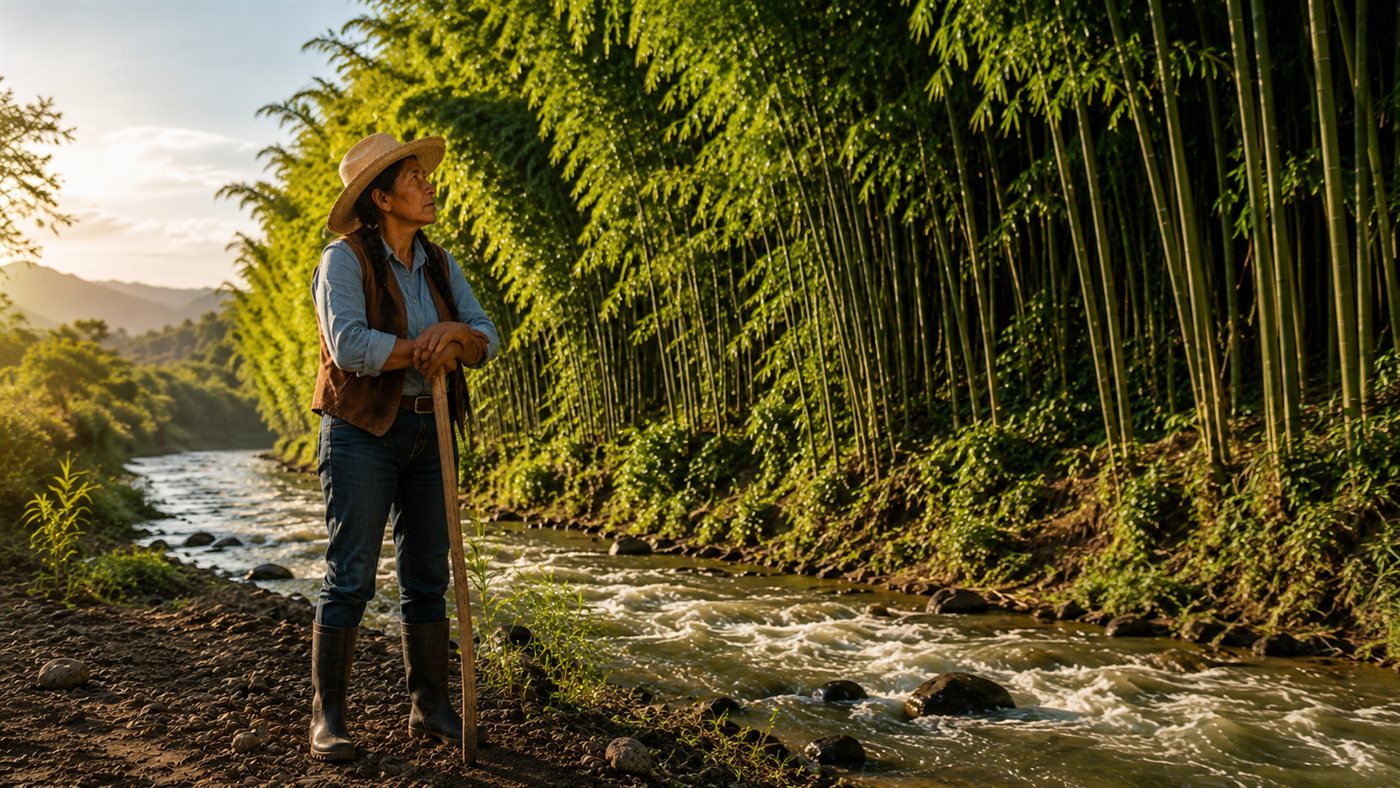
With a diameter of 5.35 meters, the tunnel allows the passage of large volumes of water, maintaining a constant flow throughout its entire length. One of the most important aspects of the project is the control of the slope: the water travels through the system with a drop of about 77 meters, enough to ensure movement without the need for pumping in most of the route. This detail drastically reduces energy consumption and increases the system’s efficiency over time.
Water captured from the Orange River feeds arid regions of the Karoo
The water transported by the tunnel originates from the Orange River, the longest in South Africa. The capture occurs from the Gariep Dam, one of the largest in the country, which regulates the flow and allows part of the water to be directed to the underground system. After traveling dozens of kilometers underground, the water is released into the Great Fish River valley, a region that historically faced water scarcity.
The final destination includes areas of the Karoo, a vast semi-arid region known for its low water availability and limitations for intensive agriculture. The tunnel acts as an invisible bridge between an area rich in water resources and another marked by scarcity.
Infrastructure allowed agricultural expansion in previously unproductive regions
Before the construction of the system, much of the areas supplied by the tunnel had severe limitations for agricultural production. The lack of water restricted cultivation and made the activity economically unviable on a large scale.
With the arrival of water in constant volume, these regions underwent significant transformation. Irrigation allowed the development of agricultural crops, increased productivity, and greater economic stability. The impact goes beyond agriculture, influencing land occupation, income generation, and regional development.
Project integrates into a larger water management system in the country
The Orange-Fish Tunnel does not operate in isolation. It is part of a broader water resource management system that includes dams, channels, and other infrastructures. The Gariep Dam, for example, plays a fundamental role in storing and regulating the flow of the Orange River, ensuring that water transfer occurs in a controlled manner.
This type of integration allows different regions of the country to be served according to their specific needs. The project demonstrates how large hydraulic systems can be interconnected to optimize the use of natural resources.
Construction faced significant technical and geological challenges
Excavating a tunnel of almost 83 kilometers in rocky terrain was not a simple task. The construction required detailed soil studies, stability control, and solutions to deal with different types of rock along the route.
Moreover, it was necessary to ensure that the tunnel maintained a precise slope, avoiding interruptions in the water flow. The execution took place at a time when the available technologies were less advanced than today’s, which further increases the complexity of the project. The work is considered a milestone in hydraulic engineering due to its scale and the conditions under which it was built.
System operates continuously and with low energy consumption
One of the distinguishing features of the Orange-Fish Tunnel is its operational efficiency. As the system uses gravity to transport water, energy consumption is reduced compared to systems that rely on constant pumping.
This characteristic makes the project more sustainable in the long term, both from an economic and environmental perspective. Furthermore, the underground structure reduces losses due to evaporation, an important factor in dry climate regions. The combination of energy efficiency and low water loss increases the system’s viability over decades.
Economic impact goes beyond agriculture and reaches production chains
The increased availability of water not only benefits the agricultural sector. It also influences other economic activities, such as agribusiness, trade, and services. Regions that previously had limitations for growth have started to attract investments and expand their participation in the regional economy.
This multiplier effect shows how water infrastructure can serve as a basis for economic development. Water becomes a factor of economic transformation in previously marginalized areas.
Model shows how countries can redistribute natural resources internally
The case of the Orange-Fish Tunnel is an example of how a country can address inequalities in the distribution of natural resources through infrastructure. By transferring water from regions with greater availability to drier areas, the system reduces disparities and expands the productive use of the territory.
This type of approach can be applied in other parts of the world with similar characteristics. Resource redistribution becomes a strategic planning tool.
Invisible structure sustains production and growth without drawing attention
Despite its importance, the tunnel remains practically unknown outside technical circles. Unlike monumental dams or open canals, it operates completely out of sight. This invisibility contrasts with the real impact of the work, which sustains economic activities and large-scale supply. The project shows that some of the world’s most important infrastructures operate away from public view.
Large-scale underground water redefines the limits of modern engineering
The Orange-Fish Tunnel represents a specific approach to a global problem: how to bring water where it does not exist in sufficient quantity. By combining scale, precision, and efficiency, the work redefines what is possible in terms of hydraulic engineering. This type of solution gains relevance in a scenario of increasing pressure on water resources. Engineering now acts as a bridge between regions with excess and scarcity of water.
With almost 83 kilometers in length, continuous gravity flow, and direct impact on agriculture in dry regions, do you believe that underground works like this could become increasingly common in countries facing inequality in water distribution? Leave your opinion in the comments.