






 Portuguese
  Spanish
  4 min of reading
  0 comments


Experiment by Double M Innovations showed that a homemade nuclear battery assembled with five tritium vials, two amorphous solar cells, and sealing with aluminum tape managed to store up to 2.9 volts during the night, even operating with extremely low power and without any external energy input
In a recent experiment, the homemade nuclear battery created by Double M Innovations showed that the radioactive decay of tritium vials can be converted into usable electricity with a simple, compact, and self-sufficient setup. Although the energy production is still extremely small, the test revealed a way to generate constant energy without sunlight or any external input.
The project combines tritium vials with small solar cells to form a compact nuclear energy source. The proposal uses the glow produced by the decomposition of the radioactive material to power the system and generate a measurable electric current.
How the homemade nuclear battery transforms radiation into energy
The operation begins with tritium, a radioactive form of hydrogen commonly found in products that glow in the dark. As this material decomposes over time, it emits low-energy electrons, which hit a phosphor layer inside sealed glass tubes and produce a constant green glow.
-
An African fish is terraforming lakes by altering sediments, increasing turbidity, and changing the food chain: the silent advance of the tilapia Oreochromis niloticus

-
In the USA, thousands of people are being paid to wash dishes and clean the house with body cameras, every movement turning into data to train robots to imitate humans, in a new “digital gig” that could redefine the future of domestic work.

-
At 22 years old, a young person from Recife creates an artificial intelligence startup with a team barely over 25, serves giants like Bayer and Ipiranga, earns millions without taking a cent from investors, and transforms a young company into a national AI phenomenon.
-
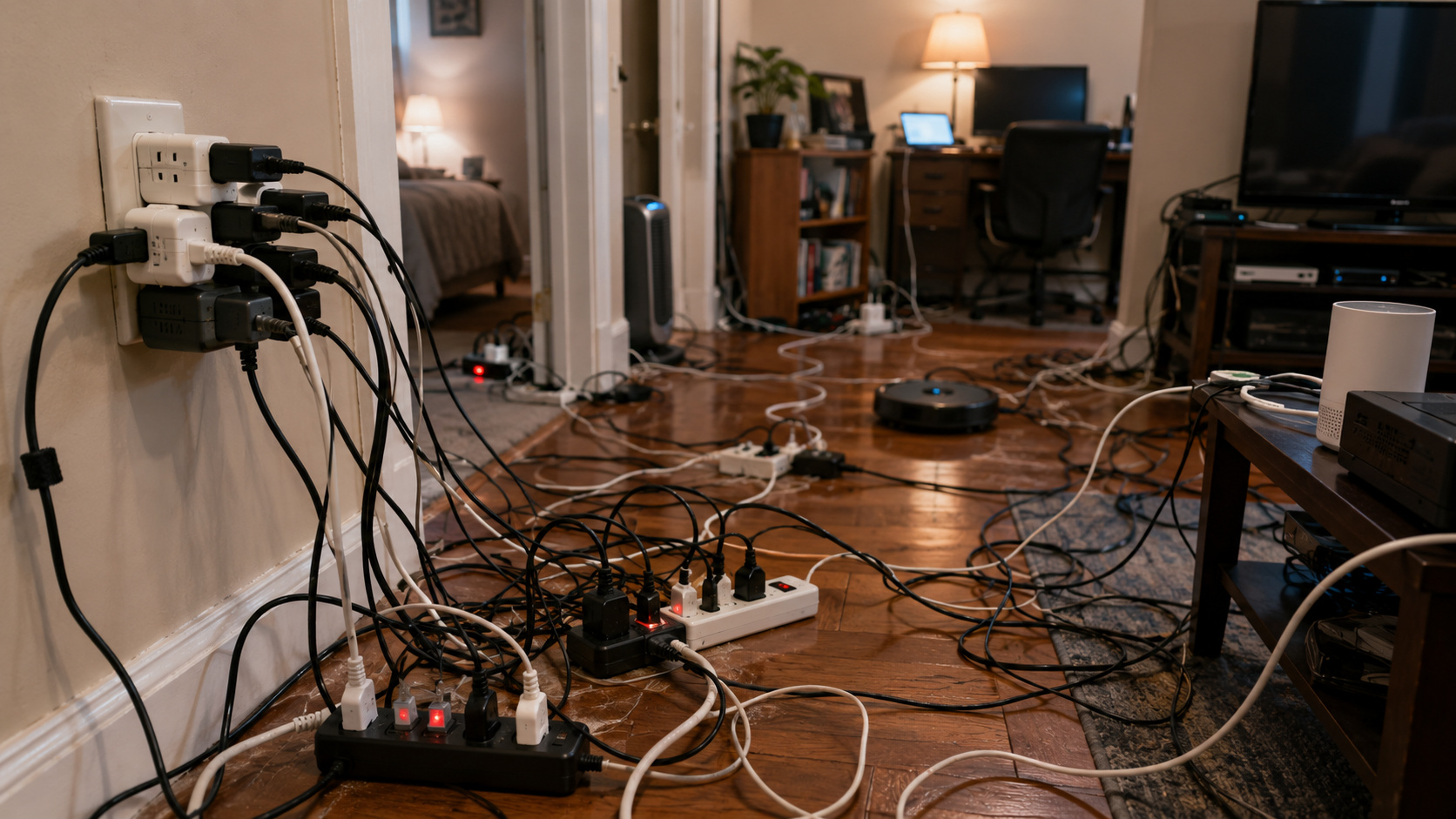
The invisible danger inside the house: plugging too many devices into the same outlet and spreading extensions throughout the rooms can overload the electrical network, silently heat wires, and turn a common habit into one of the leading causes of house fires.




Instead of capturing sunlight, the device harnesses this internal luminosity as a power source. For this, amorphous solar cells are placed directly against the tubes, as this type of cell is sensitive to low light and can convert this weak glow into electricity, similar to what happens in poorly lit indoor environments.
To improve the performance of the assembly, the entire unit is hermetically sealed with aluminum tape. This closure prevents the entry of external light and ensures that only the luminosity produced internally contributes to energy generation.
Simple structure uses solar cells and five tritium vials
The battery assembly was made with basic components that are easily found in the market. Two small amorphous solar cells, similar to those used in calculators, form the main base of the system.
Between these two cells, five tritium vials were positioned in a row. Each measures about 3 millimeters in diameter and approximately 11 millimeters in length, and the second solar cell is placed on top to form a compact layered structure.
The interior of the device also receives a reflective material to enhance the utilization of the generated light. After that, the entire assembly is wrapped and sealed, in a design that eliminates the need for soldering and complex wiring, allowing for quick assembly as soon as all the parts are available.
Measurements show slow but steady charge
After assembly, the tests of the homemade nuclear battery began with a standard multimeter. Each solar cell recorded between 0.45 and 0.47 volts, but the output current was so low that it became difficult to detect directly.
To improve the measurement, the cells were connected in series and linked to a small capacitor. This way, the system began to store charge over time, instead of relying solely on an instantaneous output.
The results showed a gradual increase in the accumulated voltage. After 10 minutes, the capacitor reached 2.2 volts; after an hour, it reached 2.4 volts; and by the end of the night, it achieved 2.9 volts without any external power input.
Long lifespan does not eliminate power limit
Even with the continuous increase in voltage, the total power remains very low. The system operates in the nanowatt range, an insufficient level to power an LED or keep small electronic devices running for long periods.
Still, the concept presents an important advantage: tritium has a half-life of about 12 years. This allows the material to continue producing energy for an extended period before its generation capacity significantly declines.
Commercial nuclear batteries achieve superior performance because they align radioactive materials and the components responsible for energy capture with greater precision. This adjustment improves conversion and increases energy production compared to the version presented in the experiment.
In the format shown by Double M Innovations, the homemade nuclear battery serves as a proof of concept. The test demonstrated that simple and easily found materials, combined with internal radiation, can generate a measurable electric current, albeit at a very limited level.




Be the first to react!