






 Portuguese
  Spanish


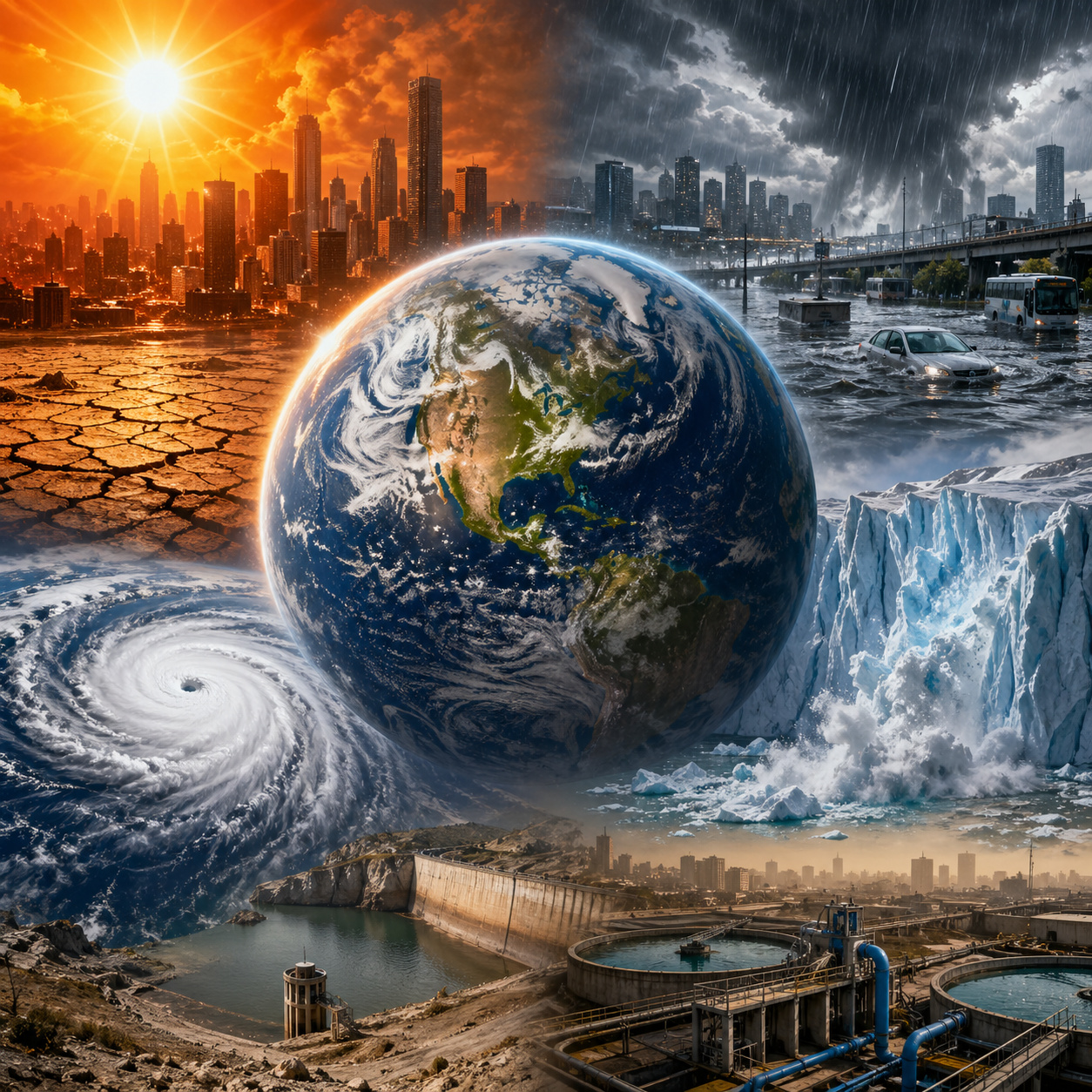

WMO report confirms 11 consecutive warmest years and warns of global impacts from extreme heat, intense rainfall, and ice melt.
On March 23, 2026, the World Meteorological Organization (WMO) published the State of the Global Climate 2025 report and consolidated data that helps to gauge the acceleration of global warming: the period between 2015 and 2025 brought together the 11 warmest years ever recorded since the beginning of instrumental observations. In the same document, the WMO reports that 2025 was the second or third warmest year in the historical series, depending on the dataset used, with a global average temperature close to 1.43 °C above the 1850-1900 average, a reference used as a pre-industrial baseline.
More than an isolated record, the report describes a persistent warming sequence that reinforces a structural change in Earth’s climate system. The WMO’s central interpretation is that the planet is no longer experiencing only episodic heat fluctuations, but a continuous, cumulative, and globally widespread process, driven by increasing greenhouse gas concentrations and visible across multiple climate indicators.
This scenario brings the world closer to the warming thresholds that guide international climate agreements, even though the 1.5 °C target of the Paris Agreement is assessed over long-term averages, and not by a single isolated year.
-
College Dropout Turned Window Cleaner Builds $1 Million Cleaning Business with Subscription Model After 18 Years of Door-to-Door Work
-
Race for Data Centers in Brazil Intensifies Pressure on Critical Energy Resources

-
Melting Glaciers Uncover Ancient Tools, Preserved Mummies, and Strategic Minerals in the Arctic and European Mountains
-
Melting Glaciers Uncover Ancient Tools, Preserved Mummies, and Strategic Minerals in the Arctic and European Mountains

Extreme heat intensifies and directly impacts health, productivity, and infrastructure
One of the main points highlighted by the WMO is the increase in the frequency and intensity of heatwaves.
These events have been recorded across different continents, with temperatures exceeding historical averages and directly affecting public health, especially in densely populated urban areas.


Beyond human impact, extreme heat also influences economic sectors. Outdoor labor productivity can be reduced, electrical systems face increased demand for cooling, and urban infrastructure suffers from thermal expansion and accelerated wear.
Heat is no longer just a discomfort but now represents a large-scale operational and economic risk.
Intense rainfall and floods amplify damage in cities and agricultural areas
The report also points to a significant increase in the occurrence of extreme precipitation events. Intense rainfall over short periods has caused floods in urban and rural areas, often exceeding the drainage capacity of cities and leading to damage to infrastructure, homes, and crops.
These events tend to be more difficult to predict and manage, especially when they occur abruptly.
The intensification of rainfall represents one of the main challenges for urban planning and climate risk management.
Tropical cyclones show signs of greater intensity in a warmer planet
While the total frequency of cyclones does not show a uniform increase across all regions, the report highlights that more intense events are becoming more common.
Cyclones with greater energy can cause stronger winds, more voluminous rainfall, and higher storm surges, increasing the potential for destruction in coastal areas.
These events affect not only traditionally exposed countries but also regions that are beginning to face new risk patterns. The increased intensity of cyclones amplifies the potential impact on populations and economies.
Accelerated ice melt contributes to sea level rise and loss of climate stability
Another central focus of the report is the advance of ice melt in polar and glacial regions. The loss of ice mass in Greenland, Antarctica, and glaciers around the world directly contributes to sea level rise.
Furthermore, ice melt can alter oceanic and atmospheric circulation patterns, influencing the climate in different parts of the planet.
The reduction of ice reserves is not just a consequence of warming, but a factor that can amplify future climate change.
Impacts already affecting global economies and pressuring supply chains
The WMO highlights that the effects of climate change are already being felt across different economic sectors. Extreme events can disrupt production chains, affect the transport of goods, and raise reconstruction costs after disasters.

Agriculture is also impacted, with variations in rainfall patterns and temperatures affecting productivity. These effects show that climate is no longer an external variable, but a central factor in global economic dynamics.
Urban systems face increasing pressure with more frequent extreme events
Cities concentrate a large part of the world’s population and are, therefore, on the front line of climate impacts. The combination of extreme heat, intense rainfall, and limited infrastructure can lead to critical situations, such as power outages, floods, and disruption of essential services.
Furthermore, the urban heat island phenomenon can further intensify the effects of high temperatures.
The urban environment becomes one of the main points of vulnerability on a warming planet.
Water and food security enter a zone of concern with climate change
The report also draws attention to the relationship between climate, water, and food. Changes in rainfall patterns and increased evaporation can affect water availability, while extreme events can compromise harvests.
These factors have the potential to impact food security, especially in already vulnerable regions. The interdependence between climate, water, and food production broadens the scope of climate change effects.

One of the most important points of the report is the confirmation that the observed warming is not a result of short-term natural variability.
The sequence of 11 years among the warmest on record points to a consistent trend, mainly associated with the increase in greenhouse gas concentrations in the atmosphere.
This pattern reduces the probability of spontaneous reversal in the short term. The continuity of warming reinforces the need for adaptation and mitigation on a global scale.
Scientific community highlights the need for coordinated actions to reduce risks
Given this scenario, experts point out that coordinated actions are essential to limit future impacts.
This includes emission reductions, investments in resilient infrastructure, and the development of early warning systems for extreme events.
International cooperation is also considered fundamental, as the effects of climate change transcend borders. Without effective measures, the trend is for risks to intensify over the coming decades.
Given this scenario, how much more can the planet withstand the continuous intensification of climate extremes?
The confirmation of a historic sequence of warmer years raises a central question about the future of the global climate.
With extreme events becoming more frequent and intense, natural and human systems are operating under increasing pressure.
The question that emerges is direct: if the planet is already under this level of climate stress, to what extent will it be possible to maintain stability in economies, cities, and essential systems in the coming decades?


