






 Portuguese
  Spanish
  6 min of reading
  0 comments



In Different Eras, Brazilian Cities Created Laws That Today Seem Incredible, But Which Arose to Try to Solve Local Problems. From Banned Fruits to Airports for Flying Saucers, These Bizarre Norms Show the Curiosities of the Country’s Legislation
Laws exist to organize coexistence among people and protect everyone’s rights.
They are created by government authorities with the aim of maintaining order, justice, and safety.
Even the strangest laws ever created in Brazil had this purpose, however curious they may seem today.
-
Survivor of 1966 SS Daniel J. Morrell Shipwreck in Lake Huron Recounts 38-Hour Ordeal in Extreme Cold

-
The Greatest Hoax in World Cup History? The Film That Denied Brazil’s 1958 Victory and Exposed How Fake Evidence Can Seem Convincing on TV
-
Fake South Korean Online Stores Offer Shopping Thrill Without Spending Money or Receiving Products
-
The War of Jenkins’ Ear: How a Severed Ear Sparked One of the 18th Century’s Most Unusual Conflicts


Moreover, laws define duties and responsibilities for citizens. This allows community life to occur in a predictable and balanced way. When everyone knows the rules and their consequences, coexistence becomes safer.
Another important point is that laws provide tools to resolve conflicts. With them, it is possible to seek fair solutions for misunderstandings between people, businesses, or institutions.
Courts and justice systems are examples of these tools, created to ensure impartial decisions.
How Laws Shape Behavior
Laws also guide how people should act in relation to the State and each other. This social ordering contributes to the stability of relationships and the protection of individual and collective rights.
Among these rights are freedom of expression, property rights, and the right to life. In addition, laws ensure access to education and equal treatment under the law.
They exist to prevent abuses and promote justice, combating inequalities and ensuring protection for all.
When someone disrespects a law, there are prescribed penalties. These punishments serve to discourage harmful behaviors and protect the well-being of society.
Therefore, even laws considered bizarre in their time were created out of some concern for social or health issues.
Banned Fruit in Rio Claro
A curious example occurred in Rio Claro, in the interior of São Paulo. 130 years ago, on November 30th, the city prohibited the sale of watermelons and other fruits that were considered dangerous to public health.
The decision was made during the administration of Lieutenant Colonel Marcello Schmidt and imposed a fine of 5,000 réis for violators.
The seized products were to be destroyed, according to the text of the resolution recorded in Book 1 of the Public and Historical Archive of Rio Claro.
The measure may seem absurd today, but it made sense in that context. At the end of the 19th century, infectious diseases were common, and basic sanitation was poor.
Frequent outbreaks of yellow fever plagued the city, and it was believed that certain fruits could transmit or worsen diseases.
At that time, Rio Claro was a regional powerhouse and was trying to avoid health problems that could compromise its growth. The heavy fine was intended to discourage the consumption of these foods.
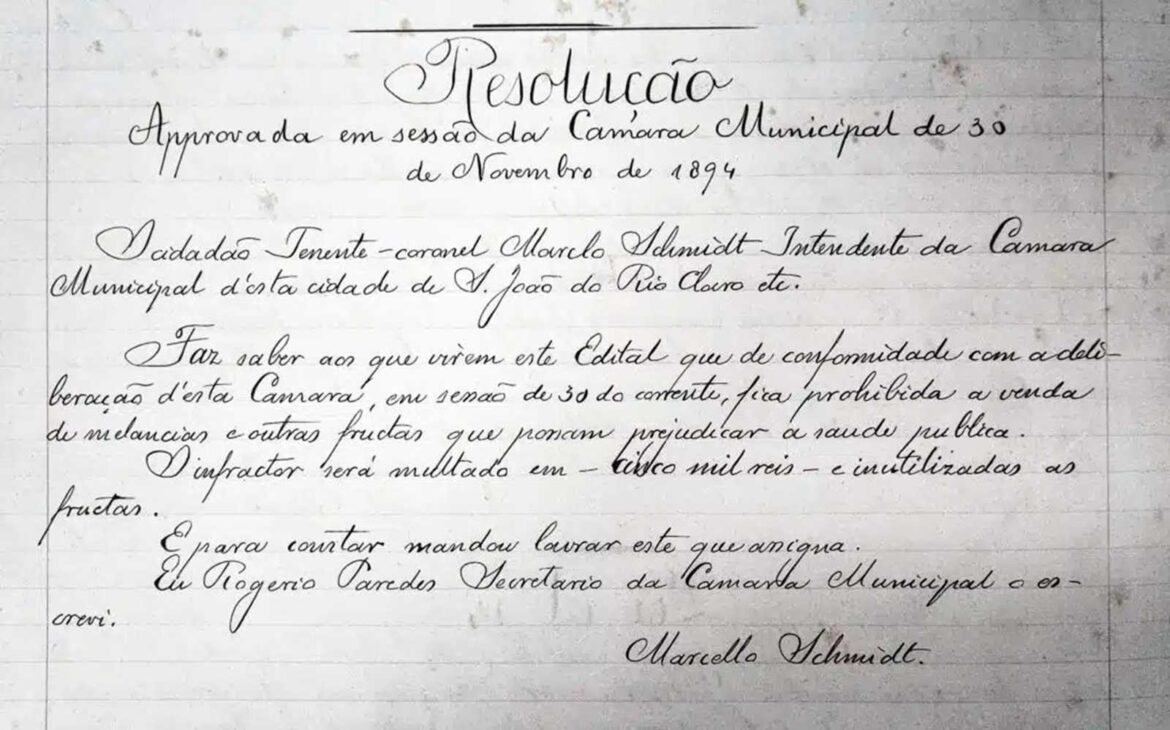
Approved in the Municipal Chamber session of November 30, 1894
The citizen Lieutenant Colonel Marcello Schmidt – Intendent of the Municipal Chamber of this city of S. João do Rio Claro etc.
Proclaims to those who see this notice that in accordance with the deliberation of this Chamber, in the session of the day of the context, the sale of watermelons and other fruits that may harm public health is prohibited.
The offender will be fined five thousand réis — and the fruits will be destroyed.
Hunting for the African Snail
Another unusual case also arose in Rio Claro, more than a century later. In 2011, a law was created that established the “Day C – Day for Collecting the African Snail,” celebrated every second Sunday of November.
The proposal came from former councilwoman Maria do Carmo Guilherme and was sanctioned by then-mayor Du Altimari, both from the MDB party.
The goal was to combat the infestation of the African snail in the city.
The law stipulated that the Zoonoses Department of the Municipal Health Foundation would organize actions for the collection and elimination of the pest. The activities could take place at one or several locations in the municipality, depending on the level of infestation.
This mobilization aimed to protect public health and prevent environmental damage. Although it is a one-time event, it became part of the city’s official calendar and is still provided for in municipal legislation.
Everyone Against the Ants
The city of Rio Claro was also responsible for another unusual law, this time in 1965. The Law No. 967 prohibited residents from keeping ant hills on their properties, whether in houses or vacant lots.
Those who violated the rule would have to pay a fine of 2.5% of the minimum wage at the time. The intention was to prevent the proliferation of ants, which could harm crops and structures.
Although it may seem exaggerated, the rule shows how local authorities sought specific solutions for environmental and health problems.
It exemplifies how laws can arise from practical concerns, even if they sound strange today.
Airport for Spaceships
In 1995, the city of Barra do Garças, in Mato Grosso, created one of the country’s most peculiar laws. A project approved by the mayor provided for the construction of a “Disk Port,” an airport designated for the landing of flying saucers.
The proposal had official status and defined a specific area for the reception of alien ships.
Masks Banned at Parties
Another curious example occurred in São Luís do Maranhão in the 1960s.
The then-mayor Epitácio Cafeteira created a “code of conduct” that banned the use of masks at parties, except during Carnival or with special authorization.
The justification was that the measure would help identify criminals during public events. According to the mayor, masks hindered the police’s work and increased the risk of offenses at popular festivities.
The unusual rule shows how some laws emerge from concerns for safety, even if they end up restricting cultural practices.
More Serious Environmental Crime on Holidays
The Environmental Crimes Law 9.605/98 included a rule considered strange by many.
Article 15 states that environmental crimes committed on Sundays or holidays receive harsher penalties.
The logic behind this is practical: on these days, there are fewer inspectors available to curb environmental violations. Therefore, the greater punishment serves as a way to discourage illegal actions during the inspection staff’s time off.
This measure is an example of how laws can be adjusted to compensate for the operational limitations of public authorities.
Save Portuguese
In 1997, the municipality of Pouso Alegre, in Minas Gerais, approved Municipal Law 3306/97. It imposed a fine of one hundred reais for signs and banners with grammatical errors and five hundred reais if the error was on a billboard.
The idea was to preserve the Portuguese language and improve the city’s image. Although unusual, the measure sought to promote correct communication in public spaces and prevent errors from being reproduced on a large scale.
This law gained national attention and became known as one of the most eccentric in the country.
Rain Prohibited
Also in Aparecida, an even more outlandish project was presented. The mayor sent a proposal to the Chamber to prohibit rain, floods, thunderstorms, and lightning in the city.
He stated that the idea was a response to councilmembers demanding solutions to flooding.
The project contained only two articles. The first states that “the occurrence of floods in the neighborhoods of the city caused by heavy rains, hailstorms, storms with lightning, strong winds, and flooding in the Paraíba do Sul River and its tributaries in the municipality is strictly prohibited.”
Although it never became a reality, the proposal is remembered as one of the most absurd laws ever attempted in Brazil. It symbolizes how, at times, the public power resorts to humor or provocation in response to local political pressures.





-

-

2 people reacted to this.