






 Portuguese
  Spanish


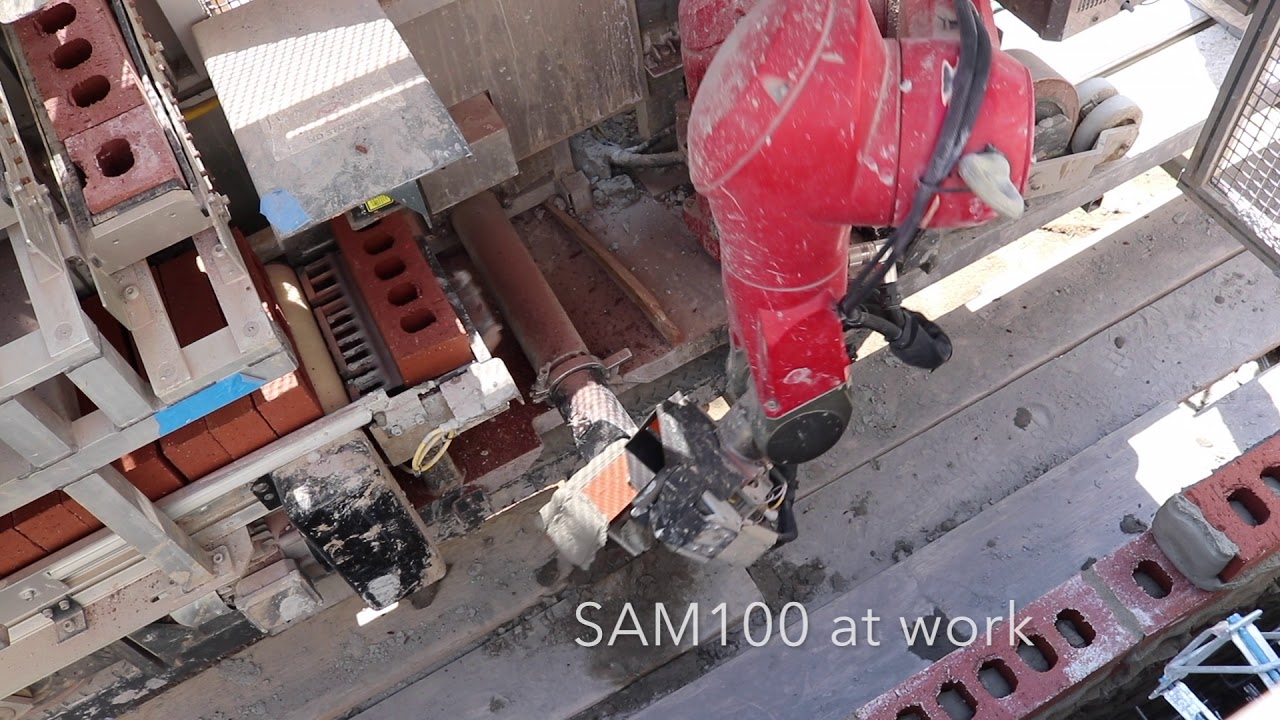


Robot SAM100 applies mortar, positions up to 3,000 bricks per day, and changes traditional masonry with semi-automated operation.
Traditional masonry, one of the most manual stages of construction, already has a robot capable of taking over part of the repetitive work that previously depended solely on human labor. The SAM100, short for Semi-Automated Mason, was developed by Construction Robotics to work on masonry projects with bricks and mortar. According to records from Construction Robotics and applications in projects in the United States, the SAM100 is described as a robot capable of placing an average of 1,200 to up to 3,000 bricks per day, using a combination of conveyor belt, robotic arm, and mortar system.
Robot SAM100 automates the most repetitive cycle of traditional masonry
The SAM100 is not a humanoid robot walking around the construction site. It is a semi-automated machine designed to work alongside masons, taking on the heavy and repetitive task of picking up the brick, applying mortar, and positioning the piece on the wall.


Construction Robotics describes the equipment as a system designed to assist the mason in lifting and placing bricks, while the human professional remains responsible for the preparation, monitoring, and final quality of the wall.
-
28-meter, 156-ton titans traveled 20,000 km from China to the port of Santa Catarina: Portonave received 7 fully electric megacranes, part of a R$ 210 million package, to double container handling.

-
They exchanged the idea of a large house for a 35 m² warehouse, spent US$ 12,000 on the structure, and created a tiny house in Colorado with space to live and work.

-
A newly opened terminal in the middle of the Amazon has begun transporting soy and corn through Amapá, eyeing the queue of ships that is congesting the ports in the South.

-
Goodbye to old tiles: renovation technique without construction transforms bathrooms in a few hours, eliminates debris, and reduces costs with coverings using special paints, high-resistance adhesives, and modern finishes that completely renew the space.


The robot does not completely eliminate the worker, but shifts the human role to operation, supply, control, and finishing, while the machine repeats the heavy movement thousands of times a day.
Machine applies cement and positions bricks with robotic arm on site
In a project at the University of Nevada, in Reno, the SAM100 was described as a robot that uses a robotic arm to spread mortar on the brick and position it on the wall of the University Arts Building.
At Auburn University, in Alabama, the robot was also used in the construction of the Jay and Susie Gogue Performing Arts Center. The project coverage reported that the equipment was capable of placing more than 3,000 bricks per day on site.

The operation still requires humans around. In Auburn, workers operated alongside the SAM100 to load bricks and mortar, while the robot performed the repetitive task of laying.
Productivity can reach 3,000 bricks per day, but it depends on the type of construction
The most striking number is productivity. Technical sources and materials related to Construction Robotics cite the SAM100 as capable of placing up to or more than 3,000 bricks per day, a number well above typical manual production in conventional masonry.
An academic analysis from Cal Poly, published in 2019, described the SAM100 as the first commercially available robot for brick laying on site and reported productivity in the range of 2,000 to 3,000 bricks per day.
Straight and repetitive masonry is where the robot gains more strength
The SAM100 is especially interesting in long, straight, and repetitive walls, precisely where traditional construction consumes many hours of labor with the same movement.
Penn State describes the system as suitable for assembling brick and mortar walls, with better application in straight wall processes.

This is the type of site where automation makes the most sense: extensive facades, buildings with modular repetition, institutional works, schools, commercial buildings, and projects with a large volume of bricks.
In complex walls, cutouts, curves, architectural details, and fine adjustments, the human hand still plays a relevant role. The robot speeds up repetition, but it doesn’t turn all masonry into pressing a button.
Human operator remains alongside the machine, but the role changes radically
The most aggressive point of the agenda is the change in work. The bricklayer ceases to be just the professional who lays brick by brick for hours and becomes an operator, inspector, and responsible for the final quality of the wall.
Construction Robotics itself states that the SAM100 was designed to work with a mason, not as a total and isolated replacement of the team. The human professional remains responsible for site setup and final quality.
But the transformation is evident. If a machine can perform thousands of repetitive movements per day, masonry ceases to be a purely manual activity and starts to resemble a mechanized operation.
Robot shows how civil construction begins to mimic the logic of factories
The SAM100 represents a symbolic shift for civil construction because it brings to the site a logic that has already dominated factories: mechanical repetition, standardization, reduction of physical effort, and machine-assisted production.

The difference is that the construction site is not a perfect assembly line. Each site has its own soil, climate, access, design, team, and interferences. Therefore, the robot first enters the more predictable stages, such as straight and repetitive walls.
Even so, the message is strong: traditional masonry, based on the human rhythm of placing one piece after another, is no longer the only technological option available.
End of bricks laid only by human hands
The SAM100 does not mean the immediate end of masons, but it shows the beginning of a change that could directly affect how walls are built in projects with high repetition.
When a machine applies mortar, positions bricks, and works alongside a human operator, construction no longer relies solely on physical strength but on logistics, control, robotics, and productivity.
The question that remains is simple: if the robot can already lay thousands of bricks per day, how much longer until the traditional wall ceases to be a purely human task?








No good in footing or uneven tight spaces but on long straight runs can’t fault it
As a semi-retired bricklayer I say bring it on. It can do all those boring straight walls. If there should be any corners, dog-legs, doorways, windows, with or without sills, piers, with or without caps, soldier courses, arches or overhand laying, recesses or projections, and the site foreman knows the right people, he will be able to rustle up an old tradesman who will lay those bricks at a specialist craftsman rate, starting at five pounds each, subject to inflation, weather and distance from home. Extras for tools, protective clothing, safety boots, site hut, table and chairs with tea on tap. What a joy not to have adjust the perps and bed for bricks that are longer or shorter, thicker or thinner, out of square or damaged faces. I will be available at six months notice.
I’ll hod on you