





 Portuguese
  English
  Spanish
  8 min of reading
  4 comments


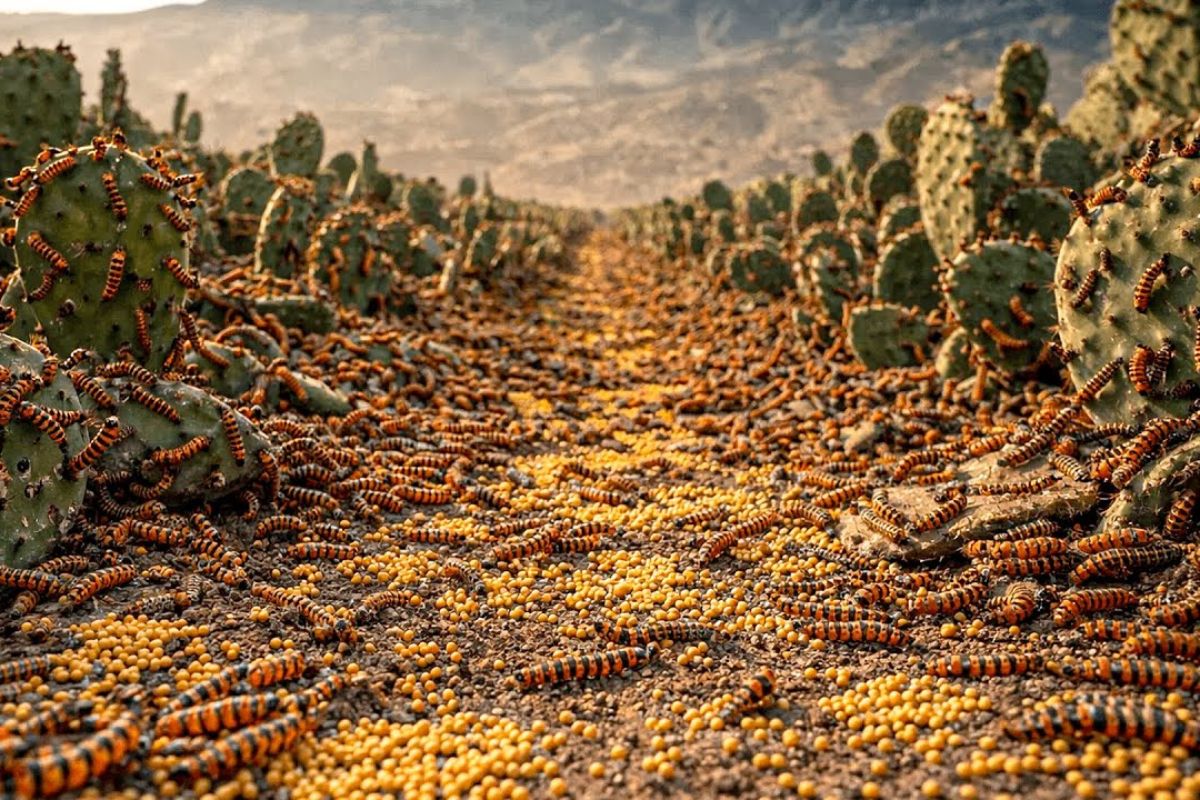


Biological Control Experiment with Millions of Eggs from the Cactoblastis Cactorum Moth Attacked the Invasive Prickly Pear Cactus and Reclaimed Millions of Acres of Farmland for the Country.
Australia saw up to 60 million acres of farmland become useless, suffocated by an invasive cactus that formed true walls of thorns. In sheer desperation, the country decided to bet on millions of moth eggs to confront a plant that was advancing 1 million acres per year, in one of the most radical biological control operations in history.
What began as a colonial plan to produce luxury red dye ended up transforming into an agricultural crisis that nearly erased the productive heart of Australia from the map. When fire, poison, and machinery failed, scientists turned to millions of moth eggs and demonstrated that fighting nature with nature can work spectacularly but can also create new problems in other countries.
When a Cactus Almost Swallowed Australia

The origin of the crisis lay not in a weapon, but in a color. In colonial times, the most valuable red dye in the world came from cochineal insects that lived on prickly pear cacti. This red dyed the tunics of kings, the robes of cardinals, and the famous red coats of British soldiers.
-
New ‘inexplicable’ stainless steel created in Hong Kong can cheapen green hydrogen, resist seawater, and challenge expensive materials used today in electrolyzers

-
Scientists are baffled as to how a giant eruption in Tonga may have destroyed atmospheric methane and revealed an unexpected path to curb part of global warming.
-
Huawei surprises with a luxury smartwatch with 99 diamonds and launches a children’s watch with a camera, powerful battery, and advanced security and health features.
-
Virus alert on the small island: Tristan da Cunha, without an airport and with only 216 residents, now under attention for hantavirus.


To break Spain’s monopoly on this market, Britain saw an opportunity in Australia. In 1788, ships arrived in the new territory bringing spiny pear trees infested with cochineal from Brazil. The plan was simple: to establish a local dye industry using the cacti as a base.
The problem was that nature did not cooperate with the economic script. The cochineals nearly disappeared in the Australian climate, but the cactus loved the new environment.
For decades, the plant remained confined to coastal areas and seemed harmless. Colonists planted prickly pear as a living fence, garden ornament, and even as emergency food for cattle in times of drought.
From the mid-19th century, everything changed. New varieties of prickly pear began to spread across Queensland and New South Wales.
Colonists took seedlings inland, and the dry climate on the other side of the Great Dividing Range was perfect for the invasion. Two species, in particular, exploded: the common prickly pear and the pest prickly pear.
By the early 20th century, the metaphor of “invasion” ceased to be an exaggeration. In 1919, cacti occupied about 22 million acres and were advancing at a rate of 1 million acres per year, until they reached the milestone of 60 million acres of farmland that were simply rendered useless.
Entire properties were engulfed by a living wall of thorns. Cattle starved in paddocks surrounded by cacti, unable to reach usable pasture.
Fire, Poison, and Machinery: Everything Failed Against the Wall of Thorns

Faced with the advance of the plant, the government reacted as best it could. In 1886, New South Wales passed a law making landowners legally responsible for destroying the cactus on their property. Inspectors traveled rural areas, recorded infestations, and issued cleanup orders.
In practice, it was almost an impossible request. Farmers attempted to burn the plants on a large scale. The flames consumed the surface growth, but the underground roots remained alive and the cactus sprouted again.
Others tried to uproot entire colonies. It was exhausting work that destroyed the soil and took days, and still, any fragment of pad left on the ground generated a new plant.
It was like dealing with a “zombie” organism: every crushed piece returned in the form of new invasion points.
Mechanical equipment also emerged, such as horse-drawn rollers designed to crush the cactus until it turned into pulp. The result was even worse: the crushed pieces rooted where they fell, accelerating the spread.
When physical solutions failed, chemical warfare ensued. In the early 20th century, the Queensland government offered a reward of thousands of pounds for anyone who could present an effective method.
No proposal worked. In the end, farmers resorted to toxic combinations of arsenic pentoxide with sulfuric acid, sold in cans specifically for prickly pear destruction.
Producers spent months spraying the poison, in an expensive, labor-intensive, and dangerous work for human health.
Some cacti were eliminated, but new colonies appeared faster than anyone could treat them. Besides the invasion, Australia began to deal with contaminated soil and water, multiplying environmental damage.
The Radical Idea: Fight the Cactus with Millions of Moth Eggs


Realizing that blades, fire, and poison would not defeat the wall of thorns, the government changed strategies. In 1913, a team of biologists was sent to North and South America to observe prickly pear in its native environment. There, one discovery grabbed attention: the cactus existed, but did not dominate the landscape.
The difference lay in the natural enemies. In countries like Mexico and Argentina, the plant coexisted with insects and fungi that had evolved with it over thousands of years. These predators kept the cactus under control, preventing it from becoming a pest.
Thus arose the proposal that would change history: to bring these natural enemies to Australia. It was the concept of biological control, using nature itself as a weapon against an invasive species.
Instead of more poison and machinery, the idea was to release millions of moth eggs capable of targeting only the cactus, ignoring agricultural crops and native plants.
World War I interrupted plans for a few years. But in 1920, the federal government and the states of Queensland and New South Wales joined forces to create the Commonwealth Prickly Pear Board, focused solely on preventing the cactus from destroying the entire eastern interior of the country.
Entomologists led by Alan P. Dodd returned to America and collected over 30 species of insects and plant pathogens to test at research stations. The goal was to find an agent that would aggressively attack the prickly pear and ignore the rest of the ecosystem.
The primary candidate ended up being a moth: the Cactoblastis cactorum, native to Argentina. The life cycle impressed the scientists. The females laid eggs in characteristic patterns on the pads of the cactus.
When they hatched, the caterpillars worked together, breaking through the thick skin to reach the soft tissue inside.
Within weeks, a colony of larvae could transform a healthy plant into a decayed husk, hollow inside. It was exactly the kind of intense attack Australia needed to reverse the invasion.
How Millions of Moth Eggs Were Created and Distributed
Before releasing anything into the environment, scientists needed to ensure that the moths would not attack other plants.
In controlled tests, the caterpillars were exposed to dozens of different species. The result was clear: they ignored everything except the prickly pear.
Once relative safety was confirmed, the most ambitious phase of the program began, the multiplication of the insects.
In laboratories like the Chinchilla experimental station, the first generations were treated as if they were worth gold.
The eggs brought from Argentina were distributed among facilities, kept under temperature and humidity adjusted to the limit, closely monitored.
From an initial population of just over 500 female moths, scientists managed to collect over 100,000 eggs. In the next generation, that number jumped to millions.
It was then that millions of moth eggs began to leave the laboratories every day, ready to be used as a biological weapon.
In Chinchilla, distribution reached tens of millions of eggs daily. Farmers received packages with simple instructions: place the eggs at the densest points of cacti and wait.
In 1926, the decisive moment arrived. The experts gave the green light, and the first Cactoblastis cactorum moths were released into the environment.
It was a nationwide biological control experiment, betting that millions of moth eggs would be able to reverse an invasion that fire, poison, and machinery had failed to contain for decades.
The Impossible Happens: The Wall of Thorns Crumbles

The response in the field was quicker than many imagined. The moths adapted, the caterpillars spread, and subsequent generations grew in cascading effect.
The reproduction rate of the moths was so high that, for the first time, the spread of the insect seemed faster than that of the cactus itself.
Fields that had become impenetrable green walls began to change appearance. The pads of prickly pear began to rot from the inside out.
The barriers became hollow, crumbled, and disappeared. Lands abandoned by families years earlier became accessible again.
Gradually, the area devastated by the cactus began to shrink. The numbers are impressive: about 60 million acres of land were restored to production without the use of more chemical poison or mass burning.
It was an agricultural and economic victory. Communities that were on the brink of extinction were able to recover. Land that had been worthless regained value.
The gratitude was so great that, in 1936, the Boonara community built the Cactoblastis Memorial Hall, a hall dedicated to the moth that freed the region from the plague.
In 1965, a historical association erected a stone statue with a plaque recording the “indebtedness” of the people to the insect that saved the thorny lands.
Australia began to have monuments not only for war heroes, explorers, and politicians, but also for a moth. It became the symbol of an extreme solution that worked.
When the Hero of One Country Becomes the Villain in Another
But the story does not end with a simple conclusion. Decades later, in 1957, the idea arose to replicate the Australian success elsewhere.
The Cactoblastis cactorum was introduced to Caribbean islands that were also suffering from invasive cacti. There, the native cacti had never encountered that enemy before.
The result was destructive. The moths attacked native species with the same efficiency they had demonstrated in Australia.
From the Caribbean, the insect spread to Mexico, where it found a new victim: commercial prickly pear plantations, cultivated for centuries for food and economic use.
What was a solution for one country became a tragedy for another. The moths destroyed plants that sustained entire communities.
Southern states in the United States also went on alert, fearing that the plague would spread through their ecosystems and crops.
The irony is harsh: Australia solved its crisis by importing a natural enemy from South America. In doing so and inspiring new uses for the moth, it indirectly helped spread the insect to places where it began to threaten species that had existed for thousands of years.
Today, ecologists see this story as an emblematic case. Biological control can be incredibly powerful, but it can also spiral out of control if applied without geographic limits, long-term studies, and rigorous monitoring.
The Lesson from Millions of Moth Eggs
The episode of the prickly pear shows that technology and nature can work brilliantly together, as long as there is serious research, testing, and awareness of risk.
Millions of moth eggs returned millions of acres of productive land to Australia and saved entire rural communities. At the same time, the same method, applied in another context, turned into an agricultural and environmental nightmare.
In practice, the story of this cactus and this moth serves as a reminder that radical solutions to environmental crises can work beyond expectations but can also create new problems if copied carelessly.
In a world facing biological invasions, exotic species, and climate change, this balance between urgency and caution becomes increasingly important.
And you, looking at the case of Australia: in your opinion, is it worth taking risks with solutions like millions of moth eggs to save entire ecosystems, or should we be much more conservative even in the face of gigantic crises?


In Australia’s case the effects were thoroughly researched before action was taken. Definitely worth the risk. Other places jumped in without proper research and experimentation.
Correction to my previous comment: The island of Isla Mujeres in Mexico where C cactorum was detected and eradicated is not uninhabited, but the other island it was detected on, Isla Contoy, is an uninhabited wildlife refuge and it was also detected there and eradicated in the mid 2000’s.
Cactoblastis cactorum is not yet known to be established in Mexico. It was found on Isla Mujeres, a uninhabited Caribbean island off the Yucatán peninsula in the mid 2000’s but was eradicated by the Mexican agricultural agency. It is however now established in south gulf coast of Texas close to the border with Mexico. A small wasp parasitoid was imported from Argentina by USDA as a biological control agent for C. cactorum is being reared and tested in Florida.