






 Portuguese
  Spanish


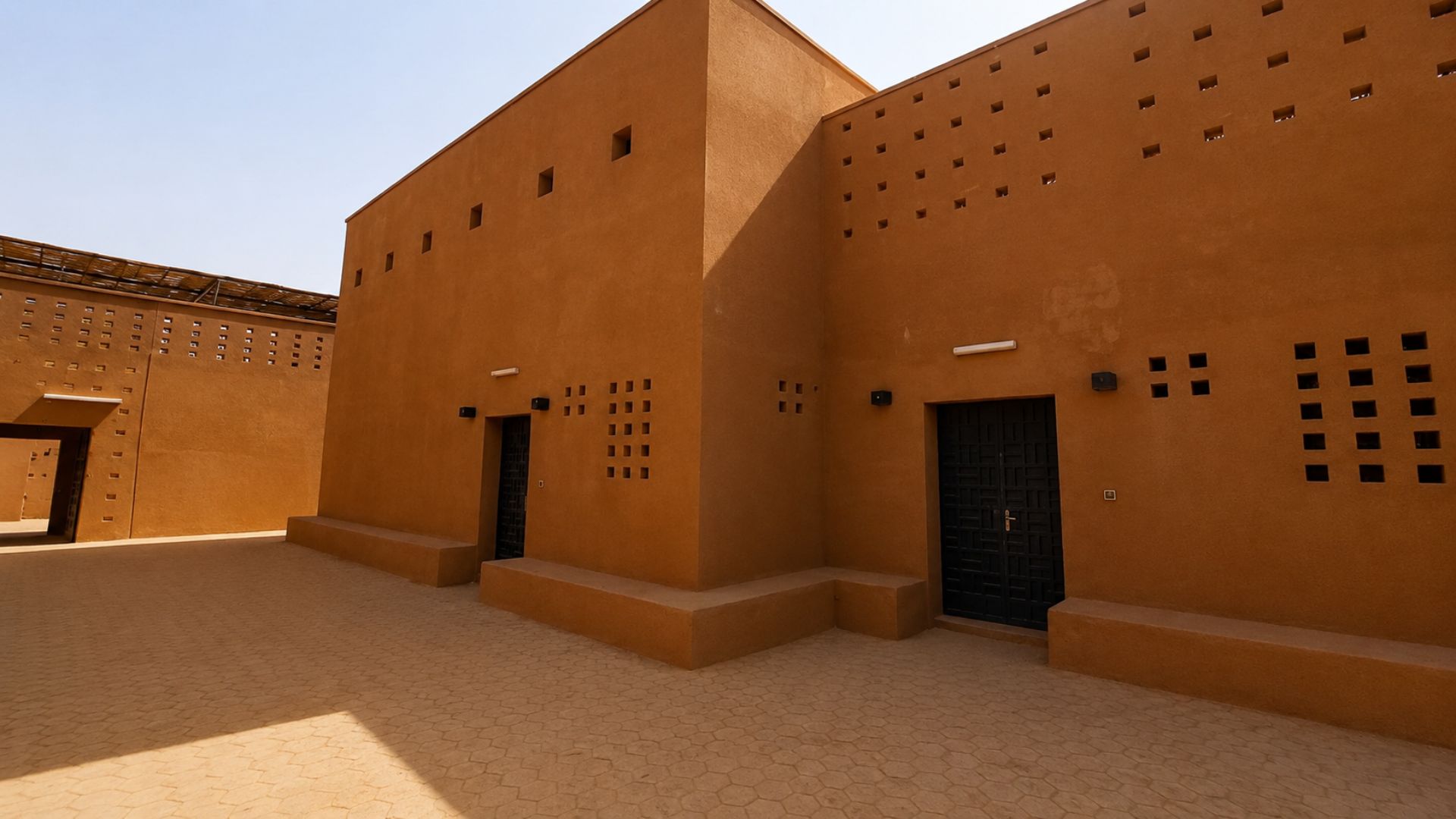


According to information from the channel DW Español, pre-colonial cities in Niger have mud buildings inhabited for ten generations, but the world has spent the last century betting on concrete and steel as synonyms of progress. Now, a generation of African architects is proving the opposite: at the 2023 Venice Biennale, half of the 90 guests were African or of African origin, a historic record. Francis Kéré, from Burkina Faso, was the first Black architect to receive the Pritzker (2022). And in Dakar, the new Goethe Institute, built with red earth from Senegal, was completed in April 2026 as a symbol that mud is not a poor man’s material: it is a technical solution for the 21st century.
In Niger, mud buildings have stood for ten generations while the entire world spends billions on concrete and steel, and the question that African architects are answering with real projects is as simple as it is provocative: why did we abandon the most abundant, cheapest, and most efficient material on the planet to build with the two most polluting? The red earth of West Africa, transformed into pressed bricks with techniques that eliminate cement or reduce its use to 4%, is being incorporated into public buildings, hospitals, schools, and cultural centers with thermal performance that concrete cannot achieve.
The 2023 Venice Biennale was the turning point. Curator Lesley Lokko invited about 90 architects and artists, half of whom were African or of African origin, an absolute record in the history of the exhibition. Francis Kéré, from Burkina Faso, presented an installation on the future of West African architecture. Mariam Issoufou Kamara, from Niger, drew plans, ornaments, and facades on the walls with chalk, recovering traditional knowledge of earth construction. The exhibition attracted 300,000 visitors, and the international press celebrated it as a milestone that changed the continent’s vision.
Francis Kéré and the mud school that changed everything

image: DW
Francis Kéré began building with mud 25 years ago when he designed a primary school for his hometown, Gando, in Burkina Faso. The mud bricks were manufactured by the community itself, which participated in the entire construction, and the result is a complex that includes naturally ventilated classrooms, teacher residences, and a library. The simple geometry creates shaded areas that eliminate the need for mechanical air conditioning, and the material regulates the internal temperature even under the extreme heat of the Sahel.
-
At 61, Former Homeless Wheelchair User Receives Key to Container Home in Brazil, Declares Independence

-
São Paulo Highway to Receive Over $260 Million in Upgrades, Including 90 Kilometers of Service Roads and New Infrastructure, by 2027
-
Couple Transforms Abandoned Seaside Public Restroom Bought for £33,000 into £295,000 Beach House After a Decade of Renovations

-
With 26 Million Brazilian Families in Substandard Housing, Churches to Launch 2026 Challenge: Each Parish to Build or Renovate a Home for a Local Family


Recognition came on a global scale. In 2022, Kéré became the first Black architect to receive the Pritzker, a prize considered the Nobel of architecture. At the ceremony, he declared that the award gave him “courage to move forward” and that he wants to inspire others as Africa taught him. For Kéré, the problem was never the mud: it was the stigma. “People reject it, considering it a poor man’s material,” he explained. “I modified its properties to manufacture uniform bricks and build a building that neighbors consider modern, using the material they are already familiar with.”
The physics of mud: why it works better than concrete in hot climates
The defense of mud as a construction material is not nostalgic: it is technical. The thermal mass of compacted earth absorbs heat during the day and slowly releases it at night, regulating the internal temperature without air conditioning in regions where the thermometer exceeds 45 degrees. Concrete, by comparison, absorbs heat and radiates it inwards, turning the interior of buildings into a greenhouse.

Mariam Issoufou Kamara, an **architect** operating between **Niger** and New York, is direct about the point: “It’s not about identity, it’s a matter of thermal mass physics that can reduce **energy** consumption.” **Her projects in Niamey include a clay residential complex that keeps the interior cool even with 45 degrees outside**, and an office **building** with a mix of **clay** and **concrete** that demonstrates commercial viability. For her, “**earth** allows us healthier ventilation and is more economical” than industrialized alternatives.
The Goethe Institute in Dakar: hybrid construction in red earth
The project that transformed theory into built proof is the new Goethe Institute in Dakar, completed in April 2026. **The building was designed by Kéré and locally coordinated by the Worofila studio**, with German engineers supervising the work commissioned by the institute itself. The **construction** uses pressed laterite **bricks** combined with reinforced **concrete** elements in the structural parts that support heavy roof loads.
The **bricks** were manufactured by the Senegalese **company** Elementerre, which doubled its **production** with new hydraulic presses. **With a manual press, the company produced a thousand bricks per day with 8% cement; with the hydraulic presses, it increased to 2,000 blocks daily with only 4% cement**, a reduction that makes the **material** cheaper and more sustainable. The founder of Elementerre plans to completely replace cement with totora, an invasive species of reed that grows in the mangroves of the Senegal River delta, whose fibers create natural insulation.
Totora: the reed that can replace cement

In northern Senegal, totora grows in abundance in the mangroves and is considered an invasive plant. **But environmental activists and builders have discovered that its long, resistant fibers, with a spongy tissue that forms natural insulation, can replace cement in the manufacture of clay bricks** and function as roof covering. The **material** filters water, stores CO₂, and protects mangroves when harvested in a controlled manner.
Mamadou Bâ, a Senegalese environmental activist, built an entire ecological house with **clay** panels insulated with totora in the walls and reeds on the roof. **The earth-totora combination creates cool, inexpensive buildings with a near-zero carbon footprint**, without the need for any imported inputs. For **African** **builders**, totora represents exactly what they are looking for: a local, renewable **material** that bypasses the industrial chain of cement and **steel**.
The new generation that wants to build entire neighborhoods and cities
The challenge that **African** **architects** now face is one of scale. **Individual houses and mud schools have already been proven; the next step is to build entire neighborhoods, villages, and cities with earth**, a leap that requires industrialization of **brick** **production**, standardization of techniques, and acceptance from the financial and regulatory **market**. The founder of Elementerre is explicit: “We have to stop building only houses that look good in magazines. The challenge is to design on a large scale.”
David Adjaye, the first **architect** of sub-Saharan origin to achieve global fame, moved from London to Accra (Ghana) and began experimenting with rammed **earth** in commercial projects. **His studio built a three-story art center with rammed earth and is now applying the technique to an office building**, scaling the **technology** to demonstrate viability outside the niche. Adjaye also works with modular laterite **bricks** that interlock without mortar, a technique that speeds up **construction** and reduces costs.
What Africa can teach the world about sustainable construction


The cement **industry** accounts for about 8% of global CO₂ emissions, and the **steel** industry for another 7%. **Together, they produce more greenhouse gases than any individual country, except China and the United States.** **Earth** **construction**, which eliminates or drastically reduces both, is not architectural romanticism: it is climate mathematics.
For Brazil, where rammed earth has a centuries-old tradition in Minas Gerais, Goiás, and São Paulo, the African lesson is especially relevant. The country faces a housing deficit of millions of units and the rising cost of cement and steel, and the possibility of building with the soil from the property itself using modernized techniques that meet safety standards is not fiction: it is a reality that architects like Kéré, Kamara, and Adjaye have already demonstrated with inhabited, award-winning, and standing buildings.
Would you live in an earth house designed by a Pritzker-winning architect, or do you think earth construction is a thing of the past? Tell us in the comments if you know of rammed earth constructions in Brazil and what you think about Africa leading the sustainable architecture revolution in the 21st century.




I will like to know more about rammed earth and building modern house with mud
It always has, it always will. We all walk on the earth and it has never sunk under our feet unless it is faced with extreme pressure.
I really appreciate the innovative idea and wish to join the crusade as an Architect practicing in Nigeria