






 Portuguese
  Spanish


An unprecedented construction in the North Sea brings together heavy engineering, offshore wind energy, and giant concrete structures in a project that could change how electricity is transmitted offshore.
Belgium is building an artificial island in the North Sea designed to concentrate and transmit electricity generated by offshore wind farms.
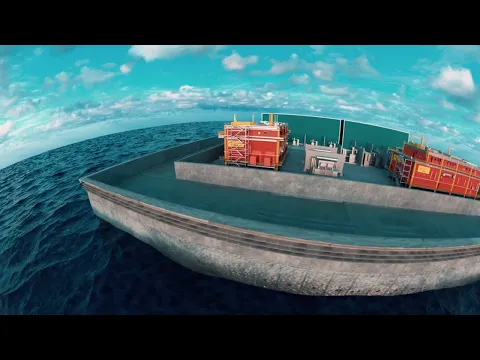
Named Princess Elisabeth Island, the structure will be located approximately 45 kilometers off the Belgian coast and will have its outer walls formed by 23 concrete caissons, each weighing approximately 22,000 tons.
Described by Elia and the companies responsible for the work as the world’s first artificial energy island, the structure will be used as a connection point between turbines installed at sea, submarine cables, Belgium’s electricity grid, and future international interconnectors.
-
In Brazil’s backyard: Tesla, by Elon Musk, announces official operations in Uruguay, where electric vehicles already make up 20% of new cars but still leaves out the largest market in the region.

-
This Mars rover may finally reveal if life ever existed on Mars.
-
A nearly 70-year-old Chinese inventor has registered 90 patents and created a device that stores water in the roots, helping seedlings survive drought while trying to transform the arid slopes of the Loess Plateau into green areas without relying on heavy irrigation.

-
Researchers want to change the way of producing rare earth magnets, reducing purification steps and making better use of the elements found in Swedish deposits.


The project is developed by Belgian operator Elia and executed by TM Edison, a consortium formed by DEME and Jan De Nul.
How the artificial island will be formed in the North Sea
The structures used in the construction are known as concrete caissons.
This type of piece is manufactured on land, transported to the sea, and installed at the project’s defined point.
In the case of Princess Elisabeth Island, the blocks will form the island’s outer contour and serve as a base for the area that will house the electrical infrastructure.
Each caisson measures approximately 58 meters in length, 28 meters in width, and between 23 meters and 32 meters in height, depending on the configuration of the storm walls.
In another technical disclosure, DEME presented approximate dimensions of 57 meters by 30 meters by 30 meters, a difference compatible with variations in block description and configuration.
Manufacturing took place in Vlissingen, Netherlands.
According to DEME, the last caisson was completed and floated in January 2026, marking the end of the construction phase for these structures at the shipyard.
After that, the blocks proceeded to the Scaldia terminal, where they undergo final work before the offshore installation of the remaining elements.
Offshore wind energy in Belgium
Princess Elisabeth Island is part of the expansion of wind energy in the North Sea, a region used by European countries for renewable generation projects offshore.
The island will be associated with the Princess Elisabeth Zone, a Belgian area designated for new offshore wind farms.
The objective is to gather the electricity generated by these farms and send it to the mainland via high-voltage infrastructure.
According to industry publications and project documents, the island is expected to serve as a connection point for at least 2.1 GW of offshore wind energy generated in the region.
The European Investment Bank also reports that the project integrates a transmission stage linked to new planned farms and interconnectors connected to the onshore electricity grid.
The electrical infrastructure planned for the island will combine high-voltage alternating current systems, called HVAC, and high-voltage direct current systems, known by the acronym HVDC.
Alternating current is widely used in electricity grids, while direct current is typically applied in long-distance transmissions and high-capacity submarine cables.
This combination is central to the project’s classification as the first artificial energy island with this arrangement.
According to DEME, the high-voltage infrastructure installed on site will group the cables coming from the wind farms in the Princess Elisabeth Zone and allow for future connections with other European countries.

22,000-ton concrete blocks
The offshore installation of the caissons began in April 2025, when the first two structures were submerged at the planned island location, 45 kilometers off the Belgian coast.
That year’s installation campaign was completed in October, and the resumption of offshore work is planned for the European spring of 2026.
In the technical context of the work, the process is described as the transport, positioning, and controlled submersion of the caissons.
Although the title uses the verb “to sink,” the operation does not consist of launching the structures into the sea without control.
The blocks need to be aligned to form a continuous outer barrier compatible with the island’s design.
After the perimeter is formed, the inner part will be prepared to receive sand, protective layers, and the electrical equipment planned in the project.


According to DEME, the island will be formed with approximately 2.3 million cubic meters of sand extracted locally.
The work was planned for an area subject to wind, waves, and sea currents.
Therefore, the caissons incorporate outer walls and protective elements defined according to the conditions of the North Sea.
The installation also depends on suitable weather windows, a common factor in large-scale offshore projects.
Biodiversity on Princess Elisabeth Island
In addition to its electrical function, Princess Elisabeth Island has incorporated design measures aimed at biodiversity, according to Elia.
The company states that the project includes solutions called “nature-inclusive design,” developed with the support of experts in conservation, marine restoration, and ecology.
Among the planned measures are protrusions on the outer walls for rest and reproduction of the black-legged kittiwake, as well as submerged structures aimed at marine organisms.
Elia also mentions relief panels, erosion protection with greater structural complexity, and solutions related to the European oyster.
The NID4BirdLIFE project, co-financed by the European Union’s LIFE program, has a planned duration of 6.5 years and is aimed at creating breeding areas for the black-legged kittiwake on the island.
According to Elia, the species is classified as threatened in the North Sea region by the European Red List of Birds, and the plan includes monitoring with cameras installed in the nesting structures.
Elia itself states that the environmental results will be accompanied by a scientific monitoring program.
This step is necessary because the response of birds, mollusks, fish, and other organisms to the island’s presence will depend on the actual occupation of these habitats and the conditions of the marine environment over time.
Offshore electricity grid in the North Sea
The construction of the island is linked to the advancement of offshore electricity grids in the North Sea.
In this model, part of the generation occurs in offshore wind farms far from the coast, and the energy needs to be collected, converted when necessary, and transmitted by submarine cables to onshore connection points.
Princess Elisabeth Island was also planned to act as an arrival point for interconnectors between Belgium and other countries.
According to Elia, the structure could function as a hub for international cables, which would allow for electricity exchange between national systems and connection with wind farms in other areas of the North Sea.
The financing also demonstrates the strategic dimension attributed to the project by European institutions.
In October 2024, the European Investment Bank announced a financing agreement of 650 million euros with Elia Transmission Belgium to support the first phase of Princess Elisabeth Island.
The approximate total cost indicated in the bank’s project sheet for this phase is 1.105 billion euros.
In practice, the island will be a technical infrastructure offshore.
Its main function will be to gather cables, house high-voltage equipment, and enable the transmission of electricity produced by offshore wind turbines.
The structure was not presented by the companies as a residential or tourist area.
Public interest in the project stems from the scale of the concrete blocks, the controlled installation in a marine environment, and the island’s role in renewable energy transmission.
The project also allows observing how coastal countries are adapting their electricity grid to deal with wind farms increasingly distant from the mainland.






Funny how any idiot or Russian troll can post their mental productions without any check whatsoever.
It’s time to think global and act local..Not local-local.
F#@#$.. Just give them land south of the country and save on green house gases emissions from their work.