






 Portuguese
  Spanish
  5 min of reading
  2 comments


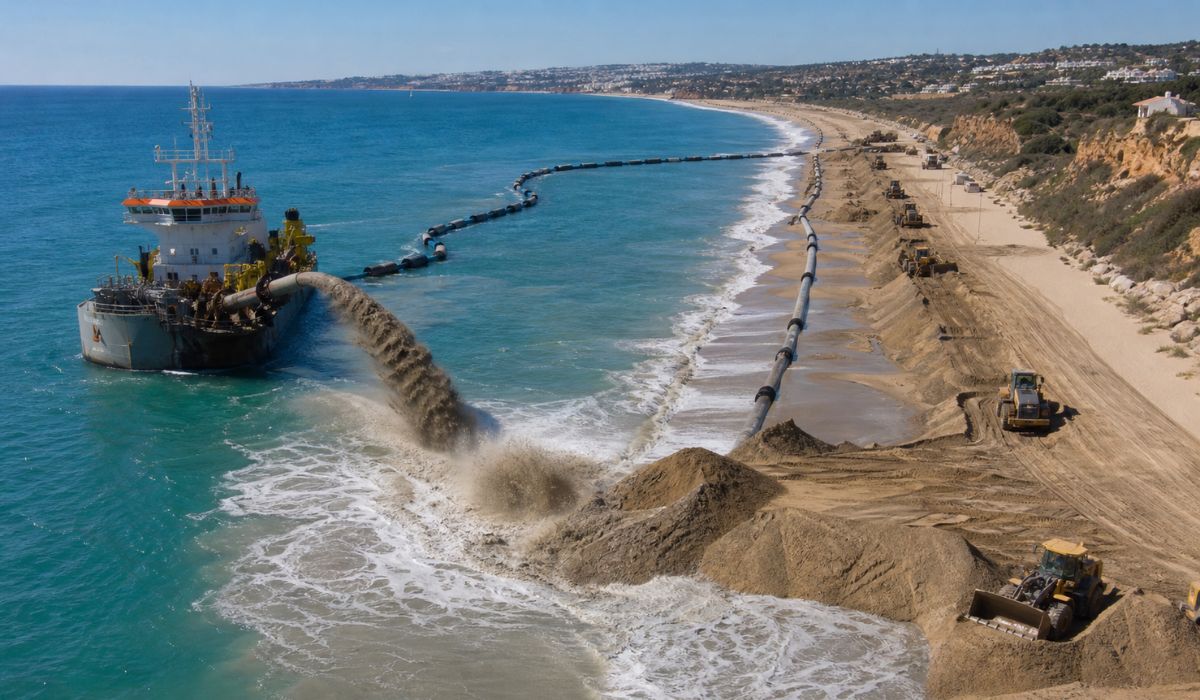


Operation in the Algarve plans to remove sand from an underwater area and reinforce vulnerable beaches, in an intervention that exposes how coastal countries try to deal with erosion, tourism, security, and natural changes on the coast.
Portugal is preparing an artificial sand replenishment operation on the Algarve coast to contain erosion in a stretch of the country’s southern coast considered vulnerable.
The intervention takes place between Quarteira and Garrão, in the municipality of Loulé, and foresees the movement of approximately 1.4 million cubic meters of sand along approximately 6.7 kilometers of beaches.
The work is conducted by the Portuguese Environment Agency, APA, within the scope of the Vilamoura–Vila Real de Santo António Coastal Zone Management Plan.
-
A rare gas cuts through the hot springs in Zambia and reveals a deep fault that may penetrate the crust down to the Earth’s mantle.

-
Forget the image of a frozen and still continent: scientists have just revealed hundreds of earthquakes beneath East Antarctica, in an area where no one expected to find this phenomenon.

-
Huawei will install Chinese batteries in 24 cities in the Amazon, in a project worth R$ 850 million that could become the largest energy storage system in Brazil.

-
China connects to the power grid the largest ultra-large battery storage station ever built in the world and signs a billion-dollar contract that consolidates a technology capable of sustaining entire cities with clean energy.


According to the Portuguese government, the project aims to reduce the effects of coastal erosion, reinforce the safety of populations, and stabilize the seafront addressed by the intervention.
How sand replenishment works on Algarve beaches
The technique used in the Algarve is known as artificial beach nourishment.
The procedure consists of removing sediments from a previously defined underwater area and transporting them to the coastal strip that has lost sand over time.
After that, the material is released onto the beach to increase the width of the sandy area and create a protective strip against wave action.
Between Quarteira and Garrão, the sand comes from a borrow area located offshore.
The operation uses pipelines installed in the sea, which carry the sediments to the selected points for reinforcing the beaches.
According to information released by APA and reproduced by Portuguese media, the installation of this structure occurred between April 2 and 3, before the start of beach nourishment the following day.
The official forecast is that the intervention will allow an average widening of the sandy area of about 37 to 37.5 meters.
This increase in width is treated by the Portuguese authorities as a way to expand the protection of the coastal strip and improve the conditions of use of the beaches, without altering the natural function of the sandy area as a transition zone between the sea and the occupied land area.

Why the Loulé coast needs sand replenishment
The Algarve coast brings together tourist beaches, urbanized areas, cliffs, and natural areas associated with coastal dynamics.
At various points, the coastline registers sediment loss, a process related to wave action, sea currents, storms, and coastal strip occupation.
When natural sand replenishment does not keep pace with removal caused by the sea, the beach tends to shrink.
In the stretch between Quarteira and Garrão, vulnerability to erosion had already prompted previous interventions.
Technical documents associated with the environmental process record beach nourishment actions in different years, such as 1998/1999, 2006, and 2010, with objectives linked to coastal protection and moving people away from risk zones near cliffs.
APA informed that the current work seeks to “mitigate the effects of erosion, reinforce the resilience of the Algarve coast, and ensure better safety and enjoyment conditions for residents and visitors.”
The statement indicates the institutional purpose of the intervention and attributes to the environmental authorities the assessment of the expected benefits for the territory.
Scale of the work draws attention due to the volume of sand
The projected volume, of 1.4 million cubic meters, dimensions the scale of the intervention.
The quantity will be distributed along approximately 6.7 kilometers of coastline, with progressive deposition in different segments of the Loulé coast.
According to APA, the schedule was divided to allow for controlled execution of artificial nourishment.
The intervention covers areas such as Trafal, Vale do Lobo, Garrão, Forte Novo, and Quarteira.
The schedule released by Portuguese authorities foresaw passing through these stretches in successive stages, with an estimated completion before the bathing season.

This operational division aims to organize sediment deposition and reduce simultaneous interferences along the entire coastline.
APA also informed that the phasing occurred in articulation with Património Cultural, I.P., a Portuguese body linked to the protection of cultural heritage.
This monitoring is necessary for maritime works and dredging because coastal areas may contain archaeological assets, submerged remains, or elements protected by heritage legislation.
Artificial nourishment does not make the beach permanent
Artificial beach nourishment is a coastal management measure, but it does not definitively interrupt the natural dynamics of the coastline.
Part of the deposited sand may be redistributed by waves and currents after the intervention, especially during periods of increased sea agitation.
This behavior is considered in such projects, which normally depend on subsequent monitoring.
In technical documents about previous interventions in the region, there is a record of partial loss of the sand volume placed in past operations.
In the case of the action carried out in 2010, the consulted report indicated that a significant part of the deposited material had already disappeared years later.
The data shows that artificial replenishment tends to function as an adaptation and maintenance measure, not as a definitive solution for erosion.
Even so, the option to reinforce beaches with sediments is used in different coastal zones because it preserves the sandy area as a leisure area and as an element of physical protection.
In the Algarve, this type of intervention is also linked to the tourist use of beaches and the need to reduce risks in areas near cliffs, accesses, equipment, and zones frequented by residents and visitors.


Coastal management in Portugal and erosion in the Algarve
The operation between Quarteira and Garrão is part of a broader coastal protection strategy in Portugal, according to the Portuguese Environment Agency.
The Portuguese government informed that the intervention is part of policies aimed at the stability of the maritime front and the safety of populations in areas exposed to erosion.
The Ministry of Environment and Energy stated that the project received an Environmental Impact Study and the respective Environmental Impact Statement before the work proceeded.
The same communication indicated an investment of 14.9 million euros and informed that the international public tender had been launched on September 3, 2025, with the award to the company Dravosa S.A.
The intervention also involves a broader scientific and environmental issue: beaches are not fixed structures.
They change according to sediment transport, wave regime, storm intensity, and human occupation in the surroundings.
Therefore, artificial nourishment works are usually accompanied by technical monitoring, which allows evaluating how much material remains in the system and how the coastline responds to the reinforcement.
In the short term, sand replenishment aims to increase the width of the sandy area and reduce the direct exposure of the coast to the action of the sea.
Over longer periods, monitoring of the region should indicate whether new interventions will be necessary and at what intervals.





Excellent.
Great scheme just what BLACKPOOL needs.