Portuguese
  Spanish




Dead Field in Self-Sustaining Oasis Today Sustains Families with Fruits, Vegetables, Meat, Eggs, and Nuts, Proving That Four Regenerative Hectares Can Surpass Chemical Monocultures and Point New Paths for Modern Agriculture
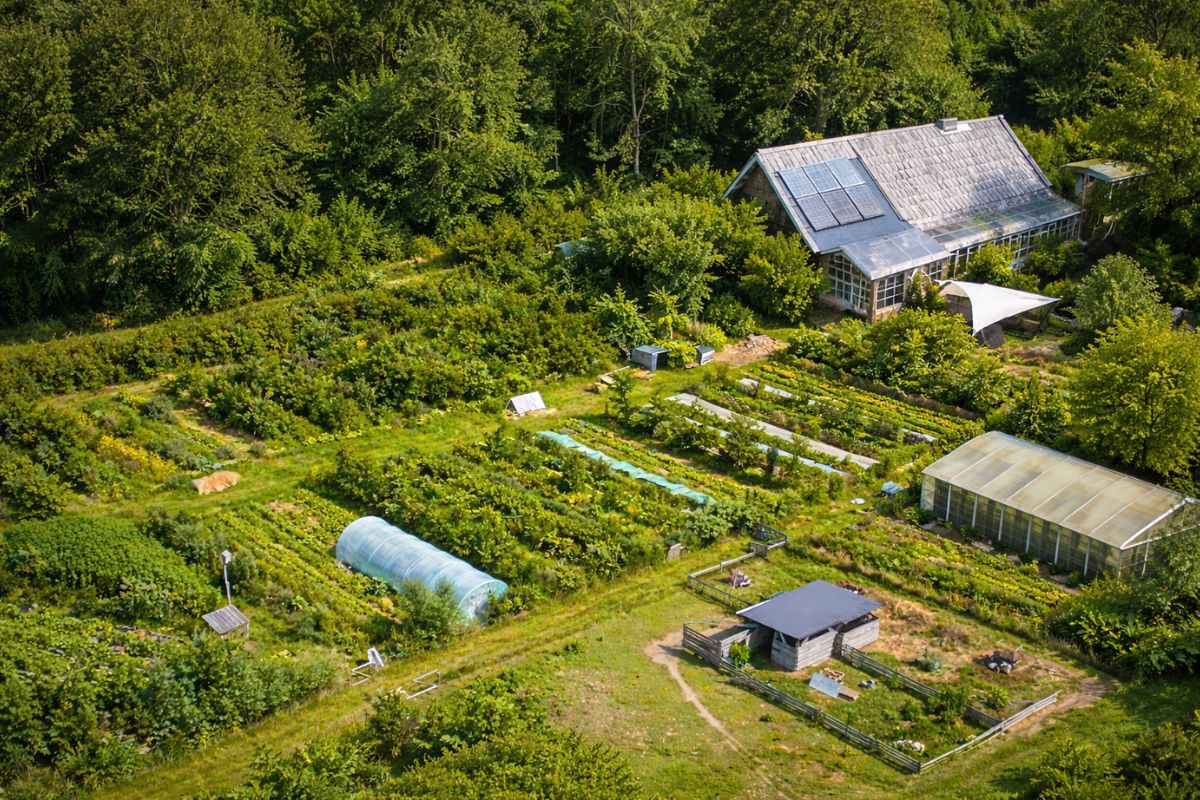
When the couple arrived at the small property in Frean, all they saw was a dead field in potential self-sustaining oasis: exhausted soil, no earthworms, the result of years of monoculture with grains and corn sprayed with pesticides, herbicides, and fungicides. The land had been treated as a mere chemical substrate, not as a living organism.
From there began a patient process of building, reconstructing, and regenerating the soil. Instead of insisting on industrial recipes, they began to observe the landscape, test species combinations, and mimic what nature already does well.
A small four-hectare farm was born, capable of mimicking an edible forest, feeding entire families, and proving in practice that diversity and regenerative management can surpass the conventional agricultural model.
-
AI Security System in Brazil Aims to Cut False Alarms by Differentiating Pets from Intruders, Enhancing 24/7 Monitoring for Homes and Businesses

-
Archaeologists Discover 1,500-Year-Old Byzantine Mosaic with Greek Biblical Inscription in Israel, Uncover Ruins of 10 Buildings Near Kiryat Gat
-
Ohio Carpenter Finds 308-Gram Meteorite the Size of a Baseball After Dreaming of Its Location

-
Chinese Student Builds Humanoid Robot for $2,100 at Age 20, Now Leads Robotics Startup in China


From Dead Soil to Return of Life
When they arrived, the picture was discouraging: an arid field recently seeded with grass, dead soil, and practically no earthworms in sight.
It was the direct consequence of years of conventional farming with intense spraying. The couple’s first major decision was simple yet radical at the same time: to stop degrading and start regenerating.
Instead of turning the soil, they began to build life in the soil with organic matter, permanent cover, and plant consortia. Trees, shrubs, and perennial vegetables entered the scene, each with its ecological function.
In a few years, what was a dead field in self-sustaining oasis transformed into a living organism: organic matter increased, soil structure improved, and biodiversity began to return.
Permaculture in Practice: House, Garden, and Edible Forest

The planning of the entire area was based on permaculture principles. The house was positioned at the center of a plot of about 920 square meters, designed as the heart of the system.
To the south, the couple installed the main garden, a greenhouse, and a small seedling nursery, ensuring a constant production of vegetables.
To the north of the house, the forest garden was born, occupying about 300 square meters. The idea was to mimic a young forest, not a dense jungle where nothing grows in the underbrush.
There coexists apple trees, plum trees, thorn bushes, and other trees in intermediate successional stages, allowing light and air to enter.
Among the trees and shrubs, a layer of perennial vegetables completes the “edible forest,” producing food in the same place year after year, without the need for constant replanting.
This combination guarantees harvests that begin in late winter or early spring and extend until the end of autumn.
Fruits, berries, leaves, and roots come out almost year-round from a relatively small area, bringing the family closer to food self-sufficiency.
Aquaforestation in Four Hectares: Trees, Beds, and Direct Planting
Over time, the farm stops being just a family project and becomes a living experiment on how to transform a dead field into a self-sustaining oasis on a commercial scale.
The inspiration from the forest garden is expanded to four hectares in a system that the couple calls aquaforestation.
Trees are planted in rows spaced 14 meters apart, in a north–south orientation, creating light corridors between the lines. In the spaces between the rows, they cultivate sun-loving vegetables in permanent beds without turning the soil.
Direct planting, continuous cover use, and regular addition of compost and composted horse manure transform the beds into true “fertility sponges.”
The result is a mosaic: rows of fruit and nut trees, strips of vegetables, and pastures in regeneration.
This arrangement allows for harvesting foods from different strata throughout the year while also protecting the soil from erosion, extreme weather, and nutrient loss.
Distribution Without Boxes and with Less Waste
From the beginning, the couple knew that it was not enough to produce well; it was necessary to distribute in a way consistent with the regenerative philosophy.
They rejected the classical model of weekly organic boxes delivered to the city, which requires a lot of sorting, standardization, and the use of packaging, often plastic.
Instead, they created an annual subscription system. Each January, people enroll for the following year and pay for the harvest for the entire season.
When production starts, customers are invited to come to the field, walk among the beds, and harvest what they would like to take home. The consumer stops being just a buyer and becomes a harvester, a direct participant in the landscape that feeds them.
This model drastically reduces waste. A crooked carrot, which would be rejected in a standard box, is accepted naturally by someone who just pulled it from the soil.
People only take what they actually intend to eat, reducing kitchen waste. And what is not harvested becomes food for the farm animals, closing the nutrient cycle.
Animals as Allies of Regeneration

Unlike the industrial view that separates livestock and crops, the couple understands the farm as an integrated ecosystem where animals are key players.
Rabbits live in mobile homes, displaced daily over the vegetation, cutting grass and fertilizing the soil with their manure.
Dairy goats are managed in rotational paddocks, changing areas every three or four days. This improves soil fertility, reduces hoof impact, and prevents overexploitation of preferred plants. Goat milk becomes kefir, cheese, and other preparations, reinforcing the family’s food autonomy.
There are also Indian runner ducks, which roam large areas in search of slugs, and muscovy ducks, calmer and equally efficient in pest control, as well as providing meat.
Geese, goats, and horses participate in pasture management, while a flock of sheep is driven in a holistic system in additional areas.
More than “producing meat,” the primary role of these animals is to build fertility, control pests, and keep vegetation balanced.
The central message is clear: it is possible to choose not to eat animals, but it is practically impossible to have truly regenerative agriculture without their presence in the system.
Chestnut Savanna and Design for the Right Climate
In one part of the area, the couple implemented a kind of chestnut savanna over about one hectare, with trees spaced 14 meters apart as well.
The choice was not random: the soil is very sandy, and the climate favors chestnuts, which adapt well to these conditions.
The design allows for enough sunlight to grow grass under the canopy even when the trees reach full size.
This way, animals can graze in the underbrush while the chestnut trees produce a harvest of high nutritional and economic value.
Instead of choosing between producing animal or plant food, the system does both simultaneously in the same area.
This type of agroforestry arrangement shows how a dead field in self-sustaining oasis can generate multiple harvests, diversify income, and increase the resilience of the property against climate and market variations.
Water, Biodiversity, and the Signs That the System is on the Right Path

One of the symbolic moments of this transformation was the creation of a small lake to capture rainwater from the greenhouse roof.
Just a few days after filling, a salamander appeared swimming there. For those who arrived at lifeless soil, seeing an amphibian settling spontaneously was a powerful sign that regeneration was working.
Over time, birds, insects, and other wildlife began frequenting the farm. The landscape transformed from a homogeneous and silent field to a vibrant mosaic of sounds, smells, and colors.
Biodiversity is not an aesthetic bonus: it is the engine that keeps the system productive, stable, and resistant to pests and diseases.
Four Hectares That Challenge the Dominant Model
Today, the small farm in Frean is a concrete example that it is not necessary to have thousands of hectares of monoculture to feed people.

On four hectares, combined with the intensive core of 920 square meters and the forest garden, the couple produces meat, eggs, vegetables, fruits, nuts, and berries, supplying their own family and a group of local customers, demonstrating that it is possible to do differently.
While the neighbor continues with a sprayed cornfield, the field next door has turned into a dead field in self-sustaining oasis, with living soil, water infiltrating, trees growing, animals integrated, and people harvesting what they eat.
The couple’s grand vision is that this type of farm ceases to be an inspiring exception and becomes the standard for the agriculture of the future.
And you, looking at the reality of your city or the countryside around you, can you imagine a common piece of land going through the same transformation and also turning into a self-sustaining oasis?