Portuguese
  Spanish


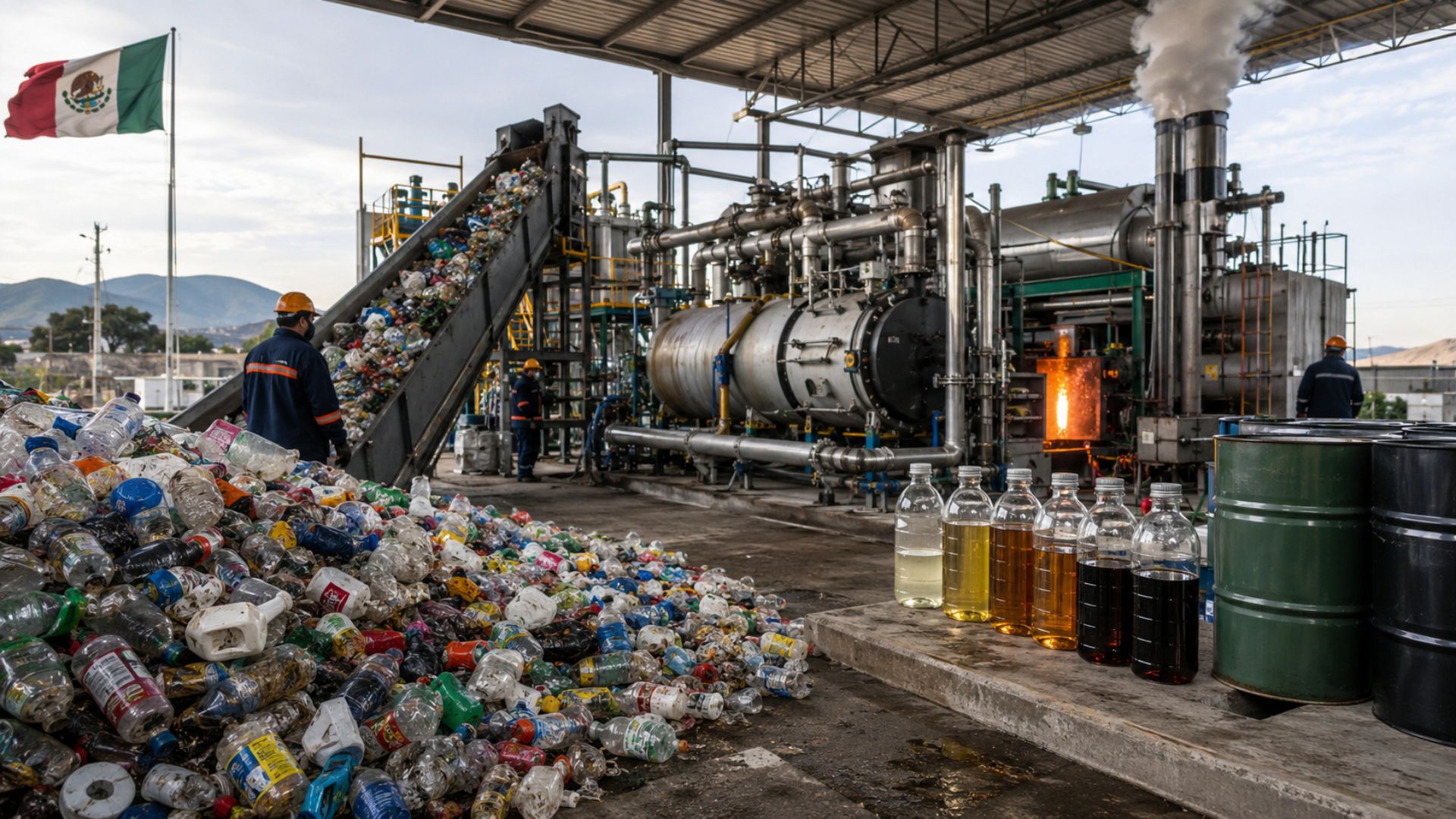


Mexican startup Petgas transforms discarded plastic into gasoline, diesel, kerosene, paraffin, and coke through thermal pyrolysis, but the promise divides opinions: the technology can reduce waste in landfills and oceans, while critics question whether this is true recycling or just another route to burning carbon in the end.
The discarded plastic that would go to landfills, oceans, or environmental accumulation has become the raw material for a technology presented by Petgas, a Mexican startup visited in 2025 by the channel Dois Bits da Vinci. The company uses thermal pyrolysis to convert selected plastic waste into gasoline, diesel, kerosene, paraffin, and marketable coke.
The project draws attention because it attempts to tackle a global problem: more than 400 million metric tons of plastic waste are generated per year, while less than 10% has been recycled, according to data from engineer Ricky from the Vinci channel. The central question is troubling: does transforming plastic into fuel solve part of the waste problem or just change the path to the final burn?
Plastic becomes fuel, but the discussion starts before the tank

The proposal from Petgas seems simple on the surface: take low-value plastic, which would hardly enter conventional recycling, and convert it into commercially usable products. The presented technology generates fractions like gasoline, diesel, kerosene, paraffin, and coke.
-
Danish Resident Discovers Six Viking Gold Bracelets Weighing 762.5 Grams, Third Largest Gold Treasure in Denmark

-
Over 200 Cities in Southern Brazil on Storm Alert as Cyclone Near Uruguay Brings Heavy Rain, Hail, and Winds Up to 100 km/h

-
Archaeologists Discover 2,300-Year-Old Beer in Sealed Bronze Vessel from Ancient Chinese Tomb
-
35,000-Year-Old Saber-Toothed Tiger Cub Found Intact in Siberian Permafrost, Whiskers, Claws, and Skin Preserved Since the Ice Age




But the visual simplicity hides a conceptual dispute. Recycling, for many people, means transforming used plastic into new plastic. In the case of conversion to fuel, the material enters another chain: it ceases to be solid waste and becomes an energy product destined for combustion.
Petgas bets on thermal pyrolysis for difficult waste
Petgas works with thermal pyrolysis, a process that decomposes hydrocarbons from plastic in a controlled heating environment. The company focuses on waste like low-density polyethylene, high-density polyethylene, polypropylene, and polystyrene, materials cited as more suitable for the system.
Even the engineer recognizes limits. PVC and PET are identified as problematic for this route, either due to undesirable by-products or because they may have their own recycling alternatives. This means that the technology does not handle “all plastic,” and this difference matters to avoid selling a solution larger than it really is.
Gasoline, diesel, and kerosene emerge as final products


During the visit to the pilot plant in Mexico, different products derived from the process were presented. The lighter fraction appears as gasoline; other stages generate diesel, kerosene, paraffin, and coke remaining in the reactor.
The tested fuel reportedly showed an octane rating above 90 in measurement, and products from previous batches were used in vehicles and equipment during the demonstration. Petgas’s strong point is showing that plastic waste can become a usable product, not just a laboratory promise.
System reuses residual gas to maintain the reaction
One of the most highlighted elements is the use of non-condensable residual gas. Instead of wasting this fraction, the system redirects it to fuel its own heating after the initial start.
This feature is presented as an efficiency factor because it reduces the need for external energy during operation. Still, it is important to separate operational efficiency from total environmental impact. A process may use less energy and still generate fuels that will be burned later.
The global plastic problem strengthens the proposal
The argument in favor of Petgas arises from the scale of the crisis. The world produces hundreds of millions of tons of plastic waste per year, and a large part does not return to reuse chains. The consequence appears in landfills, oceans, wildlife, and even in studies on microplastics in the human body.
In this scenario, any technology capable of reducing the accumulation of rejected plastic deserves serious analysis. The waste that no one wants continues to exist, and ignoring this volume is not an environmental policy. The question is to choose the least harmful destination for materials that today escape common recycling.
Why critics see this as sophisticated incineration
The strongest criticism is that converting plastic into fuel does not close the material’s cycle. Instead of keeping the carbon trapped in a solid product or transforming it into new resin, the process creates fuel that will be burned and release carbon into the atmosphere.
Organizations opposed to “plastic-to-fuel” technologies often argue that this route resembles a more complex form of incineration. The material stops polluting as visible waste, but it can return as invisible emissions. This is the tension line that prevents calling the process recycling without reservations.
The environmental promise still needs independent verification
Petgas claims that its fuels can burn cleaner than conventional fuels, with lower sulfur content and significant emission reductions compared to traditional derivatives. However, the engineer emphasizes that independent analyses are necessary to fully confirm these claims.
This caution is essential. Fuels vary according to composition, contaminants, and the origin of the raw material. As the input plastic also varies, the final product can change. Without third-party verification, environmental numbers should be treated as a promise, not a definitive conclusion.
There is no single solution to the plastic waste crisis
The analysis itself points out that other routes may be necessary. Some technologies attempt to return plastic to chemical blocks capable of becoming new material. Others focus on reducing use, collection, sorting, mechanical recycling, packaging design, and substitution with less problematic alternatives.
The Petgas route may have space for waste that finds no better destination. But it does not eliminate the need to reduce the production of disposables nor does it replace circular recycling. Turning plastic into gasoline can alleviate some of the accumulation, but it does not solve the throwaway culture on its own.
Mexico has become a showcase for a global dispute
The pilot plant visited in Mexico serves as a showcase for a technology that tries to address a global problem. The proposal attracts attention precisely because it unites two huge markets: plastic waste and liquid fuels.
This encounter also creates discomfort. If the technology grows, it can reduce abandoned waste. But it can also create an incentive to continue producing plastic under the justification that it will have an energy destination. The solution only makes sense if it does not become an excuse to manufacture more disposables.
Petgas technology shows that discarded plastic can be converted into gasoline, diesel, kerosene, paraffin, and coke, creating value from waste that would often go to landfills or oceans. The proposal is technically attractive and responds to a real crisis.
But the controversy remains: if the final fuel will be burned, the route does not equate to traditional circular recycling. The best use might be for waste without a viable alternative, and not as a license to expand the consumption of disposables. Do you consider plastic to fuel an acceptable environmental solution or just a cleaner burning of trash? Share your opinion.