






 Portuguese
  Spanish


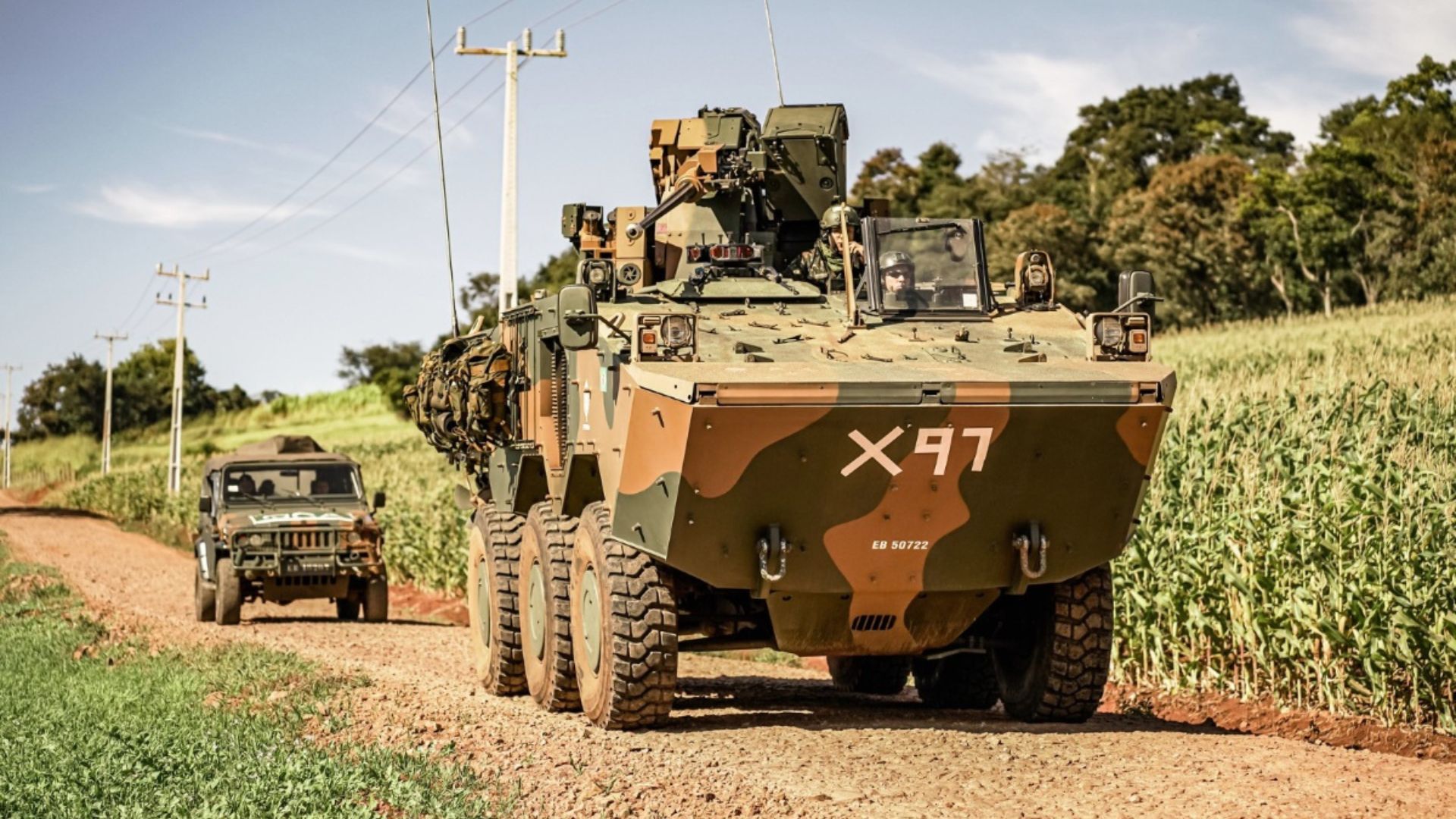

Strategic Army Program accelerates renewal of the armored fleet with amphibious vehicles, tank destroyers, modern weapon systems, and national production aimed at strengthening Brazilian land defense by 2040, amid the technological advancement of military forces and the expansion of the operational capacity of mechanized troops.
Within the Strategic Armored Forces Program, the Brazilian Army intends to incorporate more than 2,100 armored vehicles by 2040, expanding the renewal of the land combat fleet and increasing the operational capacity of the Infantry and Cavalry troops in different scenarios of action.
According to the official planning, more than 820 armored vehicles had already been acquired or contracted by the end of 2025, including wheeled vehicles, multitask models, Cavalry combat vehicles, self-propelled howitzers, combat cars, Marine Corps armored vehicles, and rescue means.
Brazilian Army bets on a new generation of armored vehicles
Amid the technological advancement of land forces and the increase in international tensions, the Army began to prioritize platforms with greater mobility, enhanced protection, and more modern onboard systems to expand the response capacity of mechanized units.
-
World’s Most Powerful MRI Machine in France, Weighing 132 Tons and Generating 11.7 Tesla Magnetic Field, Offers Unprecedented Clarity of the Human Brain

-
Hong Kong Converts Former Coastal Landfill into Desalination Plant Producing 135 Million Liters of Drinking Water Daily
-
Texas Teens Win $50,000 at World’s Largest Science Fair for Developing Non-Surgical Brain-Controlled Bionic Prosthesis with 98% Accuracy
-
Samsung Galaxy A27 Launches with 6.7-inch Super AMOLED Display, Full HD+ Resolution, Android 16, Six Years of Updates, Snapdragon 6 Gen 3, and Dust and Splash Resistance; Available for Pre-order in the US for $350


In addition to acquiring new means, the program includes modernization and operational support projects aimed at the gradual replacement of old equipment, increasing presence in border areas and operations in different types of terrain.
Guarani 6×6 leads the modernization of mechanized troops
Considered the main national platform for troop mechanization, the VBTP-MR 6×6 Guarani features characteristics aimed at rapid mobility, with about 18 tons, 6×6 traction, an approximate range of 600 kilometers, and a speed that can reach 110 km/h.
In addition to amphibious capability, which allows operations in aquatic environments without prior preparation, the vehicle can be equipped with remotely controlled weapon systems, including .50 and 7.62 mm machine guns, as well as a turret equipped with a 30 mm cannon.
While more than 700 units already operate in different regions of the country, including border areas, the Army’s planning foresees more than a thousand vehicles in versions intended for command and control, communications, engineering, health, and ambulance.
Guaicurus expands role in ground operations
Aimed at broad-spectrum missions, the VBMT 4×4 Guaicurus was incorporated for operations that require speed, protection, and flexibility, weighing around eight tons, with the ability to operate in flooded areas and modern communication systems.
With the possibility of receiving automated weapons equipped with thermal cameras in .50 or 7.62 mm calibers, the vehicle allows for target identification at long distances and operation in low visibility without direct exposure of the shooter.

Currently, the Army has 32 units of the Guaicurus, but the plan foresees the acquisition of more than 420 vehicles by 2033 to expand the presence of this model in ground operations and patrol missions.
Centauro II enhances Cavalry firepower
Among the projects considered most strategic by the Army is the VBC Cav 8×8 Centauro II, seen as the main advancement in the firepower of Mechanized Cavalry by combining high mobility, modern onboard technology, and an approximate range of 800 kilometers.
Classified as a tank destroyer vehicle, it uses a 120 mm stabilized cannon capable of hitting targets up to 5 kilometers away, in addition to reaching speeds of up to 105 km/h in ground movements.
After the approval of two prototypes, the schedule foresees the acquisition of another 96 units in the coming years, reinforcing the reconnaissance, protection, and response capabilities of Brazilian mechanized troops.
Cascavel and Leopard remain in operation until 2040
Alongside the arrival of new armored vehicles, the program also includes the modernization of vehicles already used by the troops, such as the Cascavel, which receives system updates to continue operating in a complementary manner to the Centauro II.

Another model included in the revitalization process is the Leopard 1A5, employed by Brazil since 2009 and equipped with a 105 mm cannon, a fire control system with thermal vision, and an approximate range of 600 kilometers.
Weighing about 42 tons, the tracked combat vehicle is expected to remain in operation until 2040, within a plan that seeks to avoid loss of capability while the fleet renewal occurs gradually.
Defense Industrial Base gains space in the project
While expanding the operational capacity of the troops, the program aims to strengthen the Defense Industrial Base through national production, technology transfer, and technical qualification of professionals linked to the sector.
This movement can boost areas such as armor, embedded electronics, armaments, maintenance, communications, simulation, and systems integration, considered strategic to reduce external dependence on military equipment.
The package also includes improvements to the UT-30 turret, installed on the Guarani and operated from inside the vehicle, as well as simulators aimed at preparing drivers and crews, including the Star Max system used in the Guaicurus.
Within this set of initiatives, there is also the Max 1.2 AC missile, a domestically manufactured anti-tank system pointed out as one of the main Brazilian weapons developed for action against armored targets.


