






 Portuguese
  Spanish


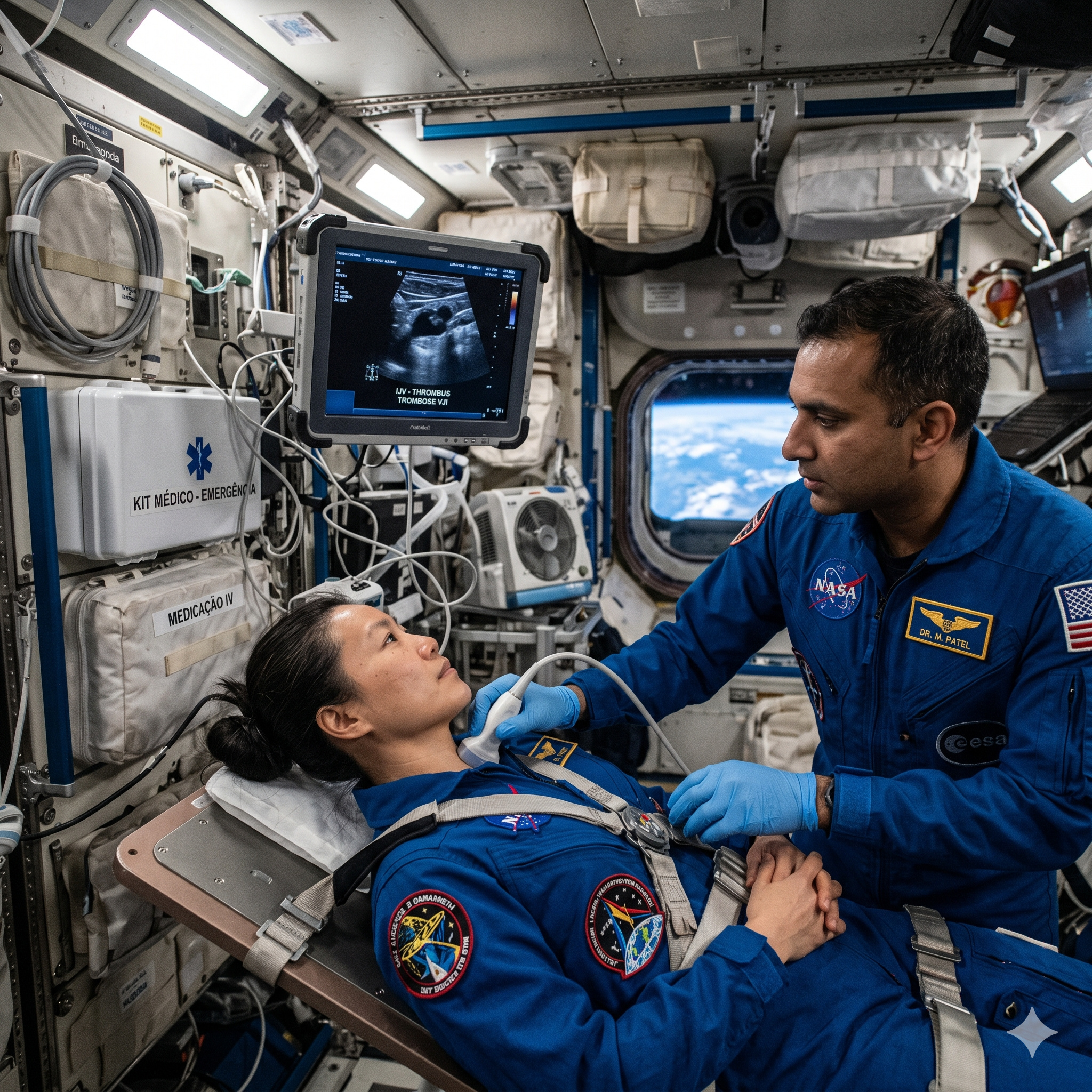

NASA treated thrombosis in an astronaut in space after a clot in the jugular and revealed an invisible risk that could impact missions to Mars.
In 2019, during a long-duration mission on the International Space Station, NASA identified what would come to be recognized as the first documented case of deep vein thrombosis in an astronaut’s internal jugular vein in orbit. The episode first appeared in a JAMA Network Open study published on November 13, 2019, and was later detailed in a clinical correspondence in the New England Journal of Medicine on January 2, 2020, by physicians linked to the agency itself and associated institutions. The diagnosis did not arise from classic symptoms. The clot was suspected during an ultrasound performed as part of a routine vascular experiment in microgravity, which immediately raised an alarm among specialists: a potentially serious event could be developing without evident clinical signs in the space environment.
From then on, the crew faced an unprecedented situation: conducting in orbit the treatment of a condition that, on Earth, would normally require hospital support, continuous monitoring, and the possibility of emergency response. All of this happened at an altitude of about 400 kilometers, without access to conventional medical facilities, while the astronaut remained on mission and was kept on anticoagulation for the remainder of the flight
Clot formed in the internal jugular and revealed the direct impact of microgravity on blood circulation
The affected vein was the internal jugular, responsible for draining blood from the brain back to the heart. Under normal conditions on Earth, blood flow in this region depends on the action of gravity and balanced internal pressures. In a microgravity environment, however, there is a redistribution of bodily fluids. Blood tends to shift to the upper part of the body, increasing pressure in the head and neck region.
-
James Webb Telescope Uncovers Unexpected Clues on Mysterious Moon, Potentially Redefining Planetary Origins

-
$1.5 Billion Sleipnir Vessel Transforms Ocean into Floating Construction Site with 12 Hybrid Engines and Capacity to Lift 20,000 Tons

-
23 Years After Tragedy, Brazil’s Alcântara Space Center to Launch New Suborbital Rocket in 2026 with South Korean SEBIT Project Targeting Near-Space Tests
-
Entrepreneur Turns Neighbor’s Coffee Grounds Waste into Eco-Friendly Pellets, Earning Up to $40,000 Monthly in Brazil


This phenomenon, known as cephalic fluid shift, had already been observed in other contexts, but the thrombosis case showed a more serious consequence of this process. During the examination, doctors identified that the blood flow in the vein was slow or partially stagnant, creating favorable conditions for clot formation.
This finding indicated that microgravity can alter circulation dynamics sufficiently to allow thrombus formation even in healthy and highly trained individuals.
Treatment had to be initiated in space with medications sent on a resupply mission
After confirming the diagnosis, NASA had to make quick decisions to prevent more serious complications, such as the clot migrating to the lungs, which could result in a pulmonary embolism.
However, the International Space Station does not have hospital facilities or a complete stock of medications for all possible clinical scenarios.
Initially, the medical team opted to start treatment with anticoagulants available on board, despite limitations. Subsequently, a more suitable medication was sent to the station via a resupply mission.
The full treatment lasted about three months and was conducted entirely in orbit, with remote monitoring by specialists on Earth, who guided the crew in real time.
This process required constant adaptation, as administering medications and monitoring side effects in microgravity present additional challenges.
Absence of advanced exams and hospital support exposed critical limitations of space medicine
One of the most relevant points of the case was the structural limitation of medicine in space. On Earth, a patient with deep vein thrombosis would undergo frequent laboratory tests, specialist monitoring, and, in some cases, more complex interventions.

On the International Space Station, options are much more restricted. Diagnosis relies on equipment like portable ultrasound, operated by the astronauts themselves with remote guidance.
There is no possibility of performing exams like CT scans or MRIs, nor of quickly accessing a hospital in case of worsening conditions.
This scenario highlighted that space medicine still heavily relies on adapted protocols and remote support, with limited scope for intervention in critical situations.
Case led NASA to re-evaluate medical risks for long-duration missions
After the episode, NASA intensified studies on venous thromboembolism in the space environment, including risk factors, prevention, and treatment protocols.
The case demonstrated that conditions considered rare can become more relevant in microgravity, especially on prolonged missions.
The agency began to include this type of event in risk assessments for future missions, considering scenarios where evacuation would not be possible. The impact of the case goes beyond the isolated episode and directly influences the medical planning of future missions.
Missions to the Moon and Mars amplify the problem by eliminating the possibility of rapid evacuation
On the International Space Station, there is the possibility of a relatively quick return to Earth in case of an emergency. On more distant missions, such as those planned for the Moon or Mars, this option ceases to exist.
A mission to Mars, for example, can last several months just for the outbound journey, with delayed communication and a complete absence of direct support.
In this context, an event like the formation of a clot takes on another dimension. Without possible evacuation, the success of the mission may depend on the crew’s ability to autonomously diagnose and treat complex medical conditions.
Microgravity alters multiple human body systems and increases medical uncertainties
The thrombosis case is not isolated in the context of physiological changes caused by the space environment. Microgravity has already been associated with various effects, including:
- Bone mass loss
- Muscle atrophy
- Cardiovascular system changes
- Changes in vision and brain
- Immune system dysregulation
The formation of a clot in the jugular adds a new element to this list, indicating that the circulatory system can also exhibit unexpected responses in microgravity.
These combined changes increase the complexity of medical care on long-duration missions.
Episode reinforces the need for medical autonomy in future space explorations
One of the main conclusions drawn from the case is the need to expand the medical autonomy of crews.
This involves the development of:
- More robust diagnostic protocols
- More advanced and compact medical equipment
- Broader training for astronauts
- Capacity for intervention in critical situations
Furthermore, there is growing interest in technologies such as artificial intelligence and advanced telemedicine to support real-time medical decisions. Space medicine needs to evolve into a model where the crew can handle emergencies independently.
Silent clot case shows that invisible risks can be decisive in the future of space exploration
The jugular thrombosis episode revealed a type of risk that was not at the center of space exploration concerns.
Unlike technical failures or external events, this is an internal problem, related to the functioning of the human body in extreme conditions.
This type of risk is particularly challenging because it can arise without warning, evolve silently, and require immediate response in a resource-limited environment.
Given this scenario, is the human body truly prepared for longer space journeys?
The case recorded by NASA raises a central question for the future of space exploration.
As missions become longer and more distant, the ability to handle unexpected medical events becomes a critical factor for success.
If a blood clot can form silently in low orbit and require improvised treatment, what could happen on a months-long deep space mission with no possibility of return?
This question remains open and continues to be one of the main challenges for taking humans beyond Earth’s orbit.


