






 Portuguese
  Spanish
  5 min of reading
  0 comments


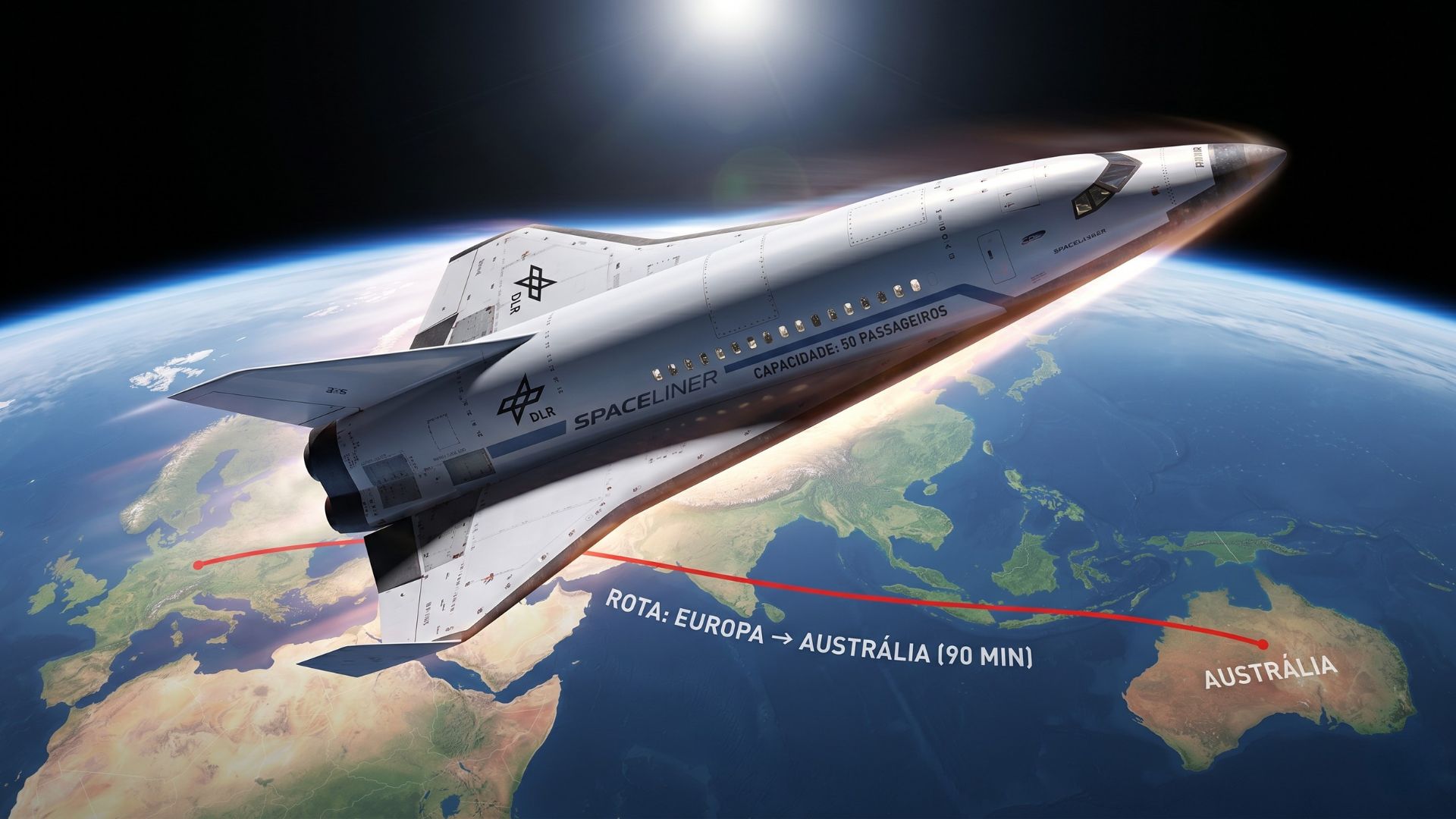
SpaceLiner is the hypersonic concept by DLR to take 50 passengers from Europe to Australia in 90 minutes with a reusable two-stage system.
While commercial aviation remains stuck at speeds close to 900 km/h and intercontinental flights that can exceed 20 hours between connections, researchers at the German Aerospace Center (DLR) have been working for years on a concept that seems straight out of science fiction: a vehicle capable of transporting passengers between continents in less time than many current domestic routes. The project is called SpaceLiner and was conceived as a reusable two-stage system capable of taking about 50 passengers from Europe to Australia in approximately 90 minutes.
Instead of functioning like a conventional airplane, it would combine features of a rocket, spacecraft, and hypersonic glider to traverse enormous distances at speeds that can exceed 25,000 km/h during part of the journey.
SpaceLiner was not designed as a jet, but as a passenger craft for suborbital flights
The concept developed by DLR completely abandons the logic of traditional commercial aviation. According to the project’s technical description, the SpaceLiner uses a configuration of two fully reusable stages, consisting of a large unmanned booster and a manned upper stage intended for passengers.
-
Space technology used to search for water on Mars is now hunting for invisible leaks under the streets of São Paulo, using satellites, AI, and chlorine signals to help Sabesp recover up to 6.7 billion liters of water.

-
Japan sends ship to extract mud rich in rare earths at nearly 6,000 meters deep in the Pacific, attempts to lift 350 tons per day from the seabed, and transforms sediments near Minamitori Island into a strategic weapon to reduce dependence on China.
-
Venus Aerospace promises a rotating detonation hypersonic engine that takes the Stargazer to Mach 9 and crosses oceans in 1 hour, but the flight that made history barely surpassed the speed of sound.

-
Brazilian student creates a cheap formula that makes plants grow up to 90% faster and wins an award in a global scientific competition.




The system would perform a vertical takeoff similar to that of an orbital rocket.
After quickly accelerating to extreme speeds, the passenger stage would separate from the booster and follow a suborbital trajectory through the upper atmosphere before beginning the descent to land horizontally on a conventional runway.
Project aims to take passengers from Europe to Australia in just 90 minutes
The Europe–Australia route was adopted as a reference mission by the researchers. According to DLR’s technical documents, the goal is to make a journey of approximately 17,000 to 18,000 km in about 1 hour and 30 minutes, something impossible for any existing commercial airplane.
Today, commercial flights between Europe and Australia typically require more than 20 total hours of travel considering layovers and connections.


In the SpaceLiner concept, the crossing would be performed practically in a single hypersonic leap through the upper atmosphere.
Projected maximum speed exceeds 25,000 km/h and enters space territory
The predicted numbers for the SpaceLiner are far beyond conventional aviation. Technical data released by DLR show an estimated maximum speed of approximately 7 km per second, equivalent to about 25,200 km/h, during certain phases of the long-distance mission.
This represents almost 28 times the cruising speed of a modern commercial airplane. It is also more than 11 times the maximum operational speed of the Concorde, which flew around 2,180 km/h.
Passengers would travel near the space border
To reach these speeds, the SpaceLiner would not remain at altitudes used by commercial aviation.

DLR reports that the planned trajectory reaches approximately 80 km altitude, a region close to the conventional space border. At this phase of the flight, the atmosphere is extremely rarefied.
This reduces aerodynamic drag and allows covering enormous distances at high speed before the gliding descent phase. In practice, passengers would travel above practically all the planet’s air traffic.
Reusable system uses 11 rocket engines powered by liquid hydrogen and oxygen
The concept does not use conventional turbines. According to DLR, the SpaceLiner was designed to operate with a total of 11 reusable rocket engines, with 9 on the booster and 2 on the passenger stage.

All would use liquid hydrogen (LH2) and liquid oxygen (LOX) as cryogenic propellants.
The choice aims to combine high energy performance with less environmental impact compared to traditional fossil fuels.
Structure would be larger than many current commercial airplanes
The most recent studies of the SpaceLiner 7 concept show impressive dimensions. The passenger stage is about 65.6 meters long and 33 meters in wingspan.
The reusable booster reaches approximately 82.3 meters in length.
When coupled for the complete mission, the two stages would form a system with a total estimated mass of about 1,832 tons at launch.
Europe sees the project as a laboratory for future hypersonic technologies
The SpaceLiner is not yet an operational program. The DLR itself describes it as an advanced concept of suborbital hypersonic transport currently under study.

Even so, the project has become an important platform for research on hypersonic aerodynamics, thermal protection, reusable structures, passenger rescue systems, and extreme flight operations.
A large part of this research received support from European initiatives such as FAST20XX, CHATT, HIKARI, and HYPMOCES.
Biggest challenge is not speed, but heat, safety, and operational cost
Flying above Mach 20 means facing extreme temperatures. During the hypersonic flight, the aircraft’s surface would need to withstand aerodynamic heating far greater than that faced by commercial airplanes and even comparable to certain phases of space reentry.
Additionally, there are challenges related to evacuation, comfort, launch infrastructure, operational costs, and international certification.
Therefore, although the concept is considered technically possible in principle by the researchers involved, it still depends on decades of technological development.
DLR designs an experience closer to a space flight than a traditional air trip
The project documents make it clear that the SpaceLiner would not be just fast transport. The researchers describe the proposal as a combination of extreme intercontinental travel and an experience close to that of a space flight.
During part of the journey, passengers would be in a suborbital environment, far above conventional air routes.
This would transform the trip into something very different from simply boarding a supersonic plane.
Technical Specifications of SpaceLiner 7
- Project: SpaceLiner
- Organization: Deutsches Zentrum für Luft- und Raumfahrt (DLR)
- Category: reusable suborbital hypersonic transport
- Configuration: two reusable stages
- Capacity: 50 passengers + 2 crew members
- Passenger stage length: 65.6 meters
- Booster length: 82.3 meters
- Passenger stage wingspan: 33 meters
- Maximum projected altitude: about 80 km
- Estimated maximum speed: approximately 25,200 km/h (Mach 24)
- Estimated range: up to about 18,000 km
- Engines: 11 reusable rocket engines
- Propellants: liquid hydrogen (LH2) and liquid oxygen (LOX)
- Estimated Europe–Australia time: about 90 minutes
While much of the world tries to make planes a bit faster or more economical, the SpaceLiner proposes something much more radical: transforming intercontinental travel into suborbital hops so fast that crossing half the planet would take less time than many passengers spend today waiting to board at an airport.


Be the first to react!